I have not been able to find a thread to address this so here goes. I loved the Vodka from the NO3/PO4 standpoint but over time a brown substance started to develop on my walls, rocks, and other structures in the tank even at very low doses. (ie. 05 ml per 100 gal). What caused this and how do i avoid it?

You are using an out of date browser. It may not display this or other websites correctly.
You should upgrade or use an alternative browser.
You should upgrade or use an alternative browser.
Long Term Vodka Question/Help
- Thread starter re_vogel
- Start date

HighlandReefer
Team RC
Your description of a "brown substance" can be a lot of things.
Algae, cyano, diatoms or perhaps a bacteria. Can you post a focused close-up pic?
Algae, cyano, diatoms or perhaps a bacteria. Can you post a focused close-up pic?
HighlandReefer
Team RC
Higher levels of phosphate can lead to algal type problems. Personally, I would run some GFO to reduce the phosphate. You will need to watch your nitrate levels as well. Reduced feeding can help with both.
Good skimming, water changes and GAC will help reduce the dissolved organic matter in your water column, which can lead to problems also.
Good skimming, water changes and GAC will help reduce the dissolved organic matter in your water column, which can lead to problems also.
Thanks for your reply but this is an issue that develops over about 6 mths. Basically i start using Vodka and the hair algea/po4/no3 go away. as time progresses this substance begins to grow on the rocks and walls. Its almost like it is the bacteria that are growing and covering the rocks and walls. I'm sure its not but based on the timeline and progression that is what it seems like.
Do you dose Vodka and if so i take it you don't see this issue?
Do you dose Vodka and if so i take it you don't see this issue?
HighlandReefer
Team RC
There are a lot of hobbyists in your same position. Reducing your nitrate and phosphate levels to a zero reading will help in getting rid of many type of algae pests. IME, reducing nitrate and phosphate levels too low can kill or cause problems for many types of coral. Running GAC & GFO will all help in reducing the growth of these type of pests. In many cases they will not eradicate the pest. Vodka dosing will help reduce the nitrate and phosphate levels also, but will not necessarily eradicate the pest either.
A common problem is being able to identify your pest to a catagory correctly: true algae, cyano, dino, bacteria & other assorted pests that look similar. In many cases a micro look at your pest is best to properly ID it to one of these catagories.
IMHO, if you are faced with an algal type pest problem, it is best to implement an algae pest control program strategy:
1) Wet skimming with a good quality skimmer. Clean your skimmer cup at least once per week.
2) Reduce your nitrates and phosphates to a zero reading using the hobby grade test kits. See Randy's articles regarding this:
Phosphate and the Reef Aquarium
http://reefkeeping.com/issues/2006-09/rhf/index.php
Nitrate in the Reef Aquarium
http://www.advancedaquarist.com/issues/august2003/chem.htm
3) Proper lighting. I find that the higher wavelength bulbs are less conducive to algae growth. I now run 20,000 K bulbs from using 10,000 K bulbs.
4) Proper day length is a good thing also. I would not run your lights for more than 12 hrs total. Keep in mind that light entering from a window nearby is added to this figure.
5) Running GAC is a good practice in my book. It will help reduce the total dissolved organic carbons in your tank water and this is a food source.
6) Proper 30% per month total water changes will help export the DOC as well as some of the pests in the water column. It will help maintain the micro-nutrients as well.
7) Physical removal of the pest by hand, scrubbing and siphoning is important as well. If the amount of pest in your aquarium is overwhelming, perhaps dealing with one section at a time is a better idea.
8) Proper water circulation in your tank to prevent dead zones. When dealing with cyanobacteria pests increasing the flow where it grows seems to help.
9) Use RODI water for all top-off, salt mixing, additive mixes... etc.
10) Dosing iron may have benefits for macro-algae, but if you are experiencing algae pest problems than I would stop dosing it as it can add to the problem in many cases.
11) If you are dosing other supplements such as vitamins, amino acids, or others that contain a mix of supplements other than the basic alk., calcium and magnesium, I would stop these until you gain control of your pest. This includes many of the store bought products with unknown ingredients. Dosing Vodka or sugar to reduce your nitrates and phosphates would be an exception in my opinion.
12) Proper feeding habits. This can be the number one problem when trying to reduce your nitrate and phosphate levels. Use low phosphate fish foods.
13) IMHO, lighted refugiums may be a problem when trying to deal with an algae type pest problem. They are wonderful when it comes to reducing nitrates and phosphates. However, the light over most refugiums is conducive to the microalgae type pests. If the refugium becomes infested with a microalgae pest, I would clean it throughly of all pests as best as possible, remove the macro and turn off the lights until you gain control of your pest. Re-using the same macroalgae later may serve as a source for re-infestation of your pest.
14) Adding fish and other creatures that will eat your algae pest will help.
15) There are other items that can be added to this list if others care too share and some of the items listed may be disputed.
___________________________________________________________________________________________________________
If after you have tried all these procedures and you are still loosing the battle, I would recommend that you initiate the use of AlgaeFix Marine based on the reports I have seen in this thread:
http://www.reefcentral.com/forums/showthread.php?s=&threadid=1595003
I hate to see anyone give up on this hobby due to algae type pest problems.
A common problem is being able to identify your pest to a catagory correctly: true algae, cyano, dino, bacteria & other assorted pests that look similar. In many cases a micro look at your pest is best to properly ID it to one of these catagories.
IMHO, if you are faced with an algal type pest problem, it is best to implement an algae pest control program strategy:
1) Wet skimming with a good quality skimmer. Clean your skimmer cup at least once per week.
2) Reduce your nitrates and phosphates to a zero reading using the hobby grade test kits. See Randy's articles regarding this:
Phosphate and the Reef Aquarium
http://reefkeeping.com/issues/2006-09/rhf/index.php
Nitrate in the Reef Aquarium
http://www.advancedaquarist.com/issues/august2003/chem.htm
3) Proper lighting. I find that the higher wavelength bulbs are less conducive to algae growth. I now run 20,000 K bulbs from using 10,000 K bulbs.
4) Proper day length is a good thing also. I would not run your lights for more than 12 hrs total. Keep in mind that light entering from a window nearby is added to this figure.
5) Running GAC is a good practice in my book. It will help reduce the total dissolved organic carbons in your tank water and this is a food source.
6) Proper 30% per month total water changes will help export the DOC as well as some of the pests in the water column. It will help maintain the micro-nutrients as well.
7) Physical removal of the pest by hand, scrubbing and siphoning is important as well. If the amount of pest in your aquarium is overwhelming, perhaps dealing with one section at a time is a better idea.
8) Proper water circulation in your tank to prevent dead zones. When dealing with cyanobacteria pests increasing the flow where it grows seems to help.
9) Use RODI water for all top-off, salt mixing, additive mixes... etc.
10) Dosing iron may have benefits for macro-algae, but if you are experiencing algae pest problems than I would stop dosing it as it can add to the problem in many cases.
11) If you are dosing other supplements such as vitamins, amino acids, or others that contain a mix of supplements other than the basic alk., calcium and magnesium, I would stop these until you gain control of your pest. This includes many of the store bought products with unknown ingredients. Dosing Vodka or sugar to reduce your nitrates and phosphates would be an exception in my opinion.
12) Proper feeding habits. This can be the number one problem when trying to reduce your nitrate and phosphate levels. Use low phosphate fish foods.
13) IMHO, lighted refugiums may be a problem when trying to deal with an algae type pest problem. They are wonderful when it comes to reducing nitrates and phosphates. However, the light over most refugiums is conducive to the microalgae type pests. If the refugium becomes infested with a microalgae pest, I would clean it throughly of all pests as best as possible, remove the macro and turn off the lights until you gain control of your pest. Re-using the same macroalgae later may serve as a source for re-infestation of your pest.
14) Adding fish and other creatures that will eat your algae pest will help.
15) There are other items that can be added to this list if others care too share and some of the items listed may be disputed.
___________________________________________________________________________________________________________
If after you have tried all these procedures and you are still loosing the battle, I would recommend that you initiate the use of AlgaeFix Marine based on the reports I have seen in this thread:
http://www.reefcentral.com/forums/showthread.php?s=&threadid=1595003
I hate to see anyone give up on this hobby due to algae type pest problems.

BrassMonkey
Member
does it look like the brown stuff in this pic? if so i have it to, as well as many reefers. doesnt seem to go away easy.


re vogel,Today is day 181 of vodka dosing this time for me. I dose 24ml per day along with 2ml of vinegar . I also run gac ,purigen and gfo. I skim wet. Have not seen the brownish substance you note.
Brass Monkey. I believe what 's in your picture is a form of nuisance algae. I've seen it from time to time on new coral rock. I scrape/peel it off before moving a piece to the display since it can be quite invasive.
Brass Monkey. I believe what 's in your picture is a form of nuisance algae. I've seen it from time to time on new coral rock. I scrape/peel it off before moving a piece to the display since it can be quite invasive.
550gallons in the system. Heavy bioload including over 40 fish and full of a mix of coarls including many sps.PO4 per hannah colrimeter is .04ppm . NO3 per salifert is <2ppm.<a href=showthread.php?s=&postid=15522422#post15522422 target=_blank>Originally posted</a> by re_vogel
Brassmonkey, I can't access the picture.
TMZ- How big is your tank and how low are your PO4/NO3?

I don't know what will eat it.
As I stated earlier I dose 24 ml of vodka and 2 ml of vinegar daily for 550g along with gfo, refugia,gac etc.
I feed:nori, prime reef flake, krill, , live atremia naupali(baby brine),frozen brine, mysis, blood wornms(mosquito larvae) and cyclopeeze daily and Coral Frenzy weekly.
As I stated earlier I dose 24 ml of vodka and 2 ml of vinegar daily for 550g along with gfo, refugia,gac etc.
I feed:nori, prime reef flake, krill, , live atremia naupali(baby brine),frozen brine, mysis, blood wornms(mosquito larvae) and cyclopeeze daily and Coral Frenzy weekly.

melev
Well-known member
I dose 15ml per day of Vodka. And I feed my tank three times a day:
1/2 sheet of nori in the morning, pellets in the afternoon, and mini mysis & cyclop eeze at night.
Recent pictures...

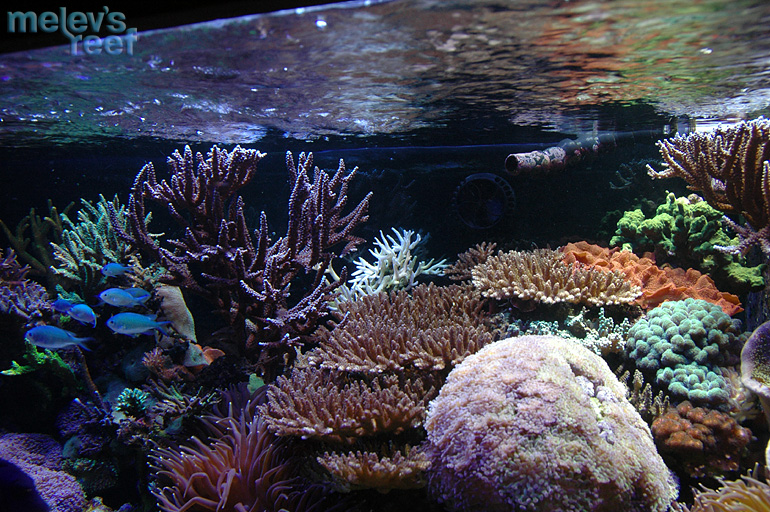
Coralline tends to grow in my sump and refugium, but not much in my tank. I do scrape the walls all the time to keep them clean though, and I can't see a lot of rockwork.
1/2 sheet of nori in the morning, pellets in the afternoon, and mini mysis & cyclop eeze at night.
Recent pictures...
Coralline tends to grow in my sump and refugium, but not much in my tank. I do scrape the walls all the time to keep them clean though, and I can't see a lot of rockwork.

luther1200
Premium Member
It looks like Brown Wafer algae to me. Which I had a bad case of. Sally Lightfoot crabs, Emerald crabs(though not as good as SL) and Naso Tangs are3 known to eat it. I have had the best luck with Sally Lightfoot crabs. But I haven't tried a NAso because my tank is to small for 1.
But the thing that has absolutely helped the most is high capacity GFO. It has cleared it up in about 2 months. And I had it really bad, and now I barely have any visable. Between the Sally Lightfoot's and the HC GFO it has taken care of the problem. But its hard to tell from those pics. Can you describe it? Does it peel off in sheets sometimes? And it encrusts when it grows, and almost has little plate like structures on the rock? MAybe a better pic would help.
But the thing that has absolutely helped the most is high capacity GFO. It has cleared it up in about 2 months. And I had it really bad, and now I barely have any visable. Between the Sally Lightfoot's and the HC GFO it has taken care of the problem. But its hard to tell from those pics. Can you describe it? Does it peel off in sheets sometimes? And it encrusts when it grows, and almost has little plate like structures on the rock? MAybe a better pic would help.
<a href=showthread.php?s=&postid=15539119#post15539119 target=_blank>Originally posted</a> by luther1200
It looks like Brown Wafer algae to me. Which I had a bad case of. Sally Lightfoot crabs, Emerald crabs(though not as good as SL) and Naso Tangs are3 known to eat it. I have had the best luck with Sally Lightfoot crabs. But I haven't tried a NAso because my tank is to small for 1.
But the thing that has absolutely helped the most is high capacity GFO. It has cleared it up in about 2 months. And I had it really bad, and now I barely have any visable. Between the Sally Lightfoot's and the HC GFO it has taken care of the problem. But its hard to tell from those pics. Can you describe it? Does it peel off in sheets sometimes? And it encrusts when it grows, and almost has little plate like structures on the rock? MAybe a better pic would help.
That's what I was thinking. When I had some of it ,I peeled it off . Once established, it didn't seem to care about lower PO4 via HC gfo though.Thanks for the info on the sally lightfoots, emeralds and nasos.
luther1200
Premium Member
Your welcome. I have heard that Naso's really can wipe it out. I saw before and after pictures 1 time and it was impressive. I have had the best luck with the Sally Lightfoot's. The Emeralds do eat it though. Unfortunatly my tank is to small for a Naso or I would have gotten 1 a long time ago.
Similar threads
- Replies
- 1
- Views
- 779


- Replies
- 13
- Views
- 2K
