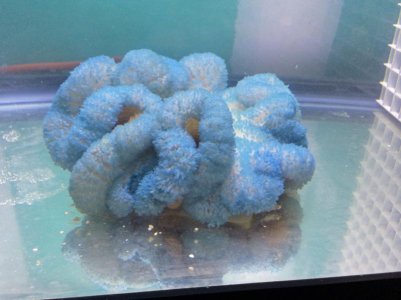
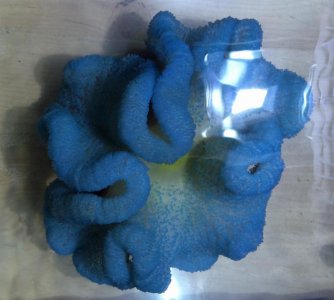
Minh's Blue LA Gigantea 6/26/2014

I promise, last picture for the day. He continue to expanded and is looking good. I will go read for my son then when he is as sleep, I will got back out and do a 100 % water change. I can see that he is larger and the color is a lot less intense. Tentacles are longer and fatter too.

attachment.php


beautiful nem, when you say 100% water change are you removing all the water and adding new water from an existing system, or are u adding freshly made water?

Thanks
 
I use DT water to change then add new water to the DT. I always have 35-85 gal of fresh salt water on hand at all time. I have 2 35 gal containers and 1 60 gal container. When I have 35 gal leftover then I mix 50 gals.
 
I turn the light on this AM to take this picture. He wa more expanded 30 mins before that.
attachment.php


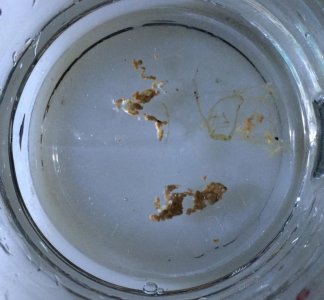
He was putting out waste. I siphoned these waste from his mouth/oral area
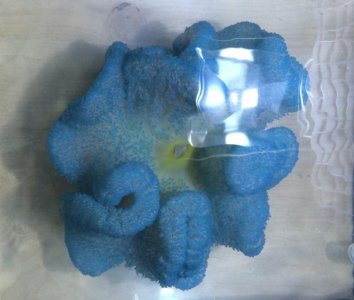
attachment.php


Right after I removed the waste
attachment.php


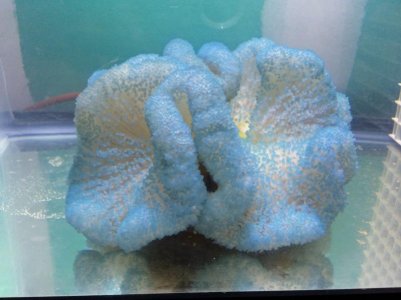
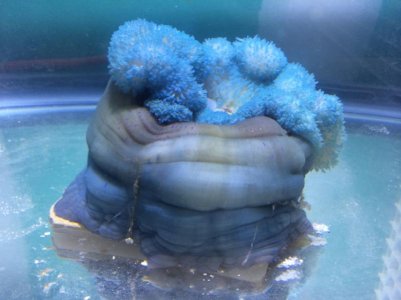
The front view at the same time
attachment.php
 

Attachments

  • BlueGigantea2014062700.jpg
    BlueGigantea2014062700.jpg
    50.8 KB · Views: 14
  • BlueGigantea2014062702.jpg
    BlueGigantea2014062702.jpg
    53 KB · Views: 15
  • BlueGigantea2014062703.jpg
    BlueGigantea2014062703.jpg
    56.1 KB · Views: 18
  • BlueGigantea2014062701.jpg
    BlueGigantea2014062701.jpg
    62.3 KB · Views: 16
Isn't it common for them to look worse after the first day of treatment? Beautiful gig by the way...very jealous! :thumbsup:

It's actually quite common for them to look really good for weeks without ANY treatment. Then they can quickly go downhill in week 3-4.

But you're right -- during treatment, the nems can look terrible as the medication helps to draw out the pollutants. For me it's a gut-wrenching experience, because they look so bad that I think they're going to die, then a couple hours they inflate and look great like nothing happened. It's the time that they never re-inflate and die that sticks in my mind.

Many people think the pastel color means the gig is looking good. The reality -- as Orion pointed out -- is that they nem is simply not fully inflated so the color is even more intense (think deflated balloon versus fully inflated one).
 
Ran home really quick to snap these pictures. He looks a little better than this AM. The water is a little cloudy but did not have time to do water change.

attachment.php


attachment.php
 

Attachments

  • bBlueGigantea2014062705.jpg
    bBlueGigantea2014062705.jpg
    59.4 KB · Views: 18
  • bBlueGigantea2014062706.jpg
    bBlueGigantea2014062706.jpg
    53.1 KB · Views: 15
It's actually quite common for them to look really good for weeks without ANY treatment. Then they can quickly go downhill in week 3-4.

But you're right -- during treatment, the nems can look terrible as the medication helps to draw out the pollutants. For me it's a gut-wrenching experience, because they look so bad that I think they're going to die, then a couple hours they inflate and look great like nothing happened. It's the time that they never re-inflate and die that sticks in my mind.

Many people think the pastel color means the gig is looking good. The reality -- as Orion pointed out -- is that they nem is simply not fully inflated so the color is even more intense (think deflated balloon versus fully inflated one).

My apologies Minh in advance as I am not trying to hijack your thread :)

I only want to highlight some of the experience I have been going through in the past few weeks attempting to treat/heal/acclimate, 2 baby gigs.

Now, I am not an anemone newbie, but these are my first gigs, so I have been learning a lot first hand also by making some mistakes.

I have been following religiously the Septra/Cipro procedures, water changes etc.

- I tried virtually every flow combination from no flow all the way to high flow.
- I used full spectrum lighting from 5% to about 60% intensity
- I used NSW, NSW + DT and DT water.
- I did 50% to 100% water changes, carefully siphoning particles and expelled waste.
- I spend on average 5-6 hours per day observing and making small adjustments if necessary.
- Temperature is at a constant 80~80.5 degrees
- I check salinity every day with a calibrated electronic Milwaukee SG tester (1.025)

Mistake I made:

Placing the gig inside the concave part of the ramekin, big mistake on my part.
I most likely could have saved (maybe) the first gig if I addressed it earlier. After D-Nak's suggestion, I carefully removed my second baby gig and placed it on top of the inverted ramekin and I could tell immediately that it 'liked' it better, plus as correctly suggested it helps the removal of stringly waste.

D-Nak you correctly hit the nail on the head saying it is a gut wrenching experience. I have been observing my second baby gig go from promisingly looking good to looking as if it is about to die and back looking half decent.

I treated the first one using Septra, the second one using Cipro.
My assessment is nowhere conclusive, but I begin feeling that Cipro is too potent to treat baby gigs (2-3" size).
I have been treating mine a full 5 days, but instead of getting better it has been progressively getting worse. On day one it was green/tan colored, but now it is a pale bleached yellow, most likely because it is expelling dead zooxanthellae, but I wonder how much Cipro is contributing to kill also good ones.

I have been using the suggested dosage of 500mg/10gal, but now in hindsight I feel it might have been too powerful for a 2" gig.

The only reason I started with Cipro with the second one, is that I wanted to observe any differences between the otherone I treated with Septra.

Granted, these weren't healthy specimens to begin with, so I knew ahead of time what I was going to get into, but nfortunately for now the only constant I observed is that one died and the second has been declining visibly.
 
clorox,
I don't think size of the anemone have any impact on the concentration of the medication. I would treat tiny anemone at the same dose as large anemone. It is the total amount of water which the medication dissolves in is what dictate the amount of medication use.
Children use less medication than adult because they are smaller. The bacterial witch cause the infection require high enough concentration of medication to kill. The antibiotic should not affect the anemone at the concentration we are using.
I use Septra DS more because bacterial can become resistant to Cipro easier. If some one, like at the wholesaler, use continue antibiotic in their holding tank, bacterial resistant to antibiotic will develop. It is easier to become resistant to Cipro than Septra.
 
This evening right before I change the water and add Septra DS
attachment.php


attachment.php
 

Attachments

  • BlueGigantea2014062706.jpg
    BlueGigantea2014062706.jpg
    53.9 KB · Views: 15
  • BlueGigantea2014062707.jpg
    BlueGigantea2014062707.jpg
    55.3 KB · Views: 16
Looking great!

I believe that a few vendors or people prior to the vendors are definetly treating with Cipro.

Like Minh said, it's not the size, but total water volume.

I've treated higher than 500/mg per 10/G on a couple before and had good results. Of course I would only recommend this as a last resort.

They tend to tolerate antibiotics well. Fish do too.
 
Looking great!

I believe that a few vendors or people prior to the vendors are definetly treating with Cipro.

Like Minh said, it's not the size, but total water volume.

I've treated higher than 500/mg per 10/G on a couple before and had good results. Of course I would only recommend this as a last resort.

They tend to tolerate antibiotics well. Fish do too.

I bet you're right, they probably think just leaving it run in their vats all the time is best, for them (so they don't loose money). Could be why it's not as effective for some, creating resistant strains, making it tougher for the end owner to acclimate, once again...

I thought the dose was 250 per 10 gallons,no? In the cipro sticky, I thought that is what was written (post #94 says 500 per 20 gallons). Most of mine were treated at the 250mg per 10 gallon level, seemed strong enough. Only on a stubborn one, IIRC, did I use 500.

Minh, it's looking good. I'm happy for you. :)
 
clorox,
I don't think size of the anemone have any impact on the concentration of the medication. I would treat tiny anemone at the same dose as large anemone. It is the total amount of water which the medication dissolves in is what dictate the amount of medication use.
Children use less medication than adult because they are smaller. The bacterial witch cause the infection require high enough concentration of medication to kill. The antibiotic should not affect the anemone at the concentration we are using.
I use Septra DS more because bacterial can become resistant to Cipro easier. If some one, like at the wholesaler, use continue antibiotic in their holding tank, bacterial resistant to antibiotic will develop. It is easier to become resistant to Cipro than Septra.


Makes perfect sense. Thanks for the explanation!
 
I did another water change just now. I think my anemone is a male and he just spawned. The water was just cloudy like I added a small amount of milk in it. The anemone still looks good. I just take a peak at him and find the HT cloudy.
 
Back
Top