Quiksilver's Ultimate 29g Tank Thread

Status
Not open for further replies.

quiksilver

New member
Whelp, as Melev will confirm I assure you, this thread is long overdue.

About a year ago, Marc and I were working on a podcast and talking about my 29g system. I had built a 12g sump/fuge at Marc's and he always cried that it was 1/8" acryllic with no euro bracing (it bowed alot but had lasted 3 years). I finally gave in and said I'd build a nice new sump and fuge but wanted it bigger than the old one.

The following is the story with tons of pictures of how that little decision led to another way overdone project as all Melev and Quiksilver projects go.


Original 29g setup with 12g sump/fuge and craptastic freshwater stand.

32219whole_setup.jpg


More to follow.
 
I guess I will start from the beginning. Technically my project started way back in the Spring of 2006 when Marc decided he wanted to replace the 29g glass tank in his son's room.

He wanted to drill it and make it reef ready as the older one had all HOB equipment. He borrowed the the diamond bit from a friend and since I had drilled a tank before he recruited me to help out.

I eventually ended up buying the tank from him as he didn't end up replacing the older 29g.

The diamond bit worked nicely with a DeWalt cordless drill. I would highly recommend cordless for 2 reasons. The obvious, no cord in your way. But secondly and even more important, you have to drill SLOW (to prevent too much heat aka CRACKS!). So slow in fact that I don't know if a cord 1 speed drill could do it safely.
29g_drill_bit.jpg


Here you can see from my past experience I learned that using a puddy to surround the area and duct-taping a hose allowed a slow stream of water to constantly flow over the area for cooling. When drilling glass this can dramatically reduce the chance of cracks from the heat of the bit friction.
29g_3.jpg


After Marc cut the first hole, he learned quickly how slow I really meant and the second was proof of his experience. Perfect.
29g_4.jpg


After cleaning up the tank, the job was done. Each hole is 1 3/4", ready for the bulkheads.
29g_final.jpg


If you decide to tackle this task, it's really not as bad as it may seem. Just be sure to check the manufacturing details on your tank to see if the glass you are drilling is tempered. Tempered glass is safety glass that is much stronger than standard glass but will shatter if you try and drill it using this method. You need to take tempered glass to a professional if you need it drilled. The tank shown was tempered only on the bottom as many tanks are.
 
Yeah I just listened to the R##FC@ST again where you talked about never coming back... Not that it's bad you are just all of a sudden.
 
Alright. So that tank sat in Melev's garage for about a year collecting dust before I bought it.

So in the meantime, I upgraded lighting on the less than awesome setup you saw in the first picture. I had coralife PC's (130 watts total) which was quite sufficient, but in Quiksilver/Melev style, that would never do.

Bring on the halide! Time for a 250 watt and a new canopy over a 29g, WOOT.

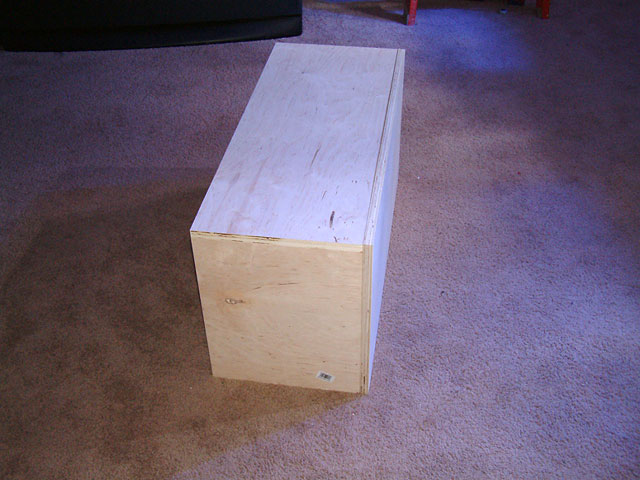
We built the canopy out of 3/4" thick birch plywood. The stuff is stong, cheaper than oak and leaves a really nice finish.
el_canopy_right.jpg


The front fits snug as you can see, but the best part is Marc's addition which is how it fits so snug but still allows access.
el_canopy_left.jpg


What can I say? He's the almighty Melev... The pointed piece of wood is a hanger bracket. The matching piece is secured in the canopy. The 1" wide strip at the bottom is so the front rests on the frame of the tank.
el_hangers.jpg


I simply lift the door off and out of the way. To replace it, I puts it straight in, and lower it onto the hangers on each end. So cool. Copyright Melev Inc. 2008(JK replicate at will, it's hawt)
el_support_lip.jpg


The 1"+ gap about the top hanger is to allow room to slide it upwards for removal.
el_hanger_bracket.jpg


We cut a hole for the 120mm fan on one side and I got a cover at a local electronics store. The fan was simply be connected to the same power as the MH ballast as to only be running while the MH was on via a light timer.
el_fancover.jpg
 
A light bracket was added to space the reflector from the top of the canopy a bit for cooling purposes as well as give us a nice place to attach the reflector.
el_mh_supports.jpg


A rear brace was added for structural integrity as well as a nice place to attach the electronic ballast. A 1.5" gap was left at the top to allow hot air out the rear.
el_canopy_rear.jpg


The spider reflector had to be bent just a bit to fit. Under most tanks you want the reflector and bulb running perpendicular to the tank for better light distribution. But hey, we are putting a 250w over a 29g.. Light won't be an issue right?
el_mh.jpg


The fan was a 110v computer fan that I wired just before the ballast straight to the same power chord. It was about $7. The stupid thing was L O U D... I'm not talking like kind of noisy, I'm saying like rivaling a screaming/dying baby seal after catching a wiff of Marc's bathroom after he relieved himself of a meal of his mom's favorite Swiss fondue loud. It has since been replaced by my favorite purchase to date which we will get to later in the project.
el_mh_and_fan.jpg


The electronic ARO 250 watt ballast was attached to the rear brace and would ignite a XM 14,000 bulb (bulb was also replaced and will be covered).
el_ballast.jpg


The wood construction took about 2 hours, and the wood cost about $40 to $45 including some stainless steel screws for the fan cover.

The lighting with ballast, mogul socket, spider reflector and bulb was about $150ish new (alot cheaper that the original coralife fixture, I wanted to cry).

I had to paint later because Marc was too busy building all of you guys' sumps...

The inside was sloshed all over with Killz which protects the wood from moisture and reflects the light. I have read all the nonsense about how using Killz could leak poisonous vapors into your tank blah blah. Let's just say if that's true then my inhabitants have lived a good 2 years totally high out of their minds and remain fine.

The outside was painted black (like the depths of Melev's soul) to match the stand.
 
one thing I've always wondered about Metal Halides is: Isn't the light coming through the back annoyingly bright. I have VHO's and they bother the hell out of me if I am not staring at something in my aquarium.
 
This is a great thread and exactly what im looking to do w/ my 29gal. Keep it up. BTW where did you purchase the components for your lighting? Im also not sure if i want to do flourecents or MH, any imput for lighting on a tank that size?
 
<a href=showthread.php?s=&postid=11665567#post11665567 target=_blank>Originally posted</a> by sm51498
one thing I've always wondered about Metal Halides is: Isn't the light coming through the back annoyingly bright. I have VHO's and they bother the hell out of me if I am not staring at something in my aquarium.

Yeah, at first after I upgraded to MH the neighbors came by to check to see if my weed growing culture was going well... Once they saw the fish tank it all made sense.

It's not as bad as you'd think, especially with the canopy. I couldn't do an MH pendant but really the canopy helps a lot. Let me just add that the growth difference in corals and color especially in SPS is worth the small amount of light bleed.
 
<a href=showthread.php?s=&postid=11665590#post11665590 target=_blank>Originally posted</a> by NBwmu
This is a great thread and exactly what im looking to do w/ my 29gal. Keep it up. BTW where did you purchase the components for your lighting? Im also not sure if i want to do flourecents or MH, any imput for lighting on a tank that size?

Hehe thanks! I hope you tag along :D I love the MH way more than the PC's even though it's probably overkill. No one can say I don't have enough light for anything I put in my tank.

The hardware all came from Hellolights but the bulb came from wherever I could find it cheapest at the time. I highly recommend Hellolights, they were awesome.
 
Aight, fast forward a year later to March 2007. Marc and I were talking about the possible sump/fuge upgrade. Course I had like 300 ideas on stands and props tanks too. We start bouncing ideas off each other and it got to the point where I knew this was going to be amazing and went and started buying supplies.

In June we set aside a 3 day weekend to dedicate as much of 72 straight hours as we could.

I'll begin with the stand and stay as close to the order we actually built all this. For explanation purposes I will have to deviate just a bit as we pretty much accomplished all of the rest of the build in 3 days and many things overlapped.

I won't really bother going over the unbelievable amount of plans we went through like I normally would do at this point. There is nothing to discuss about the plans really, it's already built and being used at this point :D

The stand was constructed out of 3/4" thick birch plywood to match the canopy. It's dimensions are 31" wide x 36" tall x 16.25" deep.
Picture1.jpg


The rear has 2 cross braces. One at the top for support...
Picture3.jpg


and one in the middle not only for structural integrity, but for a shelf anchor (will be explained further).
Picture4.jpg


Here's Marc cutting the back cover off out of 1/4" thick plywood.
Picture2.jpg


Both back pieces were cut, but only the top was attached at the time to allow the sump to be slid in the rear during setup.
Picture5.jpg


A 2.5" frame was mounted on the front for structural purpose as well as a door mount.
Picture6.jpg


You can see how the frame would make it impossible to fit a sump of the largest possible size in from the front. Which is what led Marc to doing the back in 2 sections and just attaching the top until the sump was in.
Picture8.jpg


Marc is cool? I'll let you decide.
Picture7.jpg
 
Last edited:
finally a tank build from quicksilver. it's long overdue.


does this mean reefcast is going to start having regular shows? :)
 
The shelf was constructed to fit the prop tank which you will see later. The hole on the left is for the drain line of the display. The hole on the right is the return for the whole system. The center hole is for the bulkhead under the prop tank (you'll see, hold your horses).
Picture9.jpg


It fit nicely into the stand. Here you can see the 1" cross brace on the front of the shelf for support.
Picture10.jpg


The stand held the weight of the empty tank! WOOT!
Picture11.jpg


I had said that the stand was 16.25" deep and you may have asked why at the time because a 29g standard tank is only 12.25". Well the overhang behind was left because I wanted all the plumbing to feed through internally. This helps reduce sound of water through plumbing in the room, as well as capture any drips off the plumbing in the stand instead of dripping all over the carpet. It also allowed me to fit in a bigger sump, again overkill being the key when dealing with Marc and Evan.
Picture12.jpg


Then Marc measured for the two holes (return and drain) for plumbing.
Picture19.jpg


Marc drilling drain hole.
Picture16.jpg


Marc drilling return hole.
Picture14.jpg
 
With the two holes cut, the stand is looking more complete.
Picture13.jpg


The front door was constructed with a window to see the prop tank. But is looking very unfinished without trim. I actually offset the window about 2 inches high so that when you are standing in front of the stand or sitting on the couch across the room you can clearly see the prop tank. If it was even with the tank, you would have to get your eye level at the same as the prop tank to see it.
Picture93.jpg


Marc used to be a professional trim carpenter and so I let him work his magic here.
Picture94.jpg


The trim for the window was made of four separate pieces that all slid together to fit perfectly.
Picture92.jpg

Picture90.jpg

Picture89.jpg
 
Time to get some air moving through that stand. Marc began measuring from fan holes.
Picture80.jpg


Two 80mm computer fans will be put in these two holes that Melev is cutting.
Picture79.jpg


Prior to painting, I put spackle over all the holes left from the nail gun. If you look close here you can see the spackle around the outside of the door. I waited for the spackle to dry and then sanded it to make it all smooth and flush with the wood.
Picture91.jpg


After the stand was built, there was quite a bit of excess saw dust and crud left from drilling, cutting, etc. I used a compressor with a trigger tip to blow all the excess junk out to prep for painting.
Picture87.jpg

Picture88.jpg
 
I had to include this because I just want you to see 1) How all of you perceive Marc isn't necessarily accurate LAWL 2)24 hours of woodwork can make a man crazy.

Marc being really cool

*If you put the video on repeat I can't guarantee you won't wet yourself.
 
Status
Not open for further replies.
Back
Top