
You are using an out of date browser. It may not display this or other websites correctly.
You should upgrade or use an alternative browser.
You should upgrade or use an alternative browser.
Refugium help and opinions!!
- Thread starter frankDtank
- Start date

davocean
Active member
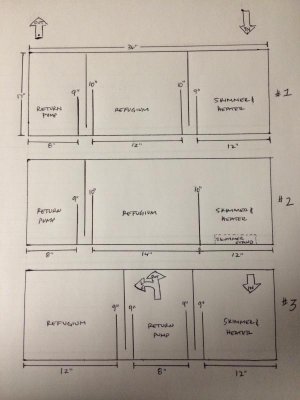
I like #1 old school version, but you don't need that last baffle at return, the 9", and keep your last baffle at return as an under, bubbles float up in fuge.
I also would put heater in fuge.
The under baffles you have are drawn all the way to top, hope that is not your plan, I make my sump water level at about 3/4 so there is room for back siphon overflow, and keep your return lines high enough for an early break.
I also would put heater in fuge.
The under baffles you have are drawn all the way to top, hope that is not your plan, I make my sump water level at about 3/4 so there is room for back siphon overflow, and keep your return lines high enough for an early break.
fltekdiver
Active member
Both #1 and #2 your only going to have water movement through your refugium on top
#3 with the return in the middle, you can control your refugium by teeing off your return, which is what I did on mine
If you are going to keep the refugium in the middle, try to use two pcs of glass and keep a 1/2" gap between them so you get flow through the middle of the refugium also
Here's my 40 breeder, with a 20H as a refugium
#3 with the return in the middle, you can control your refugium by teeing off your return, which is what I did on mine
If you are going to keep the refugium in the middle, try to use two pcs of glass and keep a 1/2" gap between them so you get flow through the middle of the refugium also
Here's my 40 breeder, with a 20H as a refugium
frankDtank
New member
I like #1 old school version, but you don't need that last baffle at return, the 9", and keep your last baffle at return as an under, bubbles float up in fuge.
I also would put heater in fuge.
The under baffles you have are drawn all the way to top, hope that is not your plan, I make my sump water level at about 3/4 so there is room for back siphon overflow, and keep your return lines high enough for an early break.
So, in the drawing, the baffles that go to the top. You're saying to bring them down so the top is about 3/4 from the top??
fltekdiver
Active member
Yes, That's correct. You can't have your baffles all the way to the top
That would me when your power cuts off, the return is only going to fill that chamber up, and you'll overflow your sump
You need to calculate how much is going to drain down into the 40B when your return pump is shut off, or a power outage
That also depends on where you put your siphon break
That would me when your power cuts off, the return is only going to fill that chamber up, and you'll overflow your sump
You need to calculate how much is going to drain down into the 40B when your return pump is shut off, or a power outage
That also depends on where you put your siphon break

uncleof6
Active member
None of the above. Somone already covered the baffles all the way to the top of the sump. However, there is no point to bringing them up to within 3/4" of the top of the sump either. If your first baffle (bubble trap) is say 9" tall, the middle baffle should be 9" tall, raised off the floor by 1". This is more than enough for the sump to function properly. Fuge baffle in a 40 breeder (if you must have a 'fuge') should be around 12" - 13", any taller is not going to do you any good,
Beyond that, # three is the best option, as the other two do not provide very much flexibility at all. Also, in #3 there is no point to the bubble trap between the 'fuge' and the return section, a single baffle will suffice, and the return section really should be larger so the pump will have longer run time before burning up due to evaporative loss, when your ATO fails.
As far as power out drain down goes, you need enoug spare volume in the sump to contain ALL power out drain down. This is mandatory design criteria. Check valves, and anti-siphon holes are false security. They will fail you as soon as you turn your back. The failure probability of check valves (though these were not brought up) is 100%. The failure probability of anti-siphon holes failing is 99%. It only takes a small piece of coralline or other FOD, and they are disabled and you flood all over the floor. Never use a device or method to prevent a flood that can fail, even remotely, as you final line of defense. In the case of a sump, the extra volume needs to be your final line of defense, it cannot fail, well...unless your math skills are a bit rusty... Do keep your return line within 1" of the DT water level, any deeper is not going to do you any good. Let the power heads do the job they are really intended to do....
Beyond that, # three is the best option, as the other two do not provide very much flexibility at all. Also, in #3 there is no point to the bubble trap between the 'fuge' and the return section, a single baffle will suffice, and the return section really should be larger so the pump will have longer run time before burning up due to evaporative loss, when your ATO fails.
As far as power out drain down goes, you need enoug spare volume in the sump to contain ALL power out drain down. This is mandatory design criteria. Check valves, and anti-siphon holes are false security. They will fail you as soon as you turn your back. The failure probability of check valves (though these were not brought up) is 100%. The failure probability of anti-siphon holes failing is 99%. It only takes a small piece of coralline or other FOD, and they are disabled and you flood all over the floor. Never use a device or method to prevent a flood that can fail, even remotely, as you final line of defense. In the case of a sump, the extra volume needs to be your final line of defense, it cannot fail, well...unless your math skills are a bit rusty...
Do keep your return line within 1" of the DT water level, any deeper is not going to do you any good. Let the power heads do the job they are really intended to do....
davocean
Active member
So, in the drawing, the baffles that go to the top. You're saying to bring them down so the top is about 3/4 from the top??
To keep the answer and your sump simple, the answer would be yes, that is correct.
I say 3/4 as a general guideline which is pretty much what it usually comes out to when you figure how much back siphons, and I would rather have a little more room than not enough.
There should be fuge a plenty at that level.
Yes, there are many out there that do seem to like T's to different sectioned off areas of sump, and all the plumbing that goes w/ it, but IMO it really is not needed.
Yes, you could only run the first glass baffle short for water level, but why pay for the extra glass on the other if it doesn't do anything.
frankDtank
New member
Thanks for the quick responses guys. I will modify my drawings and repost and get additional feedback. I will try to add what I got from everyone. Another question is how do I black out the glass that surrounds the refugium area, if I plan on having the refugium in the middle?? I heard its important to keep the light from hitting the other chambers and contain the growth. Is this true??
frankDtank
New member
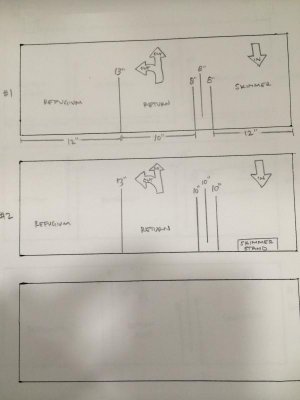
Here are some new drawings. Let me know guys. Thanks.
uncleof6
Active member
Here are some new drawings. Let me know guys. Thanks.
Again, number 3, but you are still wasting material by having two bubble traps, instead of one bubble trap after the skimmer section. Your bubbles are going to come from the drains (because you are going to use a durso, operating above its trouble free flow capacity) and an out of adjustment skimmer, not from the fuge area.
You are also still wasting material by making the center baffles go all the way up. Some of the reasoning for not doing this, posted in this thread is absurd, and there is no guideline whatsoever concerning this, however, it is a waste of material, and it will not serve any purpose at all.
For the sump to work properly, the water level in the fuge section (for instance) should not be any higher than the baffle closest to the fuge. E.G. 9" deep fuge. Otherwise you will be breeding an oil slick on the surface that is never going to go away. Surface water needs to flow over a baffle, so you are not going to want to fill the fuge up to the rim with brim...otherwise subsurface water will flow under the middle baffle to the return section, and you will not be happy that you were paying attention to some dubious advice...
I suggested a 13" tall fuge baffle, and only one of them. The sends surface water over the baffle (to keep the oil slick moving back around ultimately back to the skimmer) and gives you a 4" boost is fuge volume. Not that this is going to be of any value, but folks are stuck on fuge volume, rather than more important considerations, such as return section and pump protection. It is what it is though.
I am thinking it may be possible, that you are missing what the task of the baffles really is (bubbles are a minor consideration) and how water is supposed to flow through a sump, as is usually the case when someone is wanting to run baffles up to the top of the tank. This is not at all an uncommon condition.
If so, perhaps this will help: Surface water should flow over the top of the baffles, exactly as it does in the DT into an overflow. E.G. the water level is set by the first baffle encountered. This maintains surface skimming/surface renewal (just as important as it is in the DT), save for a bubble trap, where water flows under the second baffle, and the sump should only run ~ half full, under normal conditions. This covers the power out drain down problem in most common circumstances. These are the only defensible guidelines there are concerning baffles/water volume in general. Pump protection is a different, though related topic....
frankDtank
New member
Lots to take into consideration. Is there a way to convert a Durso to work more efficient? Maybe I should just make a basic sump with no refugium? I think I was miss guided when I was told that a refugium would help my tank run cleaner( although I have no issues with my levels) just some algae prob but not much.
frankDtank
New member
Oops uploaded the same picture from before. I will fix that.
uncleof6
Active member
Lots to take into consideration. Is there a way to convert a Durso to work more efficient? Maybe I should just make a basic sump with no refugium? I think I was miss guided when I was told that a refugium would help my tank run cleaner( although I have no issues with my levels) just some algae prob but not much.
All you can do with a durso is convert the drain system to a siphon system.
Refugiums are rather ambiguous at best. Though a well defined methodology, they are missapplied, multi-tasked in a sump, which usually results in it not doing anything particularly well, for instance using chaeto and sand, sort of negate each other in that the chaeto uses nitrates, but the sand produces nitrates, net effect: ~ 0. An RDSB should not have chaeto or rock in it, just sand. Just iterating through the combinations will show some things.
Some are eliminating them (myself for one) in the sump anyway. A fuge in the sump single tasked with just chaeto is not going to hurt anything, if you have the room for it (a 40 breeder usually does.) But they are not as essential as it may seem. You can always run a bucket DSB to clear up most algae problems.
Always remember a little algae is not a bad thing, the natural reef is mostly algal if we look at it in terms of actual bio-mass, and it adds some color. It only becomes a problem if it gets out of hand. New tanks suffer, sure, but mature systems with a good amount of photosynthetic corals (reduces the nitrate levels; research it) and generally have less out of hand algae problems. Quality circulation (rather than quantity) in the DT keeps cyano in check. (which needs next to nothing to grow anyway, just sayin)
frankDtank
New member
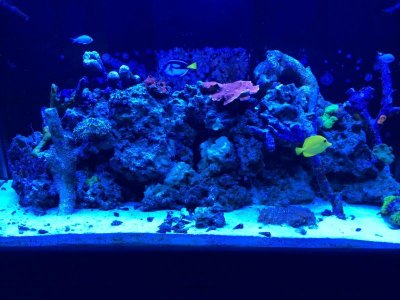
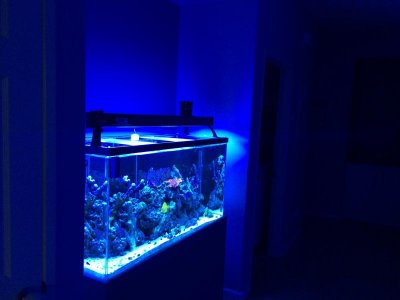
Thanks for the great info. I still would like to increase my sump size to a 40g breeder. Now the question is whether or not to go with a fug or a basic sump setup. My tank seems to look nice from my sump I run now ( I'm fairly new to this so my opinion means little).
Here are some pics of tank( couldn't add multiple pics for some reason so I will post individual ones)
Here are some pics of tank( couldn't add multiple pics for some reason so I will post individual ones)
Attachments
frankDtank
New member
davocean
Active member
A fuge is awesome if used for the right reasons and set up properly, and again IMO that is keep it simple.
LR rubble and chaeto, and you don't even need much rubble, no reason to make a dietrus trap.
Chaeto does not need sand to grow.
Too many assume a fuge is solely for nutrient export, and there are more efficient means of ridding excessive nutrients.
While a fuge will help, it would have to be pretty big to do anything I would consider substantial, but still, it does help step in the right direction, penny's saved makes a dollar type of thing.
Really, a fuge is a place of refuge from predation that allows pod growth and reproduction, and that is an awesome natural live food source for many fish.
Also if you run a reverse light cycle it helps to maintain PH.
Those two benefits alone make it well worth while for adding just an extra baffle or two, which is all you are really doing since going w/ a good size sump, increasing volume, might as well do something positive w/ that extra water volume.
LR rubble and chaeto, and you don't even need much rubble, no reason to make a dietrus trap.
Chaeto does not need sand to grow.
Too many assume a fuge is solely for nutrient export, and there are more efficient means of ridding excessive nutrients.
While a fuge will help, it would have to be pretty big to do anything I would consider substantial, but still, it does help step in the right direction, penny's saved makes a dollar type of thing.
Really, a fuge is a place of refuge from predation that allows pod growth and reproduction, and that is an awesome natural live food source for many fish.
Also if you run a reverse light cycle it helps to maintain PH.
Those two benefits alone make it well worth while for adding just an extra baffle or two, which is all you are really doing since going w/ a good size sump, increasing volume, might as well do something positive w/ that extra water volume.
frankDtank
New member
Ok so I like the idea of having a "T" from my return pump to the refugium. I think it will help me get more flow thru the fug if I do the plumbing right. And also give me room to make the baffle taller on just the refugium section. Here are my two ideas I have on that. The only difference is making the baffles taller on the return and skimmer area on option #2, and putting the skimmer on a stand to achieve the optimal working height.
Now in my tank I have my return bulk heads pretty high up and my internal overflow with a Durso installed. So there isn't much water to worry about in case of a power outage. I also have one way valves( which are never 100%)
Also having my return "T" may help with the fact that the return pump I plan on getting may be a little too much, even with head loss, for my Durso. It will help lower my returns output.
Now in my tank I have my return bulk heads pretty high up and my internal overflow with a Durso installed. So there isn't much water to worry about in case of a power outage. I also have one way valves( which are never 100%)
Also having my return "T" may help with the fact that the return pump I plan on getting may be a little too much, even with head loss, for my Durso. It will help lower my returns output.
Attachments

swk
New member
My sump is very close to the last design you made.
My fuge space is too small to make much of a dent for nutrient export, and honestly, vinegar dosing has made my fuge expendable for this application. The only reason I still keep it online is for pod production and a place to have a reverse photoperiod to help with ph swings at night. I grow macros, and have a dsb, but all it is is a fancy safe haven for little critters, which btw, is well worth it ime. Here's a pic.
View attachment 285489
This is my current setup with a 20L sump
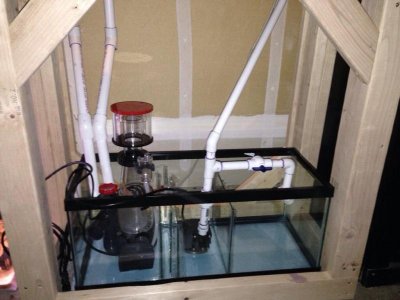
Here's basically the same setup on a 40gal in my garage.
My fuge space is too small to make much of a dent for nutrient export, and honestly, vinegar dosing has made my fuge expendable for this application. The only reason I still keep it online is for pod production and a place to have a reverse photoperiod to help with ph swings at night. I grow macros, and have a dsb, but all it is is a fancy safe haven for little critters, which btw, is well worth it ime. Here's a pic.
View attachment 285489
This is my current setup with a 20L sump
Here's basically the same setup on a 40gal in my garage.
uncleof6
Active member
Ok so I like the idea of having a "T" from my return pump to the refugium. I think it will help me get more flow thru the fug if I do the plumbing right. And also give me room to make the baffle taller on just the refugium section. Here are my two ideas I have on that. The only difference is making the baffles taller on the return and skimmer area on option #2, and putting the skimmer on a stand to achieve the optimal working height.
Now in my tank I have my return bulk heads pretty high up and my internal overflow with a Durso installed. So there isn't much water to worry about in case of a power outage. I also have one way valves( which are never 100%)
Also having my return "T" may help with the fact that the return pump I plan on getting may be a little too much, even with head loss, for my Durso. It will help lower my returns output.
#1 now...no point in adding baffle height, and needing to use a stand under the skimmer. The added volume is completely insignificant. On the other hand, if the height of the return section needs to come up to protect the pump (evaporative loss) then go for #2...

Similar threads
- Replies
- 9
- Views
- 338

- Replies
- 0
- Views
- 231
- Replies
- 0
- Views
- 173
- Replies
- 1
- Views
- 946

- Replies
- 58
- Views
- 6K
