Alex T.,
I used Crystal Seas Bioassay Laboratory Formula salt mix for years without any problems whatsoever. However, it was the only brand I ever used. I did not switch from Instant Ocean to Crystal Seas. Some of the people who switched from Instant Ocean (and perhaps Reef Crystals) to Crystal Seas reported some problems with bleaching. Other people did not have that problem and I don't know of anyone who started out with Crystal Seas who ever reported any problems.
So I still don't know what the problem was, I just know that it seemed to only affect people switching from Instant Ocean (and perhaps Reef Crystals) to Crystal Seas and not affect people switching from other brands. I do know some people who successfully switched from Instant Ocean to Crystal Seas but I believe they did it very slowly over a period of time.
If anyone (Randy?) has any clue what that was all about, please speak up.
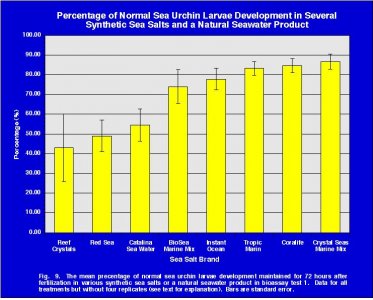
As far as the study that you referenced, there was a surge of people switching to Crystal Seas following Dr. Ron Shimek's article showing that Crystal Seas performed better than some other brands in a study of survival rates among sea urchin larvae. Instant Ocean's chief scientific officer, Dr. Tim Hovanec, responded with a study of his own to refute Dr. Shimek's study and its conclusions.
Dr. Hovanec's study actually confirmed most of Dr. Shimek's results but Dr. Hovanec disagreed with Dr. Shimek's conclusions. Dr. Hovanec said that we should not be "tempted" to consider the salt that did poorest at keeping sea urchin larvae alive to be "worse" than the salt that performed best.
I will attach
Dr. Hovanec's own chart from his own study and you can see why Dr. Hovanec does not want you to be "tempted" to jump to conclusions. Reef Crystals is at the far left side of Dr. Hovanec's chart and Crystal Seas is at the far right side, but please down be "tempted" to consider Reef Crystals "worse" than any of the other brands.
Here's how they managed to explain that little inconvenient truth:
The results from the above experiment demonstrate that SSS are not "poisonous" to sea urchin larvae. Furthermore, no one SSS can be considered better, or worse, than the others. While one might be tempted to consider the sea salts who [sic] returned lower mean values of normal sea urchin development to be "worse" than others, this view is not supported by the statistical analysis. -- Timothy Hovanec, Ph.D., Chief Scientific Officer, Marineland.