im going to show you guys the pics of the columns of two crispas on the first page of this post to show you.the first is from jwoyshar ,the second is from rh doug,and then mine.mine is just older and bigger but has the same cream colored foot and vericue.the reason mine has a redish tint is the light shinning threw.

You are using an out of date browser. It may not display this or other websites correctly.
You should upgrade or use an alternative browser.
You should upgrade or use an alternative browser.
Show off your sebae please.
- Thread starter sonofgaladriel
- Start date
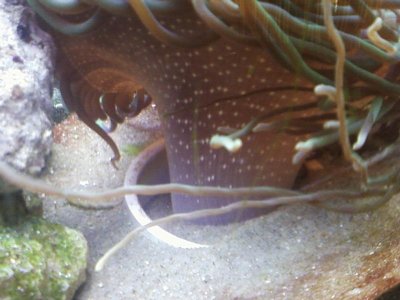
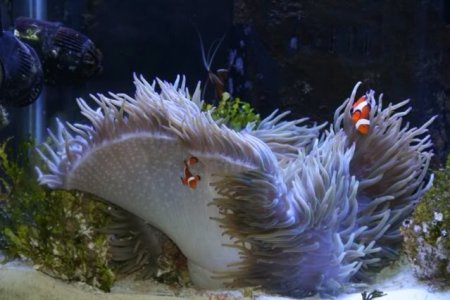
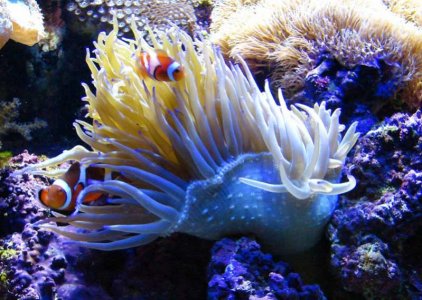
sqwat, in that last post with the 3 pics, the first two pics are obvious crispas, and the last is an obvious M. doreensis. The column is classic doreensis. And, as Elegance said, a very nice doreensis, at that. Tentacle count is considerably less for doreensis compared to crispa, and your anemone has a lower tentacle count as can be seen in your first pic in this thread.

elegance coral
They call me EC
If you want your anemone to be M. doreensis, you're in luck. LOL
If you look at jwoyshar's pic, you'll see that the tissue of the column is white. In person, this white tissue will be very thick. This is why crispa is known as the "leathery" anemone. If you could see the whole pedal disk, you'd see that it's huge. By comparison, your anemone has much more delicate tissue, the column is much thinner (and darker), and the pedal disk is much smaller.
M. doreensis doesn't always have a orange/red column. In fact, most of them I've seen have a tan column. Here's a deformed doreensis with tan columns and pedal disks. If you look close enough, you can also see the verrucae.

Here's another one showing the verrucae. It also has a tan column like yours.

The tentacle count of your anemone is to low to be crispa. The tentacles even curl like that of M. doreensis. Which is why another name for this anemone is the "corkscrew" anemone.
Anemone ID can be very difficult with sick, or stressed individuals, or with poor quality pic's. In your situation, the anemone seems very healthy, and we couldn't ask for better pic's. This makes identifying the anemone very easy. It is, beyond any doubt, M. doreensis.
If you look at jwoyshar's pic, you'll see that the tissue of the column is white. In person, this white tissue will be very thick. This is why crispa is known as the "leathery" anemone. If you could see the whole pedal disk, you'd see that it's huge. By comparison, your anemone has much more delicate tissue, the column is much thinner (and darker), and the pedal disk is much smaller.
M. doreensis doesn't always have a orange/red column. In fact, most of them I've seen have a tan column. Here's a deformed doreensis with tan columns and pedal disks. If you look close enough, you can also see the verrucae.
Here's another one showing the verrucae. It also has a tan column like yours.
The tentacle count of your anemone is to low to be crispa. The tentacles even curl like that of M. doreensis. Which is why another name for this anemone is the "corkscrew" anemone.
Anemone ID can be very difficult with sick, or stressed individuals, or with poor quality pic's. In your situation, the anemone seems very healthy, and we couldn't ask for better pic's. This makes identifying the anemone very easy. It is, beyond any doubt, M. doreensis.


davocean
Active member
There is nothing to convince, because it is an M. doreensis.
Yep, I agree, M. doreensis.


davocean
Active member
I'm noticing that in most of the pics, perhaps all, the crispas are attached in the rocks. I'm curious what percentage of the time H. crispa attaches in rock vs. sand.
Crispa's pretty much always anchor in sand, but often wedge through rocks making it look like they are attached to rock sometimes.
The rare times I see Crispa's attached high up on rocks are usually due to lower light than they prefer, and they can reach up higher for more light.
Mine started out this way, but as soon as I got proper light, it went straight down to the sand bed, as that is their preference.


elegance coral
They call me EC
i will never convince you so i will stop.
It's all good.:beer:
You're obviously taking very good care of this anemone, and it seems very healthy. In the end, that's all that really matters.:thumbsup:
elegance coral
They call me EC
I'm noticing that in most of the pics, perhaps all, the crispas are attached in the rocks. I'm curious what percentage of the time H. crispa attaches in rock vs. sand.
I don't know if this helps or not, but here's a very old pic of my crispa. It lived for a long time at the sand/rock interface, just like haddoni would do. Then I added my haddoni. The crispa moved to the top of the rocks, it's tentacles shrunk, and it stopped eating. Then one day I came home from work to find it upside down on top of the haddoni. It was dead within days. Some lessons are learned the hard way.:sad2:

Here's my old malu. It's position was a little odd. It's foot was in a deep hole in the rocks, that was about one inch in diameter.

davocean
Active member
Dave,
Where did you get your Picasso pair? The shape of the fish are just perfect. Very nice pair
Thanks, got my pair from Donisreef

taylor t
New member
Here is my h. crispa, I've had it for 9 years. It hosted a pair of breeding gold bar maroons for a few years until I lost them when a heater broke and electcuted all the fish. It has been hosting a pair of breeding ocellaris since 2006. The tank is 3ft across so I would guess it is nearly a foot across. When I got it, it was bleached (and tiny) but quickly recovered with feedings. I initially fed it silversides and whole krill, but now it just catches what it can when I feed the tank a frozen mix, multiple times a day. Sometimes I do target feed it with a direct squirt of the mix with a turkey baster.

Thank you for posting this. I also have a crispa a couple years old, and it's not huge like I thought they get. That's one of the reasons I thought mine was malu, and it was labeled as such when I bought it. Yours being 9 years old and only a foot... Mine's a couple years old, and hasn't grown much lately. Mine came with little stubs for tents too. I've seen some very large ones and thought they all grew huge. Thanks for posting with a little history.
Here's mine.


Nebthet
New member
Thanks Garygb, I was never too sure if it was one or the other. A few speculated that due to the tentacles in the middle being shorter than those on the rim it was a Malu. Either way, I just love the thing, (as does my male percula whose home it is) and am happy it is healthy.. I can't wait until it gets big. I am upgrading to a 75g just to give it the extra room to grow out when it really stars going.
Similar threads


- Replies
- 0
- Views
- 330
