Silent and Failsafe Overflow System

Maybe a 2 new sticky threads should be started with one being a proper internal only BA setup and one for Internal/external setups. As I made an honest attempt to read through this monster of a thread I came to the conclusion (maybe falsely) that the internal/external overflow was "the best way." Uncle, thank you for so much time you put into this thread! I just feel that it has become information overload as so many have tried to modify the system and have sought advise on how to deal with the problems. I feel there just needs to be a simple HOW -TO thread and if someone varies the system, they should seek help on a separate thread.
Dave

Yes - the thread has become unmanageably large and long; and much of it is not relevant, making searching through it difficult. I don't know that starting a new thread would fix that. User forums like Reef Central are great for discussions and Q&A, but rather poor as reference sites. I've toyed with the idea of setting up a wiki or some other reference site, but honestly don't have the time right now. Hopefully some day...
 
Wondering if anyone has tried this before. I currently run a Bean Animal drain. I wanted to try to get more turn over in the tank. If I add a gate valve to the secondary drain and turn it into Herbie would there be any reason that comes to mind that it wouldn't work? Once I know that more turnover in the tank would remedy some of the issues I am having then I would consider re-drilling 3 more holes to setup another full Bean Animal system. I just don't want to do it if there is any reason that I am not thinking of at the moment that will cause it to not work properly.


Thanks,

Adam

What is your setup, and how much flow are you running? In his original description, Beananimal describes 1" bulkheads with 1.5" pipes running 2000 GPH, and that's not even wide open.

If I read your post correctly, you are talking about running a full siphon (presumably wide open,) a 2nd full siphon dialed back with a gate valve and a dry emergency? Doing this eliminates one of the failsafes of the system, so I can't recommend it. Unless you have significantly undersized bulkheads, flow shouldn't be an issue.
 
I'll be drilling my tank for the external Bean design this week, and was hoping someone could answer two quick questions for me:

1) Will two holes in the tank draining into the box be enough or should I have three?
2) Is there a set size for dimensions of the box? Or can I make it whatever size I want?

Thanks!

1. You need 3 holes for a bean. Please re-read Bean's original description and make sure you understand the operation and fail-safe mechanisms.
2. Sizing of the overflow box depends on your tank, plumbing, flow, etc. There is no single 'correct' size. Before you drill your tank, you should carefully plan everything out with you overflow box, plumbing, etc to make sure you have everything sized and spaced correctly. Take your time and do this right before proceeding; you'll save yourself heartache later on.
 
1) Will two holes in the tank draining into the box be enough or should I have three?
!


1. You need 3 holes for a bean. Please re-read Bean's original description and make sure you understand the operation and fail-safe mechanisms..


Your always a huge help doc, but he is asking if two holes through the tank into an external box (with 3 hole bean in the external) is sufficient.

Because you want steady even flow through to the external box and drains I recommend going with 3 wholes, but Doc may have a differing opinion.
 
1. You need 3 holes for a bean. Please re-read Bean's original description and make sure you understand the operation and fail-safe mechanisms.

I understand that the three pipes used in Beans design needs three holes. But in many of the external box designs i've seen around YouTube and this forum, they did something like this plan I found on Google Images. Notice how the guy plans to drill two holes in his display tank for the water to drain into his external box where the Bean plumbing is housed. There's even a video of a guy functional 40 breeder with external Bean overflow and he had what appeared to be 2 holes. I just wanted to be sure two was enough, otherwise I will do 3 to be safe.

4KdXcb6.png
 
I understand that the three pipes used in Beans design needs three holes. But in many of the external box designs i've seen around YouTube and this forum, they did something like this plan I found on Google Images. Notice how the guy plans to drill two holes in his display tank for the water to drain into his external box where the Bean plumbing is housed. There's even a video of a guy functional 40 breeder with external Bean overflow and he had what appeared to be 2 holes. I just wanted to be sure two was enough, otherwise I will do 3 to be safe.

4KdXcb6.png

I would drill as many as I can fit into the width of the box. On my tank it was done that way opposed to being grooved and I notice that the box doesn't get as much water as the siphon can handle which causes me to have less turn over then I want.
 
I understand that the three pipes used in Beans design needs three holes. But in many of the external box designs i've seen around YouTube and this forum, they did something like this plan I found on Google Images. Notice how the guy plans to drill two holes in his display tank for the water to drain into his external box where the Bean plumbing is housed. There's even a video of a guy functional 40 breeder with external Bean overflow and he had what appeared to be 2 holes. I just wanted to be sure two was enough, otherwise I will do 3 to be safe.

Sorry - I misunderstood your question.

Like floyd said, the number of holes doesn't matter, as long as they are sufficient to allow relatively unrestricted flow through to the external box. I don't have a good rule to gauge the size of the though-holes, but remember, the entire flow of your sump/overflow will be running though them. If you're trying to run 1000 gph then a single 1.75" hole (1" bulkhead size) will probably be a bit small.
 
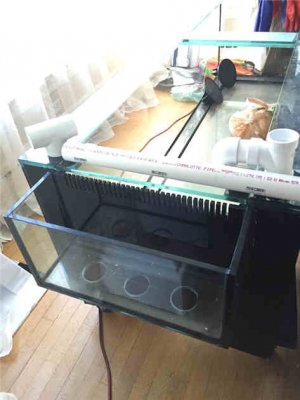
Not sure if this has been answered in the thread already but I'm wondering about oversizing the pipes on the drain line vs. the bulkheads. I'm setting up a 250 with a peninsula overflow (first photo). 1.5" bulkheads and thinking of going with 2" piping. The drainage will flow through the first floor into the basement.

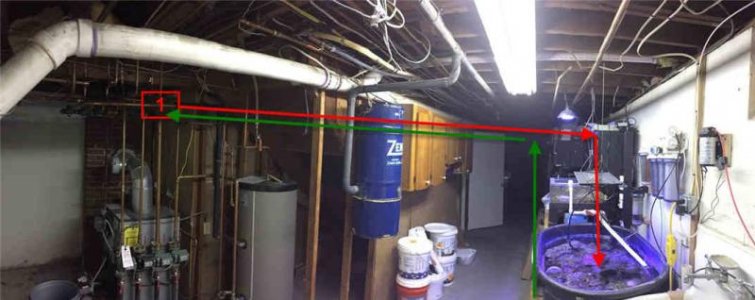
While I'll be going through the floor with flex pvc as there are some unique turns, there will likely be a nearly horizontal run from the area behind and above the furnace to the sump on the right (second photo with the drain lines coming down from the first floor where the [1] is). Will this present a problem for a silent drain and/or greatly reduce flow?

Planning on running back up from the sump with 1.5" pipe via a Reeflo Hammerhead (green arrow). I'm guessing ~14ft of head on that.
 

Attachments

  • overflow.jpg
    overflow.jpg
    22.6 KB · Views: 5
  • basement-drain-map.jpg
    basement-drain-map.jpg
    44.6 KB · Views: 6
Not sure if this has been answered in the thread already but I'm wondering about oversizing the pipes on the drain line vs. the bulkheads. I'm setting up a 250 with a peninsula overflow (first photo). 1.5" bulkheads and thinking of going with 2" piping. The drainage will flow through the first floor into the basement.

While I'll be going through the floor with flex pvc as there are some unique turns, there will likely be a nearly horizontal run from the area behind and above the furnace to the sump on the right (second photo with the drain lines coming down from the first floor where the [1] is). Will this present a problem for a silent drain and/or greatly reduce flow?

Planning on running back up from the sump with 1.5" pipe via a Reeflo Hammerhead (green arrow). I'm guessing ~14ft of head on that.

Yes, horizontal runs cause problems for a bean overflow. They make it difficult for the siphon line to purge the air which in turn reduces the flow.
 
So is this going to be a huge issue preventing proper flow or will it just be less than ideal? Any suggestions on a workaround. I can probably build in a little incline. I just don't want the line to come down too low across that space if I can avoid it.
 
Can you run it tight inside the ceiling joist when you come through the floor and provide a gradual slope over from there? I would think you can achieve a reasonable angle without it becoming too low if you start as high as possible... Doc will have a more experienced answer though.
 
I am starting a new reef build. Hopefully I dont **** everyone off, but I have been through many pages throughout the forum to even remember. I am sure the information is probably out there, but wow information overload. So I have decided to start a thread specific to my project.

Tank – 65 gal (36X18X24)
Sump – Trigger Systems Ruby 36s (36X15X16) – Total water volume 34.5 gallons

What I liked to do:

Build an external overflow with a Bean Animal, the overflow box to be 20” wide located in the center of the tank “ on the back”)

Questions:
1. Do I notch the tank from the top – What dimensions?
2. Or - Should I drill holes out the back of the tank. If so what size, how many and where in relation to desired water level.
3. How deep should the overflow be – what dimensions?
4. What size drain lines?
5. What determines the water level with this type of design?
6. What size pump for the desired 10X turn over?
7. If you want to paint the back of your tank black – what do you paint it with and how do you get the silicone to stick to the paint when you mount your overflow box?

I am sure there are more questions that need to ask (feel free to suggest), but I will start here and see where the information goes. Thanks everyone for your support, I just want to get the basics right the first time and be able to enjoy the project.
 
So is this going to be a huge issue preventing proper flow or will it just be less than ideal? Any suggestions on a workaround. I can probably build in a little incline. I just don't want the line to come down too low across that space if I can avoid it.

I can't say for sure - I've never built a bean overflow with a horizontal run, so my answer is extrapolated from what I've read of other people's experience and my knowledge of the physics.

Horizontal runs interfere with the siphon line purging air at startup. If there is air in the line, it won't run as a full siphon, it will be noisy, and the flow will be decreased. This will then lead to increased flow in the open channel and possibly oscillations in the overflow levels. It's possible that it may work, depending on your flow, pipe diameters and exact configuration, but I can't say for sure.

Perhaps someone else who has actually tried it can chime in.
 
I am starting a new reef build. Hopefully I dont **** everyone off, but I have been through many pages throughout the forum to even remember. I am sure the information is probably out there, but wow information overload. So I have decided to start a thread specific to my project.

Tank "“ 65 gal (36X18X24)
Sump "“ Trigger Systems Ruby 36s (36X15X16) "“ Total water volume 34.5 gallons

What I liked to do:

Build an external overflow with a Bean Animal, the overflow box to be 20" wide located in the center of the tank "œ on the back")

Questions:
1. Do I notch the tank from the top "“ What dimensions?
2. Or - Should I drill holes out the back of the tank. If so what size, how many and where in relation to desired water level.
3. How deep should the overflow be "“ what dimensions?
4. What size drain lines?
5. What determines the water level with this type of design?
6. What size pump for the desired 10X turn over?
7. If you want to paint the back of your tank black "“ what do you paint it with and how do you get the silicone to stick to the paint when you mount your overflow box?

I am sure there are more questions that need to ask (feel free to suggest), but I will start here and see where the information goes. Thanks everyone for your support, I just want to get the basics right the first time and be able to enjoy the project.

Is it a rimless tank or a rimmed tank? You can notch the tank or drill holes. Most people do the latter, since it's hard to make the notch look good. If it's a rimmed tank, definitely drill holes - the rim is required for structural stability.

How much flow are you going to be running? That determines the rest of the answers. In general, a 1" pipe can flow 1500-2000 gph, or more, depending on the drop, so 1" will be plenty for you siphon. The open channel may benefit from being slightly larger simply because a larger pipe will be able to handle a wider range of flows while remaining silent.

Water level in the tank is determined by the overflow weir. Water level in the overflow is determined by the gate valve on the siphon line and the height of the open channel drain.

You can use plain latex paint to paint the tank. It won't stick very well and will be prone to scratching. Or you can use a black background like you can get at pet stores. Do it after you put the box on the back. silicone will stick to the paint, but the paint won't stick to the glass and the box will fall off. Paint won't stick to silicone.

Your pump is determined by how much flow you want, the plumbing, and anything else you want to run off the pump.
 
OK, thanks. I get what you're saying (Swope2bc, I'll definitely be trying to start it as high as possible). I've got no other recourse but to try it so I'll report how it goes. Thanks, guys!!
 
OK, thanks. I get what you're saying (Swope2bc, I'll definitely be trying to start it as high as possible). I've got no other recourse but to try it so I'll report how it goes. Thanks, guys!!

As long as you've got the drains setup right in both locations the horizontal run should work fine. I've been running with a 12' horizontal run for several years now with no issues. Make sure to put the valve at the sump area and don't put the siphon more then an 1" under water and less is better. It will be loud when it purges the air. Tuning the valve is tricky at first running up and down stairs but once set you should never have to touch it again. Also, plan for the extra water volume that has to drain back down on power outage or return pump shutdown.

One thing I do on almost an annual basis (about 1-2 years) is swap my siphon line with my open channel and get a drain snake and clean out the siphon. As the horizontal run will tend to build up anything and everything dead and alive. Also, try and use 45's for everything. I have two 45's butt up together to make 90's where I need too.
 
Jason-
Thanks for sharing your experience. I'm sure you're not the only one, but you're the first person I've heard of running a Bean overflow with a long horizontal section. How much flow are you running through what size pipes? How does startup go and how long does it take to equilibrate? Do you have the pipes completely horizontal, or at a slight angle?

Having the valve at the bottom is what is generally recommended for basement sump systems. Like you said; after the initial setup, you shouldn't have to mess with it. Good advice on the plumbing volume, too.

I can totally believe that you get buildup in the horizontal pipes. If I were to setup such a system, I would probably put a couple of unions on the horizontal section to facilitate clean out.
 
Back
Top