Silent and Failsafe Overflow System

... I would probably put a couple of unions on the horizontal section to facilitate clean out.
I wasn't thinking of this - but thanks!!

Also, are there any photos of a valve setup at the bottom? Is it just above the sump outlet or at some other point? I'm glad I didn't buy my gate valves yet since I've decided to size the pipe up to 2" (drain holes are 1.5"). Valve goes on the full siphon, correct?

I'm not overly concerned about power cutoff scenarios as I'll be lowering the sump volume to compensate for that (plus a little extra). Noise is no issue downstairs.

Valve adjustment will need teamwork. I knew those motorola walkie-talkies would come in handy some day!!
 
Jason-
Thanks for sharing your experience. I'm sure you're not the only one, but you're the first person I've heard of running a Bean overflow with a long horizontal section. How much flow are you running through what size pipes? How does startup go and how long does it take to equilibrate? Do you have the pipes completely horizontal, or at a slight angle?

Having the valve at the bottom is what is generally recommended for basement sump systems. Like you said; after the initial setup, you shouldn't have to mess with it. Good advice on the plumbing volume, too.

I can totally believe that you get buildup in the horizontal pipes. If I were to setup such a system, I would probably put a couple of unions on the horizontal section to facilitate clean out.

It's pretty much straight horizontal and if anything my full siphon is angled up sightly. Tight spaces. I just measured and its more around 13' horizontal. 12' is just what I remember being easier to remember. :). It's all 1" sch40 pvc. Flow is around 750gph via a mag1800.

Top one is primarily and currently the siphon. It's shoved on top so would make a slight up angle there.
83b4730925957bb2e31aca99a9c45d87.jpg


798ad9dbe9ceae12cc404c47afb82dff.jpg


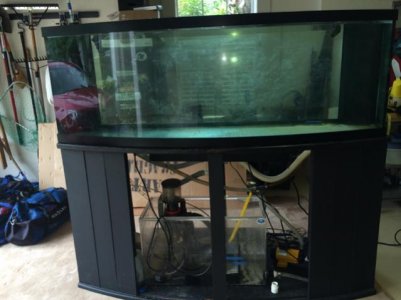
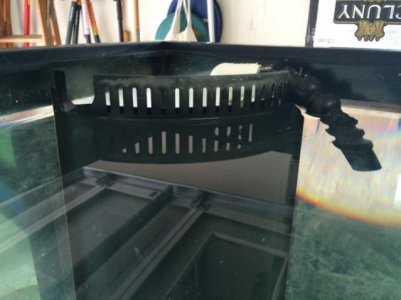
Back of the tank first getting it setup. Only thing different is a tube stuck on top of of that back one.
881de502e36856358fb865d045568543.jpg


798ad9dbe9ceae12cc404c47afb82dff.jpg


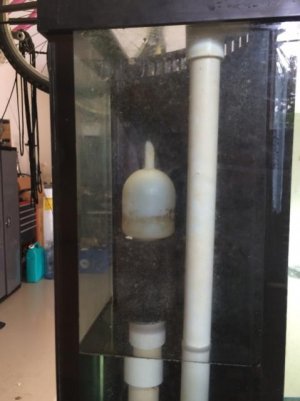
Building the external overflow drain
92bd5647e428763e59d6d3cd81f48c80.jpg


Used this to attach the above to the tank(along with resealing the entire tank...)
3de3629b7c612ce0920290556e8572c7.jpg


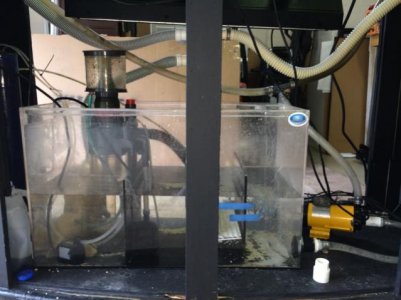
Recent picture I took the other day showing the valves. I have two in case I need to or when I make the open the siphon
ed8640c591132035486918885ce4f547.jpg


Have been running like this since I think 2011? I posted way earlier in this thread about it but the picture links are probably all broken since I used t iny url site.
 
Oh, I didn't answer how long start up takes. I'll have to time it to be sure but I'd say less then 30 seconds to purge all the air and create the full siphon.


I think I answered all the questions.
 
Cool, thanks. I didn't know you could get PVC in brown. That's quality!!

Hoping to get well above 2K GPH but we'll see. Beananimal calc says way above but that's under ideal conditions, I know.
 
Yeah that brown is from my old SRO3000 that was consistently inconsistent and would overflow with foam everywhere. I replaced it with the skimmer you see in that picture. It's been very consistent.
 
Reef Ready 155 rebuild CF/BA question

Reef Ready 155 rebuild CF/BA question

Hi all and thanks for reading my post.

Recently I happened upon a relatively new 150 gallon Reef-Ready BowFront, with corner overflows (Herbie maybe) with an ADHI Berlin Model-30 sump. Additional equipment includes a Coral Life 200G protein skimmer, media reactor, and BlueLine Aqua Pump 30 running the show. Right now it's empty and I can do anything to it if I like. I'm thinking of re-drilling it for a Calfo/BeanAnimal combo, for all the safety/sound benefits, also I want to make it a mixed reef. So should I just leave it be, put some LR in the sump, add a fuge (probably) then call it a day of go for the redrill? There are pics on my RC page Any Advice Would be Nice.

Tank_155.jpg

Sump_Adhi.jpg

OverFlow.jpg

Weir_Ret.jpg
 
I am currently designing my system and I am wondering whether it would be possible to divert a part of the return flow from the Full Siphon tube towards the refugium?

This is the planned layout:

picture.php


A 320 gal display tank will drain into the sump. A 170 gal cryptic refugium will be located in a separate room.

My idea is to add a "T" element to the full Siphon Pipe and put valves on both outgoing branches (leading to sump and to refugium) to regulate the flow between them:

picture.php


The piping branch leading to refugium would add 14 feet of horizontal run (with a ~10" drop in the middle as I need to catch a hole in the wall which was left to connect the two rooms - see also the first picture).

What is potentially the biggest problem is that the water level in refugium would need to be about 15" higher than in the sump:

picture.php


What do you think - would this work or not?
Any comments or opinions would be highly appreciated.


Marko
 
I partly solved my own question. By adding a baffle in the sump I can raise the water level in the Full Siphon outlet area so that it remains only 6" below the water level in the refugium:

picture.php


Still, any chance that the split/dual outlet of the Full Siphon pipe would work the way I imagined the piping?

Of course I could also lower the water level in the refugium to match the level in the sump, but then I'll loose ~50 gal of refugium water volume...
 
Hi all and thanks for reading my post.


Recently I happened upon a relatively new 150 gallon Reef-Ready BowFront, with corner overflows (Herbie maybe) with an ADHI Berlin Model-30 sump. Additional equipment includes a Coral Life 200G protein skimmer, media reactor, and BlueLine Aqua Pump 30 running the show. Right now it's empty and I can do anything to it if I like. I'm thinking of re-drilling it for a Calfo/BeanAnimal combo, for all the safety/sound benefits, also I want to make it a mixed reef. So should I just leave it be, put some LR in the sump, add a fuge (probably) then call it a day of go for the redrill? There are pics on my RC page Any Advice Would be Nice.


From the pics it appears you have at least one Durso. It's possible the previous owner had dual herbies set up, but from what I understand, a dual Herbie system is rather finicky and difficult to keep tuned properly.

Your question comes up frequently - how to convert a dual overflow system to a bean. There's no great way. Probably the easiest is to simply remove the overflow boxes, plug the holes and drill the back for a coast to coast bean. I have seen one person who modified dual overflows and combined them, adding a center weir to make it a (almost) coast to coast. You can also put the siphon and open channel overflows in one corner, and the return and dry emergency in the other corner. To do this, you have to have the emergency above the edge of the overflows. You also end up with a big dead space in one corner and significantly cut the skimming area since it all occurs at one corner, so I really wouldn't recommend it.

Based on my experience with a corner overflow Herbie setup, I would put in a coast to coast with a bean now, before getting it set up and running. It's relatively easy to do now and a royal pain to do later.
 
Silent and Failsafe Overflow System

I partly solved my own question. By adding a baffle in the sump I can raise the water level in the Full Siphon outlet area so that it remains only 6" below the water level in the refugium:


Still, any chance that the split/dual outlet of the Full Siphon pipe would work the way I imagined the piping?


Of course I could also lower the water level in the refugium to match the level in the sump, but then I'll loose ~50 gal of refugium water volume...


No - you are asking for problems by trying to regulate the siphon flow with two separate valves into separate bodies of water. Have the siphon empty into the sump and then tee off the return to feed the sump.

A couple other issues with your proposed setup: how are you going to get the water back to the sump from the refugium? With that small of a drop, you will get very little flow in the return pipe. One snail or bit of algae in the pipe will choke it off and you'll have a flood. Also, make sure your sump has the capacity to contain the water that siphons down from the tank when the power is cut. Filling the sump up to the top is another recipe for a flood.
 
No - you are asking for problems by trying to regulate the siphon flow with two separate valves into separate bodies of water. [...]

Thanks, doc - I appreciate your advice.

I am not so sure what to do with the outflow from refugium, though. I cannot put the refugium to any other place. (But that's already offtopic with respect to this thread).
 
Thanks, doc - I appreciate your advice.


I am not so sure what to do with the outflow from refugium, though. I cannot put the refugium to any other place. (But that's already offtopic with respect to this thread).


Start a new thread with your issue/goals. Someone may well have an idea that could help
 
Oh, I didn't answer how long start up takes. I'll have to time it to be sure but I'd say less then 30 seconds to purge all the air and create the full siphon.


I think I answered all the questions.

So, I timed the start up last night. With in a couple seconds the return line purges all it's air but from that time to the time the drains behind the tank become completely silent again is about 1m 38s.

On shutdown it drains all lines by the 1 minute mark and can audibly hear the siphon open up completely.
 
So, I timed the start up last night. With in a couple seconds the return line purges all it's air but from that time to the time the drains behind the tank become completely silent again is about 1m 38s.

On shutdown it drains all lines by the 1 minute mark and can audibly hear the siphon open up completely.


Thanks for posting the info. Sounds like it takes a bit longer, but under 2 minutes isn't bad, and it's purging the air and working, which is the important thing. 750 GPH in 1" pipe is reasonable flow, but not extraordinarily high. I wonder if a larger pipe (& therefore slower flow) would prevent the purging? (That's a rhetorical question; I'm not asking you to replumb your system to check!) My guess is it would, and if so, it would mean that the feasibility of a horizontal run would depend on the flow-pipe diameter ratio.
 
I'm having an issue that I hope someone can help me with. I just completed a new build using a beananimal drain. No modifications. The first time I started my return pump the drain completed a syphon and was completely silent in seconds. Ran great for days. I had to shut off the return pump for some maintenance, and when I restarted, my drain will not go quiet. There is the initial syphon, but it will not purge all the air so it is loud and lots of bubbles. It has been going like this over night.
 
You do not have a full siphon if there's air in there. Could be a couple of things. 1) There's a air leak in you siphon pipe, or 2) You're getting a vortex at the mouth of the siphon sucking in air.
 
Did you glue the internal elbows into the bulkheads or just friction fit them? Where is the water level in the overflow compared to what it was before the maintenance? Any chance something could have gotten into the siphon line and obstructed it? (I had this happen once) What happens if you open the valve on the siphon line all the way and then slowly close it?
 
Thanks for the advice guys, but I fixed it. I applied a bit of back pressure on the return pipe be placing my hand in front of it. Not sure why it worked, but it did.
 
I wonder if there was just some air that somehow got caught around the valve? It's probably worth trying to replicate. Even if you can't repeat the problem, I wouldn't worry. The beauty of the bean setup is thay you have 2 levels of redundancy; the open channel and the dry emergency. Even it there should be a power outage while you're gone and the system fails to start up as intended afterwards, it will still function safely until you get back.
 
Back
Top