
You are using an out of date browser. It may not display this or other websites correctly.
You should upgrade or use an alternative browser.
You should upgrade or use an alternative browser.
Silent and Failsafe Overflow System
- Thread starter JohnL
- Start date


Kevinsrangers
New member
Thanks for the replies, I'm going to copy.paste my original question to a new thread like you suggested.
Im really hoping I can come up with a good system.
Im really hoping I can come up with a good system.

rickztahone
New member
I'm not sure if this would help anyone, but I made a video depicting a clog simulation of the Bean Animal overflow. Enjoy:
<iframe width="853" height="480" src="https://www.youtube.com/embed/3HK4TBUB4Oo" frameborder="0" allowfullscreen></iframe>
<iframe width="853" height="480" src="https://www.youtube.com/embed/3HK4TBUB4Oo" frameborder="0" allowfullscreen></iframe>
BeanAnimal
Premium Member
Hi dear members,
Do you see any problems using this plumping in the system whime the main tank has BeanAnimal drain system? Main tank has 1.5" pipes and BH, other tanks have 1" pipes and BHs. My return pump is a Red Dragon 10m3.
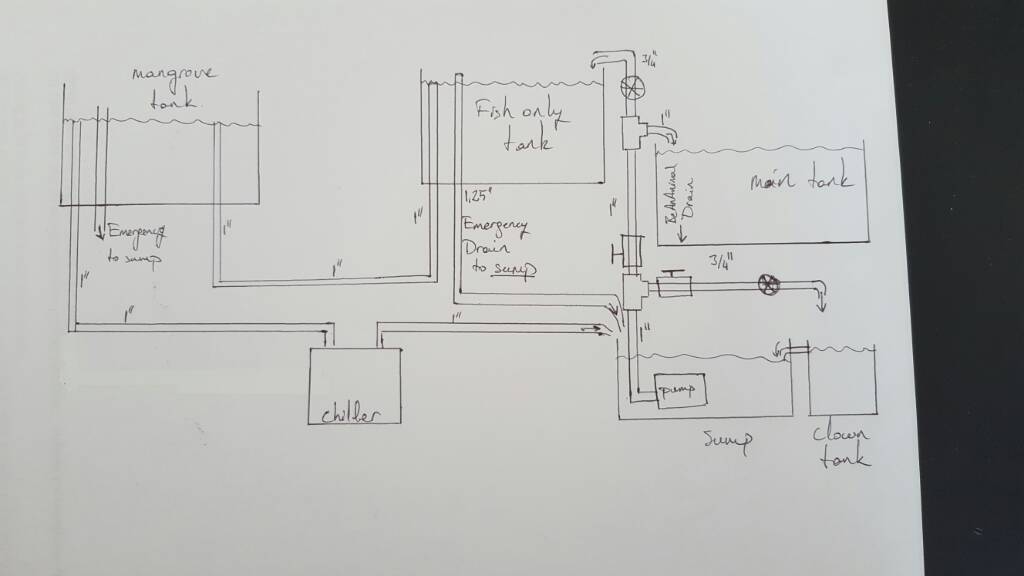
Regards
Yes... There are problems

Using a single return pump to feed multiple displays is certainly a valid concept. The problem however (among other things), is that you are splitting that flow into three systems, at least one of them "tuned". You may get it to (ignoring the other issues) balance, but it may also be a... balancing act. There are too many variables to guess at how stable it may, or may not be. If built with sufficient drainage capacity, your only real danger is noise due to the imbalance. If you passive drain systems are too small, then an imbalance could cause them to flood. The emergency pipes you have drawn will certainly help, but any setup like that needs to be FULLY tested in failure scenarios. Often times we build an "emergency" system only to find that in a real failure situation, the system does not behave as expected.
The chiller barrel will become a sediment trap if plumbed passively. It should be inline with the discharge side of the pump, and before any discharge branches. That means it will be a static pressure drop on the entire system, not a branch to cause imbalance.
Passive plumbing between systems will work, but I would (depending on flow) question the 1" piping, especially in consideration to length.

adamwheel
New member
Questions about filter socks/death traps on siphon for fish:
We created black plastic overflow covers for my internal C2C that bend 90 degrees and only allow a small gap between the weir and the cover (~1/2").
I use filter socks (water is so much clearer) and hate that the siphon is a death trap for my fish. I haven't lost any yet with the covers but assume I still will.
There are low profile strainers that can be purchased but once a fish gets inside the weir, that probably wouldn't help much.
I am considering using the clear netting (also used as my tank cover to keep wrasses in the DT) to create a barrier.
I think Bean used egg crate on his weir at one point but that seems like a nightmare to clean.
Thoughts and thanks,
Adam
We created black plastic overflow covers for my internal C2C that bend 90 degrees and only allow a small gap between the weir and the cover (~1/2").
I use filter socks (water is so much clearer) and hate that the siphon is a death trap for my fish. I haven't lost any yet with the covers but assume I still will.
There are low profile strainers that can be purchased but once a fish gets inside the weir, that probably wouldn't help much.
I am considering using the clear netting (also used as my tank cover to keep wrasses in the DT) to create a barrier.
I think Bean used egg crate on his weir at one point but that seems like a nightmare to clean.
Thoughts and thanks,
Adam

sleepydoc
Team RC
Questions about filter socks/death traps on siphon for fish:
We created black plastic overflow covers for my internal C2C that bend 90 degrees and only allow a small gap between the weir and the cover (~1/2").
I use filter socks (water is so much clearer) and hate that the siphon is a death trap for my fish. I haven't lost any yet with the covers but assume I still will.
There are low profile strainers that can be purchased but once a fish gets inside the weir, that probably wouldn't help much.
I am considering using the clear netting (also used as my tank cover to keep wrasses in the DT) to create a barrier.
I think Bean used egg crate on his weir at one point but that seems like a nightmare to clean.
Thoughts and thanks,
Adam
http://www.bulkreefsupply.com/low-profile-bulkhead-overflow-strainers.html
BeanAnimal
Premium Member
Questions about filter socks/death traps on siphon for fish:
We created black plastic overflow covers for my internal C2C that bend 90 degrees and only allow a small gap between the weir and the cover (~1/2").
I use filter socks (water is so much clearer) and hate that the siphon is a death trap for my fish. I haven't lost any yet with the covers but assume I still will.
There are low profile strainers that can be purchased but once a fish gets inside the weir, that probably wouldn't help much.
I am considering using the clear netting (also used as my tank cover to keep wrasses in the DT) to create a barrier.
I think Bean used egg crate on his weir at one point but that seems like a nightmare to clean.
Thoughts and thanks,
Adam
BLACK covers are the way to go - they keep algae from growing inside the overflow box. The eggcrate was not so bad, but could be if you have high nutrients. Like any other larger surface area exposed to light and water, it can grow algea.
In general, the overflow box is a death trap for fix that are too large to go down the siphon. The current is simply too strong. The covers should prevent this from happening. Fish small enough to go through the siphon always come out the other end just fine.
That brings us to filter socks.... Yes they are great, but I would not run one all the time. I would argue that they take too much macro fauna out of the water column (Pods, brittle stars, snail eggs, whatever). I place them over the discharge plumbing and then use a powerhead to blow the detritus off of the rocks, etc. I wait for the water to clear up, remove the socks and then do it again. Beats the hell out of changing filter socks every day or two.
If that method does not fit your plan, then yes, you can use the mesh. With a bit of thought, a mesh lid for the overflow box could be fashioned. Maybe attached to something like a channel type report cover that would slip over the weir and then be stretched over the top edge of the trim. It would be angled so that any jumper that landed on it would roll back into the display.
Thoughts on covers: My covers are fitted so that there is only a small slot above the weir. I think shrimp would fit through, but that is about it. I don't have shrimp anymore because I have a hawkfish that likes the way they taste.

Mr.Tan
New member
Alright... After reading the website bean has made that does explaining, etc.. Im going to incorporate this setup onto my tank since i am startinf fresh. Im building a 29g standard tank and going to push it to the max and make it as efficient as possible. I just have one big question:
First- I notice it is mentioned using a coast to coast overflow. Is this entirelt necessary? I was thinking of building a glass internal overflow box (opposed to having it outside of the tank for support reasons) and having it span a total of 10", this allows 3 1" holes drilled which leaves 1.5" between each hole . Will this be sufficient? I dont want a TON of gph flow, since its a small tank and im only going to use a 20 gallon tank as a sump.... Should i do smaller piping? Or is the bean animal overflow just overkill to begin with?
If i am able to do this correctly, the total width of the box im thinking 4" from back of tank to front of overflow box... Is this too much? Too little? .... Im trying to figure this out on my own as much as possible but im getting confused.
Basically the overflow i mocked up from cardboard is 10" wide, 4" tall and 4" deep from back of tank to front of overflow
First- I notice it is mentioned using a coast to coast overflow. Is this entirelt necessary? I was thinking of building a glass internal overflow box (opposed to having it outside of the tank for support reasons) and having it span a total of 10", this allows 3 1" holes drilled which leaves 1.5" between each hole . Will this be sufficient? I dont want a TON of gph flow, since its a small tank and im only going to use a 20 gallon tank as a sump.... Should i do smaller piping? Or is the bean animal overflow just overkill to begin with?
If i am able to do this correctly, the total width of the box im thinking 4" from back of tank to front of overflow box... Is this too much? Too little? .... Im trying to figure this out on my own as much as possible but im getting confused.
Basically the overflow i mocked up from cardboard is 10" wide, 4" tall and 4" deep from back of tank to front of overflow
Last edited:
adamwheel
New member
BLACK covers are the way to go - they keep algae from growing inside the overflow box. The eggcrate was not so bad, but could be if you have high nutrients. Like any other larger surface area exposed to light and water, it can grow algea.
In general, the overflow box is a death trap for fix that are too large to go down the siphon. The current is simply too strong. The covers should prevent this from happening. Fish small enough to go through the siphon always come out the other end just fine.
That brings us to filter socks.... Yes they are great, but I would not run one all the time. I would argue that they take too much macro fauna out of the water column (Pods, brittle stars, snail eggs, whatever). I place them over the discharge plumbing and then use a powerhead to blow the detritus off of the rocks, etc. I wait for the water to clear up, remove the socks and then do it again. Beats the hell out of changing filter socks every day or two.
If that method does not fit your plan, then yes, you can use the mesh. With a bit of thought, a mesh lid for the overflow box could be fashioned. Maybe attached to something like a channel type report cover that would slip over the weir and then be stretched over the top edge of the trim. It would be angled so that any jumper that landed on it would roll back into the display.
Thoughts on covers: My covers are fitted so that there is only a small slot above the weir. I think shrimp would fit through, but that is about it. I don't have shrimp anymore because I have a hawkfish that likes the way they taste.
Thanks for the reply.
At this point, wrasses and chromis are the only fish that can sneak through my black ABS covers. Given all the QT craziness we go through, losing healthy fish this way can be frustrating.
I'll try using the socks less (tall order).
Cheers and thank you for all the help the past few years,
Adam

chatyak
New member
Having some trouble determining the best size for an external overflow box.
Tank is being custom made. 98% certain it will be peninsula overflow.
72" L x 26" W x 23" H
Overflow about 22" slot on one side, leading to external box. Just not sure what the width and height of the external box should be.
1) Just standard sizing, so long as the plumbing is done correctly? Has it been determined that a certain size works better?
2) I see some say 1" drains and some with 1.5"...
3) I also just came across a post that mentioned upgrading the open channel to 1.25", to reduce the air/gurgle noise. Is this the elbow fitting or the entire drain at 1.25?
When I made my own in years past, I just made it big enough to work with and to get plumbing in. However, having a deeper overflow would allow for the open channel to be physically higher than the siphon, as opposed to the same height with an airline tube attached to the top - correct?
I read that there needs to be a certain amount of space if the open channel is higher than the siphon, so the siphon has time to purge itself of air before the water level recedes again... otherwise it's a gurgling mess.
So...
4) Do we know how much "higher" the open channel would have to be, if it's physically placed above the full siphon?
Tank is being custom made. 98% certain it will be peninsula overflow.
72" L x 26" W x 23" H
Overflow about 22" slot on one side, leading to external box. Just not sure what the width and height of the external box should be.
1) Just standard sizing, so long as the plumbing is done correctly? Has it been determined that a certain size works better?
2) I see some say 1" drains and some with 1.5"...
3) I also just came across a post that mentioned upgrading the open channel to 1.25", to reduce the air/gurgle noise. Is this the elbow fitting or the entire drain at 1.25?
When I made my own in years past, I just made it big enough to work with and to get plumbing in. However, having a deeper overflow would allow for the open channel to be physically higher than the siphon, as opposed to the same height with an airline tube attached to the top - correct?
I read that there needs to be a certain amount of space if the open channel is higher than the siphon, so the siphon has time to purge itself of air before the water level recedes again... otherwise it's a gurgling mess.
So...
4) Do we know how much "higher" the open channel would have to be, if it's physically placed above the full siphon?
Last edited:
chatyak
New member
Having some trouble determining the best size for an external overflow box.
Tank is being custom made. 98% certain it will be peninsula overflow.
72" L x 26" W x 23" H
Overflow about 22" slot on one side, leading to external box. Just not sure what the width and height of the external box should be.
1) Just standard sizing, so long as the plumbing is done correctly? Has it been determined that a certain size works better?
2) I see some say 1" drains and some with 1.5"...
3) I also just came across a post that mentioned upgrading the open channel to 1.25", to reduce the air/gurgle noise. Is this the elbow fitting or the entire drain at 1.25?
When I made my own in years past, I just made it big enough to work with and to get plumbing in. However, having a deeper overflow would allow for the open channel to be physically higher than the siphon, as opposed to the same height with an airline tube attached to the top - correct?
I read that there needs to be a certain amount of space if the open channel is higher than the siphon, so the siphon has time to purge itself of air before the water level recedes again... otherwise it's a gurgling mess.
So...
4) Do we know how much "higher" the open channel would have to be, if it's physically placed above the full siphon?
I've read more now that I have time. Here are my thoughts. Please verify.
1) Overflow size of function before asthetics. Enough room to work with. Deeper/taller may be nicer as more height variation between open/full siphons. Helps give time for flush.
2) Anything over 1500 GPH is best served with 1.5" bulkheads and 1.5" pipe. Original 1.5" pipe with smaller bulkhead was just to make water trickles quiter and due to build up/already drilled holes.
3) Above
So now I have two questions. In the original design it goes full siphon --> open channel trickle --> emergency --> airline on open submerges for full siphon.
1) Is there anything wrong with having the emergency drain kick in AFTER the airline tube is submerged on open siphon? So instead of airline tubing last, it is emergency last?
2) How much vertical height should there be between open channel air opening and main siphon, so that it has time to self flush? My overflow may use height difference to achieve this with a hole drilled in pvc elbow., so want to be sure.
Silent and Failsafe Overflow System
Hi all so I have now finalised the spec of my new tank and after taking uncle66 advice I am going for 2.5inch pipe (75mm). Here you will see 90mm bulkheads but they are different as 75mm pipe slots into them as opposed over them if that makes sense. I have drilled another hole at the other end of the overflow box just in case I need it which I don't think I will . The weir box is 300mm high. Be really grateful for any feedback before I order this .

Hi all so I have now finalised the spec of my new tank and after taking uncle66 advice I am going for 2.5inch pipe (75mm). Here you will see 90mm bulkheads but they are different as 75mm pipe slots into them as opposed over them if that makes sense. I have drilled another hole at the other end of the overflow box just in case I need it which I don't think I will . The weir box is 300mm high. Be really grateful for any feedback before I order this .

Floyd R Turbo
Either busy or sleeping
Silent and failsafe. Herbie.
Uh oh. I feel an internet fight a comin.

Swope2bc
New member
Uh oh. I feel an internet fight a comin.
Lol, saw that and opted to keep my mouth shut. Anyone with half a brain can see what system this thread is about and he is therefore either dumb or looking for a fight. Either way it didn't quantify a response. People are funny though.
rickztahone
New member
Lol, saw that and opted to keep my mouth shut. Anyone with half a brain can see what system this thread is about and he is therefore either dumb or looking for a fight. Either way it didn't quantify a response. People are funny though.
You are indirectly responding to the comment :hmm3:
Swope2bc
New member
You are indirectly responding to the comment :hmm3:
Indeed, I couldn't help myself [emoji12]
I am trying to plan out my 1st aquarium. It will be an in-wall 180-210gal (72x24x24 or 30) DT with a 75-120gal sump below the DT in a fish room. What I would like to do is a c2c internal weir on the rear of the DT draining to a box attached on the back of the tank. Would a 45deg angled weir work? Something similar to this but with a wider box on the back:

I would come up with a different way to cover the weir than attaching another piece of glass and I would have the leading edge of the weir rounded over. Are there any potential pit falls with this type of set up? I want to do it right the 1st time. Thanks for any input anyone has to offer.
I would come up with a different way to cover the weir than attaching another piece of glass and I would have the leading edge of the weir rounded over. Are there any potential pit falls with this type of set up? I want to do it right the 1st time. Thanks for any input anyone has to offer.
Alright... After reading the website bean has made that does explaining, etc.. Im going to incorporate this setup onto my tank since i am startinf fresh. Im building a 29g standard tank and going to push it to the max and make it as efficient as possible. I just have one big question:
First- I notice it is mentioned using a coast to coast overflow. Is this entirelt necessary? I was thinking of building a glass internal overflow box (opposed to having it outside of the tank for support reasons) and having it span a total of 10", this allows 3 1" holes drilled which leaves 1.5" between each hole . Will this be sufficient? I dont want a TON of gph flow, since its a small tank and im only going to use a 20 gallon tank as a sump.... Should i do smaller piping? Or is the bean animal overflow just overkill to begin with?
If i am able to do this correctly, the total width of the box im thinking 4" from back of tank to front of overflow box... Is this too much? Too little? .... Im trying to figure this out on my own as much as possible but im getting confused.
Basically the overflow i mocked up from cardboard is 10" wide, 4" tall and 4" deep from back of tank to front of overflow
I actually had a black acrylic 48" box, leaving 6" on each end for dual returns if I went that route (went with a single return). It was noisy (not loud, but more noise than I wanted). I came home from disney and the box had fallen off.
I got 2 59 1/8" pieces of glass cut and made a coast to coast using RTV108 silicone. Why I didn't go this route before, I don't know...it's so damn quiet. The only noise I get is from the slight splash from the gyre pulsing at the surface. I probably drilled my holes 1/2" too far down, but it is what it is.
As for the strainers, I'll use 1/2" netting and ziptie to my elbow in the overflow box. Past 2 days I have had to open my gatevalve up to let a snail fall, as the water line in the overflow box had risen and caused more water to go down the open channel than I want. running the Sicce 4.0 is pushing about 700 gph and my gate valve is about 3/4 closed. Plan is to get a Sicce pro 1900 on black friday, or a DC pump like the reef octopus or Eco-Tech
Similar threads

- Replies
- 3
- Views
- 335
- Replies
- 2
- Views
- 2K

- Replies
- 4
- Views
- 1K

