
You are using an out of date browser. It may not display this or other websites correctly.
You should upgrade or use an alternative browser.
You should upgrade or use an alternative browser.
Silent and Failsafe Overflow System
- Thread starter JohnL
- Start date
Question For backsump overflow:
Tank 54 x24 x24"
Sump is 6.5" width at the back.
Return Pump eheim compact 2000
Howlong should the overflow surface skimmer should be? How big should the teeth be?
haha that's almost become a loaded question around here.
my 120g tank is 48x24x24 and i went with 18" long. it's arbitrary at some point though. The best is "as big as you can go" meaning full-length, coast to coast style, or something even more ridiculous like multi-edge overflow, but no one reall ydoes that. I'm sure anything 16 - 24" would be fine in reality, just wouldn't be "quite" as good as full-length.

nanomania
New member
Well mine is backsump, not sump at bottom. So no pipes etc. Can i go 12" wud it be enough??haha that's almost become a loaded question around here.
my 120g tank is 48x24x24 and i went with 18" long. it's arbitrary at some point though. The best is "as big as you can go" meaning full-length, coast to coast style, or something even more ridiculous like multi-edge overflow, but no one reall ydoes that. I'm sure anything 16 - 24" would be fine in reality, just wouldn't be "quite" as good as full-length.
Sent from my GT-N7100 using Tapatalk
Well mine is backsump, not sump at bottom. So no pipes etc. Can i go 12" wud it be enough??
Sent from my GT-N7100 using Tapatalk
it would probably handle the flow, assuming you keep it reasonable. However, the skimming effectiveness will be reduced at that size. You might want to go toothless if possible, to maximum use of the space.
nanomania
New member
That can cause fishes and inverts going into the sumpit would probably handle the flow, assuming you keep it reasonable. However, the skimming effectiveness will be reduced at that size. You might want to go toothless if possible, to maximum use of the space.
This is what i have. 30cm. Ordered from fish street

Sent from my GT-N7100 using Tapatalk
Outdrsyguy1
New member
tried to find this answer as I saw it once before, but couldn't find again.
What sets the height of the water in your overflow? Is it the height of the "trickle" pipe?
Having issues where my overflow water level is too high and basically raises the tank water level rather than flowing through the weir. I'm guessing it's recommended to have the overflow level lower than the tank by 1/4", 1/2"?
What sets the height of the water in your overflow? Is it the height of the "trickle" pipe?
Having issues where my overflow water level is too high and basically raises the tank water level rather than flowing through the weir. I'm guessing it's recommended to have the overflow level lower than the tank by 1/4", 1/2"?
tried to find this answer as I saw it once before, but couldn't find again.
What sets the height of the water in your overflow? Is it the height of the "trickle" pipe?
Having issues where my overflow water level is too high and basically raises the tank water level rather than flowing through the weir. I'm guessing it's recommended to have the overflow level lower than the tank by 1/4", 1/2"?
open your siphon's valve more?
technically you should be setting that water level with your siphon valve. opening and closing the valve on your full siphon will be what sets the water level in there. The trickle pipe will ultimately set the high point though.
too high is when it floods on your floor, imho. I don't think it matters whether the water level is higher or lower, as long as it's got margin that it's not close to spilling out, that's all that i care about.
Outdrsyguy1
New member
Normally it sits like this.
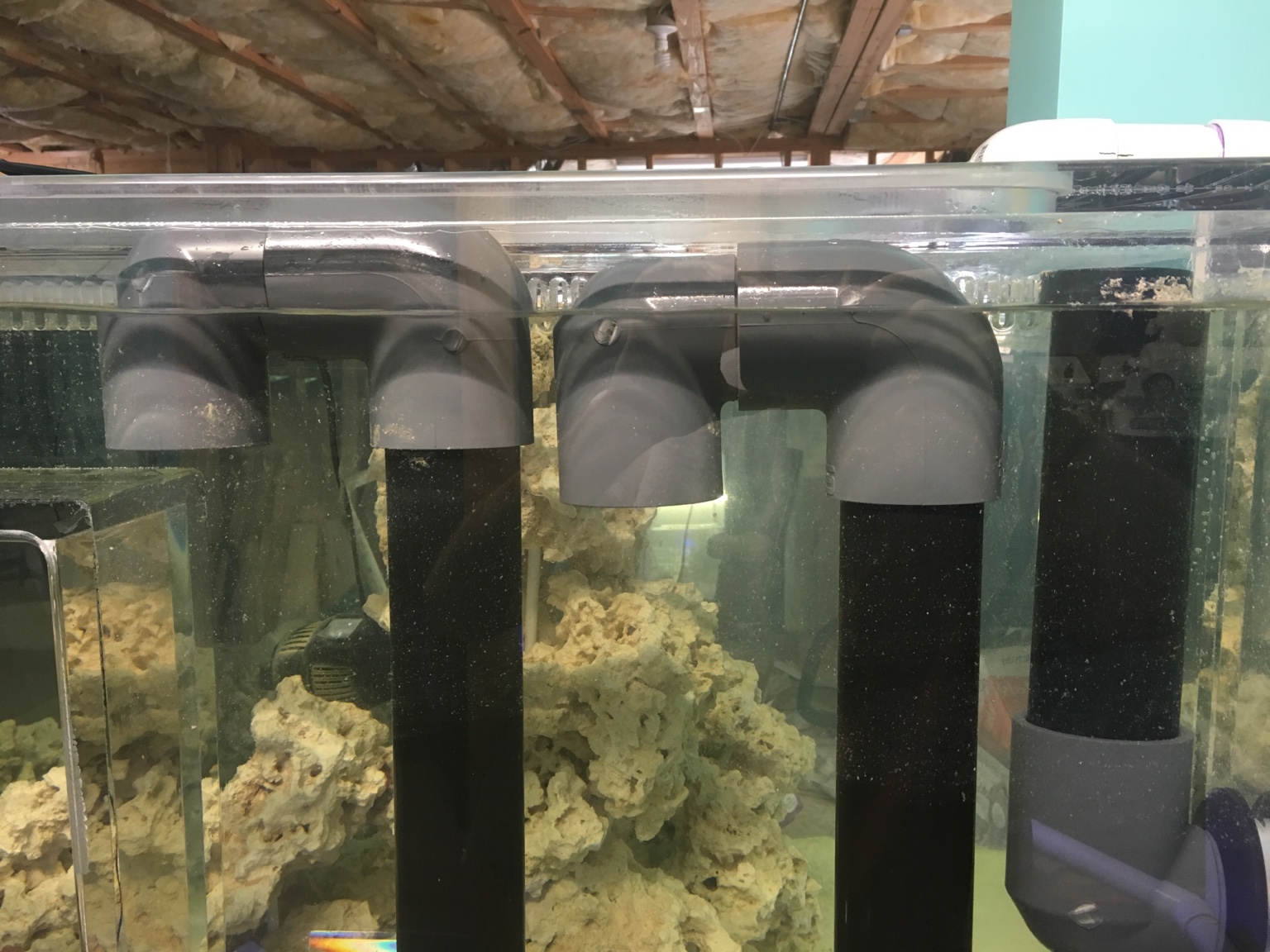
Crack it a hair open, and I mean just a tiny tiny hair on a decent cepex calve and after about 5*+ minutes it eventually get to here and starts gurgling. I'm thinking my trickle tube on the left is too high?

Crack it a hair open, and I mean just a tiny tiny hair on a decent cepex calve and after about 5*+ minutes it eventually get to here and starts gurgling. I'm thinking my trickle tube on the left is too high?

Floyd R Turbo
Either busy or sleeping
Both your OC and siphon are way too high IMO
Siphon can be all the way at the bottom of your box. Literally, just enough pipe (black, in your case) to insert into the bulkhead and then into the first 90 and that's it.
OC can be just a hair above it or even at the same level. But I don't see an airline on your OC?? That is what keeps it from siphoning. You run the airline up to just below the emergency and that kicks the OC over to siphon when the level gets close to the emergency pipe
Siphon can be all the way at the bottom of your box. Literally, just enough pipe (black, in your case) to insert into the bulkhead and then into the first 90 and that's it.
OC can be just a hair above it or even at the same level. But I don't see an airline on your OC?? That is what keeps it from siphoning. You run the airline up to just below the emergency and that kicks the OC over to siphon when the level gets close to the emergency pipe
Outdrsyguy1
New member
gotcha, thanks Floyd!
I had them higher because I didn't want my whole overflow to drain down on a power shutdown (it's a 10' long overflow so it holds a decent amount of water).
I'll get that anti-siphon tube done this weekend, just need to hit up bean's website for the parts.
I had them higher because I didn't want my whole overflow to drain down on a power shutdown (it's a 10' long overflow so it holds a decent amount of water).
I'll get that anti-siphon tube done this weekend, just need to hit up bean's website for the parts.
Floyd R Turbo
Either busy or sleeping
not sure what you mean, i.e. why you are worrying about draining the overflow box?
BTW you have a seam separating in those pics. Vertical seam to the left of the OC.
BTW you have a seam separating in those pics. Vertical seam to the left of the OC.
Outdrsyguy1
New member
yes, i didn't want to drain the entire overflow on shutdown.
What do you mean by vertical seam? an issue with my tank or how the pics appeared on the page?
What do you mean by vertical seam? an issue with my tank or how the pics appeared on the page?
yes, i didn't want to drain the entire overflow on shutdown.
What do you mean by vertical seam? an issue with my tank or how the pics appeared on the page?
i agree it's not worth draining that whole chamber on shut down, at least not on an internal overflow. on an external that's not as big of a deal.
again, i'd ditch the double-90s entirely on the siphon line. All you need is a strainer, and it can be 6" from the top, so it wont drain the whole overflow, just 6" worth.
Is there an airhole drilled into your open channel? It's hard to tell from the pics.
I think he's referring to that seam to the left of your open channel, whatever that acrylic thing there is.

sleepydoc
Team RC
The steady state level in the overflow is determined by 2 things: The level of the open channel and to a lesser extent the valve on the siphon.
Consider how the Bean is designed to operate - the siphon takes the majority of the flow with the open channel taking the flow above what the siphon can't handle.
Imagine that the siphon is established and the siphon flow and the return pump flow were perfectly matched, the water level could be anywhere between the inlet to the siphon and the ledge of the open channel (the point at the top of the inverted U where the water just makes it over the top to go down the standpipe.)
Now consider that the flow is slightly greater than the siphon can handle. The water level will rise until it starts making it over the ledge of the open channel. The more flow the open channel needs to handle, the higher the water will rise. This will continue until the flow in the open channel is 'maxed out,' at which point the water level rises to the level of the dry emergency.
For an external overflow like you describe, you don't necessarily need the inverted U, but if you omit it, the opening to the siphon pipe needs to be far enough below the surface that it doesn't entrain air. As Outdrsyguy1 noted, the further down in the box the siphon opening is, the more water will drain out when the power is cut. As long as your sump can handle the volume this isn't an issue; it should start back up again either way, but if you are interested in minimizing the amount that drains down, the inverted U will allow the opening to the siphon channel to be placed higher in the box than a straight open pipe.
I agree with Floyd - the pipes are too high in the box
Consider how the Bean is designed to operate - the siphon takes the majority of the flow with the open channel taking the flow above what the siphon can't handle.
Imagine that the siphon is established and the siphon flow and the return pump flow were perfectly matched, the water level could be anywhere between the inlet to the siphon and the ledge of the open channel (the point at the top of the inverted U where the water just makes it over the top to go down the standpipe.)
Now consider that the flow is slightly greater than the siphon can handle. The water level will rise until it starts making it over the ledge of the open channel. The more flow the open channel needs to handle, the higher the water will rise. This will continue until the flow in the open channel is 'maxed out,' at which point the water level rises to the level of the dry emergency.
For an external overflow like you describe, you don't necessarily need the inverted U, but if you omit it, the opening to the siphon pipe needs to be far enough below the surface that it doesn't entrain air. As Outdrsyguy1 noted, the further down in the box the siphon opening is, the more water will drain out when the power is cut. As long as your sump can handle the volume this isn't an issue; it should start back up again either way, but if you are interested in minimizing the amount that drains down, the inverted U will allow the opening to the siphon channel to be placed higher in the box than a straight open pipe.
I agree with Floyd - the pipes are too high in the box
Outdrsyguy1
New member
thanks a ton everyone, i need to tweak it and see how things go. I'll drill the siphon line hole and install the fittings and move things down a bit.
thanks a ton everyone, i need to tweak it and see how things go. I'll drill the siphon line hole and install the fittings and move things down a bit.
the hole is only drilled in the open channel/trickle line (the taller standpipe with the double-90s), NOT the lower siphon line (the lower pipe with the double 90s)
pfoxgrover
New member
For those that are using the double elbows in place of a TEE, are you gluing them permanently in place?
For those that are using the double elbows in place of a TEE, are you gluing them permanently in place?
no, don't glue anything inside the overflow box.
sleepydoc
Team RC
If you leave everything unglued in the box, make sure that your sump can handle the volume if the entire volume of the box drains down.
Also, be aware that for the siphon channel any unglued joints may let air in and either cause noise or interfere with the siphon. (This isn't a given but can happen depending on your fittings
Sent from my iPhone using Tapatalk
Also, be aware that for the siphon channel any unglued joints may let air in and either cause noise or interfere with the siphon. (This isn't a given but can happen depending on your fittings
Sent from my iPhone using Tapatalk
pfoxgrover
New member
Ok. Thanks for the help!
Similar threads

- Replies
- 3
- Views
- 243
- Replies
- 2
- Views
- 1K

- Replies
- 4
- Views
- 985

