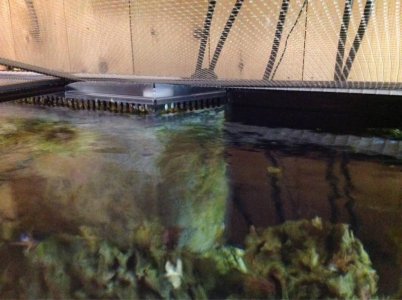
I posted this in another topic several months ago... My "lid" for the most part, keeps jumpers out of my overflow. I also have my overflows nearly full, so it isn't so bad if they get in there.
I gave this a lot of thought and tried several things over the years. I though it would be helpful to share my lessons learned:
- Black vs "clear" netting: Use black. It looks better from the top (it's easier to look through a black screen than one that appears nearly white) and may actually block less light. The black netting I have has 0.007" nylon lines whereas the "clear" I bought for this project has 0.011" lines.
My netting is 1/4". I think I bought it from a nursery as a goldfish pond net. It was cheap, much cheaper than the "upgraded" clear I bought and threw away. I wouldn't use 1/2". My jumpers are a diamond goby and possibly my wrasses. They could easily get stuck in or pass through a 1/2" hole.
- Aluminum screen frames - work well, but need a key modification to route wires (see below). Home Depot had brown frames and corners, which match my tank nicely.
To route your wire(s), you can make an inside corner by turning one of the screen frame corners around. See the picture below.
Another lesson learned: If you do this, you will not have a square frame when you are done as the screen pulls the poorly supported corner out of shape.
Solution: Reinforce the corner with a piece of acrylic. I also like to shield my overflows from the light to minimize growth in them, so I painted the underside of my acrylic black. By attaching the acrylic with silicone, I made a nice strong corner, with a light-block for my overflow and an area to route my cables.
Another lesson learned. When attaching the acrylic corner, make the frame a little out-of-square. That is, have the corner with the acrylic piece about 1/8" towards the outside of the tank compared with the front corner. The silicone will flex a little, and pull the frame into exactly square when the screen is drawn.
One last lesson learned: You need a thick screen spline as there isn't much material from the black netting to fill the frame channel. The spline I used was the largest that Home Depot carried, 0.175".
Notice how this produces a nice looking top to protect your fish, provide great top viewing and minimizes light blocking. By having the cord notch in the back corner, it easily slides towards the center for feeding. I have used 2-piece designs for each side in the past, but I found it was easy for one to slip into the tank when feeding. This approach is totally secure in place or slid towards the center.
This is how it looks where the wire leaves. Before taking this picture for this answer, I had no idea how much I had worn the top of my frame over the past 20 years.

I guess I need to break out the ole touch-up kit I bought way back when. The acrylic is a nice shiny black - it's just dusty with a drop of dried saltwater on it in this picture.
This is how the bottom of my frame looks where you can see the upside-down frame corner and how I attached the acrylic piece. I am really happy how this project turned out. I hope you find it helpful.