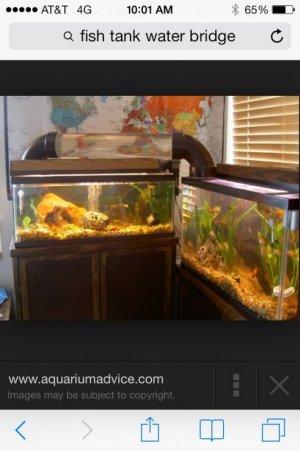
Sump drain and gravity question

Refugium feeds into sump by gravity. Notice the stack pipe over the drain line. Creates a Venturi effect to keep the flow continuous

 
I see that the OP clarified and it won't be an issue but felt the need to add...

Physics is Physics. If the 2 tanks are vat the same level, so will the water. Using 2 pumps WILL end in a flood, it's just a matter of when. Even 2 identical pumps will eventually flow at different rates, and unless you are there to monitor them 24/7/365 that idea will fail.

I disagree. With two pumps that you can adjust the speed on the tanks don't have to have the same level in them. If the output is faster then the input the sump will run lower. Also if the pumps run at the same speed you won't have an over flow the level will stay the same in the sump. As far as drift in pump speed you could calibrate the pumps and use flow meters. Level sensors could be used to prevent over flow and stop the pumps. A computer could monitor the system the same way people use computers to track PH and ect. The only way your going to run with two tanks level is by using pumps. Trying to say it has to be below is a load of BS. It's 100% a better set up but it does not have to be done that way. You don't have to gravity feed all systems. In fact most places that use tanks with liquid don't.

Two balanced pumps won't work. A sensor may stop a flood, but two pumps can't be perfectly calibrated to account for every anomoly that might be encountered (build up/clogs, etc). It would eventually fail.
 
You don't know what your talking about I worked with systems that do all kinds of stuff like this for years. I've seen pumps of all kinds set up to do all kinds of stuff and none of the set ups were with one tank higher then the other feeding it by gravity. As far as clogs you have to check your pumps rather it be one or two. Now that I think about it this could also be done with one pump and a water bridge as well.
 
You don't know what your talking about I worked with systems that do all kinds of stuff like this for years. I've seen pumps of all kinds set up to do all kinds of stuff and none of the set ups were with one tank higher then the other. As far as clogs you have to check your pumps rath it be one or two. Now that I think about it this could also be done with one pump and a water bridge as well.

As long as you add the breathing stack to the gravity drain line you won't have a problem and I agree with you that you don't need two pumps
 
Two level tanks
 

Attachments

  • image.jpg
    image.jpg
    51.2 KB · Views: 29
I work at wineries where they had sumps that were 10ft below the floor and you had to pump the wine up. The intake went straight down after a 90• and they used impeller pumps. At my job we run two pumps inline together which are tuned to each other. You can have two pumps work together guys. I've seen it done many times.
 
Sure - you can use two pumps to move water in one direction - nobody is saying you can't. What I (and others) are trying to get across is that although using pumps in each tank to move water back and forth CAN be done, it WILL NOT WORK LONG TERM for our purposes using standard off the shelf aquarium pumps. Sooner or later (sooner) one will pump faster (or slower) than the other, creating an imbalance of flow. What happens next is water on the floor.

Sure, I suppose if you want to completely clean the entire plumbing system frequently (weekly?) and then load test each pump before returning it to use, you could make it work. Who would want to???

Now - to the OP's question (now that it has been clarified) - since the sump is sitting lower than the DT (not necessarily underneath) it is a simple matter of using the appropriate sized return pump in the sump to move the water back to the DT. If at all possible, avoid 90 degree turns to make the flow smoother. This is how pretty much every sump I have ever seen or heard of is set up.
 
Sure - you can use two pumps to move water in one direction - nobody is saying you can't. What I (and others) are trying to get across is that although using pumps in each tank to move water back and forth CAN be done, it WILL NOT WORK LONG TERM for our purposes using standard off the shelf aquarium pumps. Sooner or later (sooner) one will pump faster (or slower) than the other, creating an imbalance of flow. What happens next is water on the floor.

Sure, I suppose if you want to completely clean the entire plumbing system frequently (weekly?) and then load test each pump before returning it to use, you could make it work. Who would want to???

Now - to the OP's question (now that it has been clarified) - since the sump is sitting lower than the DT (not necessarily underneath) it is a simple matter of using the appropriate sized return pump in the sump to move the water back to the DT. If at all possible, avoid 90 degree turns to make the flow smoother. This is how pretty much every sump I have ever seen or heard of is set up.

And I believe is illustrated by the pic I posted of my sump.
I'm using an external return pump because it was the best at the time for working with 10 feet of head pressure
 
Sure - you can use two pumps to move water in one direction - nobody is saying you can't. What I (and others) are trying to get across is that although using pumps in each tank to move water back and forth CAN be done, it WILL NOT WORK LONG TERM for our purposes using standard off the shelf aquarium pumps. Sooner or later (sooner) one will pump faster (or slower) than the other, creating an imbalance of flow. What happens next is water on the floor.

They have been using feed and return pumps with this type of set up for years where I work. Also I'm sure there are pumps that would do this that are made for fish tanks. There would be no flood with level switches so I don't know you seem to think that. You might have to buy pumps that cost more. You have clean your pumps no mater how many you have unless you just wait for your pump to plug before cleaning it. The point is this can be done. I don't know why your talking about the same crap that we already know can be done.
 
Last edited:
Oh I see use the level switches so the if the level gets out of balance it turns the pumps off.

Or build an integrated control with two variable speed drive pumps tied into level control. Then incorporate a control valve onto a spill back loop to a surge/make up tank. This would all need to programmed into a PLC or DCS control scheme. Or just lower the sump.
 
You should have no issue with it. If the water were to stop in that 4-5' horizontal pvc it would eventually get enough water pressure behind it to keep it flowing. Except that won't ever happen, physics is in your favor as long as the DT is above the water level of the sump.
 
Wow! This it's getting heated! You could use two pumps. Yes. Is it recommended? No. It will require additional fail safes and cost more money and there is no need in your case. To move water from one container to another, you just need a difference in levels. Gravity will take care of the rest. The greater the difference in the final levels, the greater your flow will be regardless of the path, only noting that the more bends and fittings you add, the more friction loss you'll have. That said, you could plum your path up, higher than even the display tank and gravity will still work because the force required to push the water up is offset by the force of the water pulling down on the return side as long as there is a siphon. (Consider how hang on back over flows work) the simplest plumbing however would be without a siphon and remain below the display tank water level. If the difference isn't great enough to accomplish your needed flow rate then you simply increase the size of your plumbing. Adding a second pump would be a LAST resort. There's no need to over complicate it
 
Back
Top