
You are using an out of date browser. It may not display this or other websites correctly.
You should upgrade or use an alternative browser.
You should upgrade or use an alternative browser.
T5 hood cooling system
- Thread starter Roger30
- Start date

Roger30
Premium Member
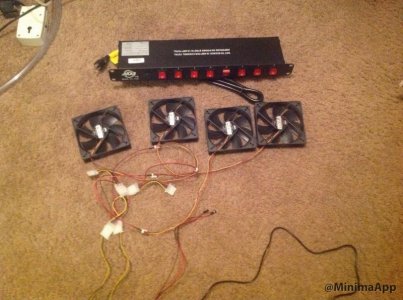
I guess I need a bit more detail. I am daisy chaining the four fans together and connecting them to one ac/doc convertor . This daisy chain is my concern. I am going to mount the fans in front of the hood blowing air out the back of the hood. The wire will run above the lights. The connectors on the daisy chain will be under the hood and I am worried they will build up moisture. Is the anything I can use to cover these connector from the element under the hood?

mcgyvr
New member
Sure..heat shrink tubing...electrical tape.. silicone caulk.. bubble gum,etc..
Fans should be wired in parallel with the power supply.. I hope you aren't implying "in series" by "daisy chain"
and make sure your power supply can supply at least 125% more than the sum of the currents of all the fans..
Fans should be wired in parallel with the power supply.. I hope you aren't implying "in series" by "daisy chain"
and make sure your power supply can supply at least 125% more than the sum of the currents of all the fans..
mcgyvr
New member
Cool! Thanks! I think I have some bubblegum I can use! That way I wont need screws to hold the wires! Why do I need 125% more power then the sum of the fans?
Its never a good idea to run a power supply at "FULL SPEED".. just like a car engine.. It will drastically shorten the life of the power supply and could cause other safety issues (fire)..
Most power supplies should have some "protection" built in but with constant voltage power supplies like this its commonly recommended to size it at 125% or more..
So for a 10 amp load get a 12.5 Amp power supply,etc...


uncleof6
Active member
Is this a DIY T5/HO setup or did you put a manufactured fixture inside a hood? Are the lamps normally driven or overdriven? If the latter, the ballasts need to be replaced with proper T5/HO ballasts, which would most likely solve your temperature issues. Finally, if a fixture enclosed in a hood, does the fixture have active cooling? A T5/HO fixture needs active cooling to operate properly...and manufactured fixtures should not be enclosed in a hood in the first place, rather suspended over the tank... One of the benefits of T5/HO is that becasue the heat "radiation" is so low, they can be run sitting on the top rim of the tank, without excessively raising the temp of the tank...
So how your system is put together, determines what will be needed to "cool" the lights down...
With T5/HO lamps, you don't just indescriminately add 4 fans in series to cool them by blowing air through the hood. Although that works for T8, T12, etc., T5/HO has very specific cooling requirements, due to the "temperature regulator" or "cold spot" location. The amount that the "cold spot" is above ambient temperature, determines the temperature of the lamp.
By looking at how the ATI PowerModule is cooled, (best fixture on the market until they got silly by adding leds) you can get an idea of what needs to be done. Several fans blow down into the top of the fixture at one end, the air moves to the other end of the fixture, cooling the ballasts, then down over the label end of the lamps, (the location of the "cold spot" usually) and again to the opposite end of the fixture and out the end.
You can see that the lamps are cooled with pre-heated air, (by the ballasts) and the warm air moves along the length. Blowing cool air at or along the middle of the lamp will cool it too much. Too much cooling will reduce the lamps output, and too little cooling will reduce the lamps output, reduce the lamps useful life, and if the lamps are being overdriven, there is the risk of the lamp catastrophically failing by having holes sucked in them. (Why the IceCap 660 *a T/12VHO only ballast* T5/HO venture was a failure.)
For a DIY setup, a fan blowing front to back (or back to front) across the lamp ends/endcaps, is all the cooling you want. At both ends is fine and covers the bases if the cold spot happens to be at the non-label end of the lamp...
So how your system is put together, determines what will be needed to "cool" the lights down...
With T5/HO lamps, you don't just indescriminately add 4 fans in series to cool them by blowing air through the hood. Although that works for T8, T12, etc., T5/HO has very specific cooling requirements, due to the "temperature regulator" or "cold spot" location. The amount that the "cold spot" is above ambient temperature, determines the temperature of the lamp.
By looking at how the ATI PowerModule is cooled, (best fixture on the market until they got silly by adding leds) you can get an idea of what needs to be done. Several fans blow down into the top of the fixture at one end, the air moves to the other end of the fixture, cooling the ballasts, then down over the label end of the lamps, (the location of the "cold spot" usually) and again to the opposite end of the fixture and out the end.
You can see that the lamps are cooled with pre-heated air, (by the ballasts) and the warm air moves along the length. Blowing cool air at or along the middle of the lamp will cool it too much. Too much cooling will reduce the lamps output, and too little cooling will reduce the lamps output, reduce the lamps useful life, and if the lamps are being overdriven, there is the risk of the lamp catastrophically failing by having holes sucked in them. (Why the IceCap 660 *a T/12VHO only ballast* T5/HO venture was a failure.)
For a DIY setup, a fan blowing front to back (or back to front) across the lamp ends/endcaps, is all the cooling you want. At both ends is fine and covers the bases if the cold spot happens to be at the non-label end of the lamp...

Roger30
Premium Member
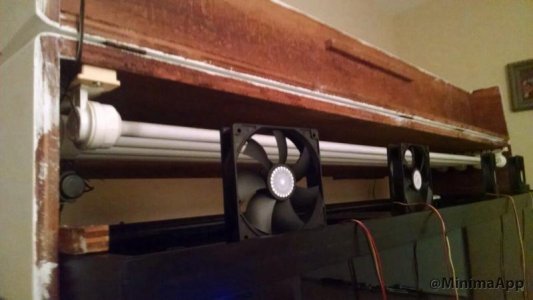
So my hood is a DIY wooden hood, 60"w x 20"d x 8"h with four DIY 80w t5 running on a 660 ice cap screwed in back of the hood. I want to place the fans in front of the hood (screwed into the top of the hood to blow air across the water, out the back and cool off my tank. The. Temp is reaching 83 and won't cool off unless I open the hood. I am hoping the fans will cool it with out me having to open the hood. The other idea I had was to place them on the back of the hood two blowing inward and two blowing outward.
uncleof6
Active member
View attachment 292109
So my hood is a DIY wooden hood, 60"w x 20"d x 8"h with four DIY 80w t5 running on a 660 ice cap screwed in back of the hood. I want to place the fans in front of the hood (screwed into the top of the hood to blow air across the water, out the back and cool off my tank. The. Temp is reaching 83 and won't cool off unless I open the hood. I am hoping the fans will cool it with out me having to open the hood. The other idea I had was to place them on the back of the hood two blowing inward and two blowing outward.
Replace the IceCap 660 with proper T5/HO ballasts....the 660 is a T12/VHO ballast, it has improper current limiting, and is not safe or proper for running T5/HO lamps.....Your temperature issues will go away...yes it costs more money than just adding fans, but you are going to spend more money replacing T5/HO lamps, and the possiblity of glass shards if the lamp decides to fail worse than just sucking holes in itself.
Even with proper ballasts however, the system will benefit from correct active cooling. T5/HO is a completely different technology than T8/T12, and you can't do the same stuff to them.
uncleof6
Active member
Thanks for all the great info! Lots to think about. Any particular ballast brand you would recommend?
Advance Transformer are the most "popular" and also the most reliable. Osram-Sylvania are also good quality. There are some European brands that work well also, and ATI uses those ballasts, but they are not always easy to come by...unfortunately Advance doee not make a 4 lamp 80 watt T5 ballast. None market such a ballast, as far as I know, because the 80 watt lamps are not very popular.... For perspective, single lamp 80 watt ballasts average $25 each, and most quad lamp ballasts (for lower wattage lamps) average $80 each.
Fulham ballasts, the workhorse, is not a proper T5/HO ballast either, but is commonly recommended. I don't recommend their use, and Fulham ballasts are the least reliable.

sreefs
Member
I agree it would be a good idea to change your ballasts. I would go with the Advance and also add a fan or two. How many ice cap 660 ballasts are you running, don't go by the number of inches it says on the ballast, that is for T12/VHO's? I believe one is good for 3 - 80 watt t-5. The ice cap 430 runs 2 - 80 watt bulbs but doesn't over drive them like the 660. Back in the beginning many people thought using the IC 660 was a good thing to over drive the T-5's, but as Uncleof6 said it is much better to use a ballast that is made for T-5's.
sreefs
Member
The wiring diagram on the ballast is for T12 VHO bulbs not T5's. That said contact coralvue they may be able to help you with the correct way to wire a 660 with T-5's if you are going to use the ballast. I think T-5's are harder to start than VHO's that is why ice cap recommended only running 3 - 60" T-5s on the 660 and two on the 430 ballast. I know how the 430 is wired for two 60" T5's it doesn.t over drive the bulbs, but not the 660. If you search for Grim reefer post on here, he had many write up's on T-5's. I am sure someone on here knows the correct way to wire that ballast for 80 watt T'5s.
uncleof6
Active member
FYI: the IceCap 430 ballast is also a T12/VHO ballast. It does not provide the proper current limiting or start characteristics that are inline with the T5/HO standard. There is no proper way to wire either the 660 or 430 to run any number of T5/HO lamps, becasue both are improper ballasts. Both ballasts over drive T5/HO lamps, both ballasts casue damage to the filiments by utilizing an instant start characteristic with lamps that are designed for a programmed start... (the filiments reach a specific temperature before the lamp fires up,) and cause further damage to the filiments by allowing too much current to flow which causes a high operating temperature of the lamp. The improper current limiting can also cause holes to be sucked in tube itself. In the real electrical field, such a misuse would be electrical code violations, Although the parts may have a UL listing, such fixtures with improper usage of ballasts would be unable to receive a UL listing. Though in the US, such listing is not required, which is how these companies get away with it.
Ultimately, IceCaps failure to modernize their products, or keep up with the times for instance remaining stuck on producing the T12/VHO ballasts, sold at a premium price far higher than proper T5/HO ballasts, rather than producing a ballast that provided the specific characteristics required by T5/HO, lead to the companies downfall, (along with rebadging low quality products, sold at a premium price) though they attempted to mitigate the problem by having special "T5/HO" lamps produced using T12 filiments. Officially IceCap blamed LED lighting, which is almost laughable as LED is still not a viable competitor to either Metal Halide or T5/HO, except in the halls of forum hype. Because NORMALLY DRIVEN T5/HO quickly became the viable alternative to Metal Halide systems, everyone tried to jump on the band wagon, and the marketing hype went into overdrive....CorralVue is currently trying to piggy back off the hype over the IceCap ballasts...since the aquarium hobby is marketing hype driven rather than being driven by an interest in science, it is easy to keep a hefty following, despite the fact that it is a misuse of the equipment.
The simplest way to spot an improper ballast for T5/HO is to look at the start type of the ballast: Programmed start—yes. Instant start—no...
Ultimately, IceCaps failure to modernize their products, or keep up with the times for instance remaining stuck on producing the T12/VHO ballasts, sold at a premium price far higher than proper T5/HO ballasts, rather than producing a ballast that provided the specific characteristics required by T5/HO, lead to the companies downfall, (along with rebadging low quality products, sold at a premium price) though they attempted to mitigate the problem by having special "T5/HO" lamps produced using T12 filiments. Officially IceCap blamed LED lighting, which is almost laughable as LED is still not a viable competitor to either Metal Halide or T5/HO, except in the halls of forum hype. Because NORMALLY DRIVEN T5/HO quickly became the viable alternative to Metal Halide systems, everyone tried to jump on the band wagon, and the marketing hype went into overdrive....CorralVue is currently trying to piggy back off the hype over the IceCap ballasts...since the aquarium hobby is marketing hype driven rather than being driven by an interest in science, it is easy to keep a hefty following, despite the fact that it is a misuse of the equipment.
The simplest way to spot an improper ballast for T5/HO is to look at the start type of the ballast: Programmed start—yes. Instant start—no...
Last edited:
Roger30
Premium Member
The original plan was to use these t5 while I saved for LEDs. However, doing research on sps, t5 seem to be the way to go. Now the question is do I spend the money to fix these t5 to the proper ballast or go led. I was not to worried about the reduced lifespan since the t5 set up was temporary but the potential fire hazard is not cool
uncleof6
Active member
The original plan was to use these t5 while I saved for LEDs. However, doing research on sps, t5 seem to be the way to go. Now the question is do I spend the money to fix these t5 to the proper ballast or go led. I was not to worried about the reduced lifespan since the t5 set up was temporary but the potential fire hazard is not cool
My recommendation based on direct experience, is to fix the T5/HO, and forget the LEDs. LEDs are not what they are hyped to be, and T5/Metal Halide are still the predominant light sources for reef tanks. There is a thread in the lighting forum: "How many are considering dumping the LEDS and returning to Metal Halide" (paraphrased.) That should tell you something.
Similar threads
- Replies
- 0
- Views
- 123

- Replies
- 2
- Views
- 264
- Replies
- 4
- Views
- 2K

