Walt's Official A. thiellei Page

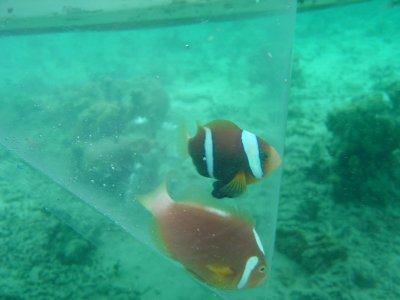
Any affiliation with Blue Zoo? That's where that one came from. Perhaps you provided it? If so, I'd like to confirm some details.
 
It looks like the fish I had and it is very possible that they bought it from me, I don't remember now. It was a few years ago when I got it. I think that I got it from Cebu although it may have come from the Solomon Islands. I have had a few similar to that from the Solomons but I think that from there they are a little chunkier and this one was more streched out and I think came from Cebu.

Dave
 
Cebu is consistent with what I was told.... and my theory about thiellei/leucokranos origin.
 
I think that one did come from Cebu but they are not very common from there. I get many more from Solomon that have somewhat similar markings along with the "Leucokranos or cap clown" that are very variable in markings. What folks call "Thiellei" markings are more common from Solomon than Cebu but have a little different body shape from Solomon. Your clown was more stretched out more like the ocellaris body shape. The Solomon ones are generally more "chunky" although they do sometimes come in with the sandaracinos streched shape.

Dave
 
This is contrary to what I've heard from other sources. If you have photos of what you're describing, I'd love to see them either here or via E-mail....
 
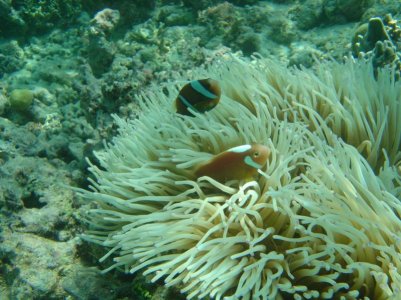
My guess is that your fish may be a sandaracinos / ocellaris mix where the ones from the Solomons may be a sandaracinos / melanopus mix. It is not uncommon to see a Mertensi anemone with sandaracinos clowns on a reef step down where there is a large colony of melanopus clowns on the reef flat just above the step down where the sandaracinos are. The melanopus live in a large colony and are all over the place while the sandaracinos will have their eggs on the rock wall just inches down from the melanopus colony. Cross fertilization would seem to be quite possible due to how close together they are. Co-habitation of clown species is common in the Solomons also but less so in other locations.

Dave
 
When I get another "theilli" type clown in I will take pictures of it to show you what I mean. I don't generally take pictures of what comes in, I did the one from Cebu because I thought it was different shape and special. I should have something in the next month or two, they are not terribly rare.

Dave
 
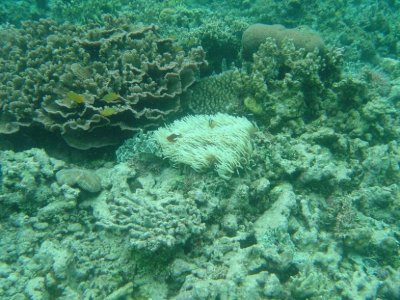
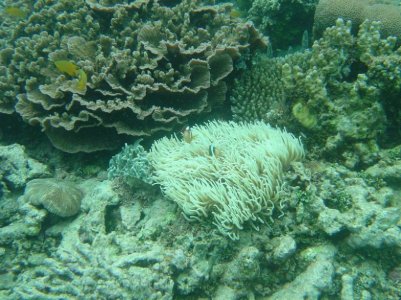
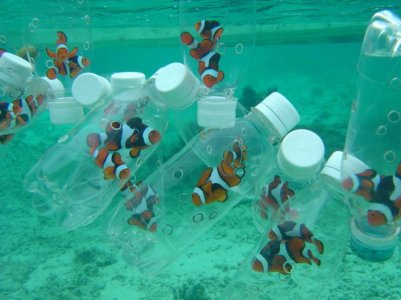
Here are a few pics of clown species co-habitating and a pic of some nice percula pairs that we collected.

Dave
 

Attachments

  • cohab 1.jpg
    cohab 1.jpg
    89.6 KB · Views: 20
  • cohab 2.jpg
    cohab 2.jpg
    104.5 KB · Views: 18
  • cohab 3.jpg
    cohab 3.jpg
    104.1 KB · Views: 17
  • cohab 4.jpg
    cohab 4.jpg
    94.3 KB · Views: 21
  • perc pairs.jpg
    perc pairs.jpg
    61.9 KB · Views: 19
Pretty cool Dave. I'm looking for a male for my number three thiellei. "Rare" seems to be a bit of a relative term....
 
Here are a few pics of clown species co-habitating and a pic of some nice percula pairs that we collected.

Dave

Very sweet pics of co-habitation. I don't know if I would have wanted to be the percs squeezing into those bottles.

Lube up with some vaseline and PUSH...
 
It may be a little hard to see from the picture but the bottles are cut down their length, just push in on the side and a large hole opens up to put the fish in. Release the bottle and it returns to original shape and the clowns are inside with no drama. Also easy to remove them this way, would be impossible to remove trying to get them out the top opening. This is an easy way to make collecting bottles that are available almost anywhere at very little cost.

Dave
 
Posted to MBI this morning:

Getting a smackdown education. The following facts didn't add up in my head 'till this morning:

1. I had a skimmer overflow 4-5 days ago.
2. Female had a couple scales scuffed for about the last three days. I thought it was because I break the bottoms out of the flower pots and maybe I didn't sand the rough edges as well as I should. I did a heavy display cleaning about three days ago too and swapped flower pots assuming that it would rectify the problem of sharp edges.
3. Having "slept on it" and being concerned about the scales getting worse, I took Tal's advise this AM and swapped the flower pot to one of my tile triangles.
4. I actually spent some time staring at the tank (I rarely take the time to do this.)
5. I came to realize that my female is getting sick as a result of the skimmer overflow.
6. Dropped a 7 gallon bucket of FW into the sump for some dilution (140 gallon system.)
7. Dropped the temp setting from 82 to 80. I will drop it to 78 tonight. I know many people have the philosophy that they should keep a high temp when fish are sick to speed the life cycle of any pathogens but I think the opposite. I want to slow the life cycle of the pathogen to slow it's progression and slow the fish's metabolism to reduce stress.
8a. I will also drop the salinity of the system to 1.009.
8b. I have not yet decided but am considering dismantling and cleaning the sump while running the display with a couple power filters till this clears up... or maybe as a permanent change to my approach.

Lessons learned:
1. I need to spend more time in front of the tank.
2. I am considering simplifying the system by switching to bioballs and removing the skimmer or #8b above.
 
Luckily it was nothing major. A little fungal infection from the dirty skimmate. Still haven't done a WC and she already looks almost completely healed. I'm guessing she did get an abrassion. Whether it was intentional or from scratching is unclear. I have water mixing for tomorrow though.

They are adjusting to the tiles well. They pretty much wouldn't come out yesterday. Today they're acting more normal.
 
Penelope has made a full recovery. Both seem to be adjusted to the new house yet still quite inquisitive about it. Pedro keeps doing burnouts on the textured surface.


IMG00072-20120115-1900.jpg


IMG00073-20120115-1900.jpg


IMG00074-20120115-1901.jpg
 
Looks good. Like the way you glued/siliconed the tiles together.

I've use the same tiles for my mated pairs of Rod's Onyx and Picasso Percs.

The Picasso's just began mating, and I'd like to get them laying on a tile surface so that I can get the eggs to someone who has the time and experiance to raise the fry. The female Picasso just knocks the tile away. She'd have a much harder time doing that with the set up you made.

Glad to hear everything worked out.

Nick
 
I can't afford any accidents with these guys. A friend of mine lost a female when a tile fell on her. I made a couple of these so I can swap them during cleanings. I can flip them over to bubble any clutches either in an A frame position or on their side so the tile is vertical.
 
Back
Top