
You are using an out of date browser. It may not display this or other websites correctly.
You should upgrade or use an alternative browser.
You should upgrade or use an alternative browser.
Anemone too big
- Thread starter timjoemak
- Start date

bues0022
New member
I am hesitant to say this is wrong but I do know of an example of a bta that was in my friend'd 55 gallon tank and was getting bigger and bigger and would not split. When she reloacated it to a 180 gallon tank it finally split. She gave me one of the halves and it split for me many times. She recently broke down her 180 and I inherited the other half. Her tank wasn't excessively clean but she did tend to have very stable conditions. I think stability/instability is key to whether they split or not.
So, there might be a truely solitary form that never splits but given my experience I have to question it. I have a feeling it has more to do with conditions.
I agree with what was said earlier about a large water change and a relocation within the tank, but given what you said about it being fully stocked with corals and not wanting it to sting them, I would suggest a large water change and throw a powerhead on it or take one off to switch up the flow and/or move the light over a little. That may or may not get it to split for you. You could also try putting a string or rubberband around it's mid point.
Good luck!
I think you're both partially right. While there may not be true genetic variations of some that are solitary and won't split and others that are, I definitely can attest that some just tend to split more than others. I once knew of a RBTA that was 18+ inches across before it split. Then it grew to the same size before splitting again. In the same tank, he had a different RBTA that would split like clockwork once it got above 6". Same tank, same water conditions, but different sourced RBTA's.

WDLV
Skunk Hybrid Freak
Good point. The other half that I just got came with five GBTAs that obviously were splitting in her system. In the three weeks I've had them it has multiplied to 8-9. One split was an accident (trauma) and another I changed the tank it was in to see if I could induce a split easily. It did split.
MY GOODNESS, 3 weeks and they multiplied to 8-9! Imagine having RBTAs for that.. phew.. damn, well, I'm seriously thinking, that if the water change doesn't work in the next couple of days, I might have to resort with cutting it in half manually, I'm really afraid of the slime and stuff, and i'd probably go for the container to put them in, but I hope that the slime stuff won't cloud my tank now would it? ><
WDLV
Skunk Hybrid Freak
I will certainly be propagating those RBTAs once they are better established. These GBTAs have the most powerful sting I've seen on a BTA. I had trouble getting one off my finger the other day.
As long as you don't cut it in your tank and remember to rinse it in reef water before re-introducing it, I don't think you have much to worry about in terms of clouding.
I do think you might want to put it in a basket on the side of your tank until the pieces heal. Depending on how small you want it, you might consider cutting it into fourths. That seems to be common among those who like to propagate them regularly. Do that search on youtube. There really are some good how to videos.
As long as you don't cut it in your tank and remember to rinse it in reef water before re-introducing it, I don't think you have much to worry about in terms of clouding.
I do think you might want to put it in a basket on the side of your tank until the pieces heal. Depending on how small you want it, you might consider cutting it into fourths. That seems to be common among those who like to propagate them regularly. Do that search on youtube. There really are some good how to videos.
Actually I seriously think, cutting it manually might be the best option I have right now. And actually I'm thinking of cutting it into fourths! Well alright, so after I cut it, rinse it with my tank water, and I should be good to go? And of course place it in a basket or a plastic container?
Actually thinking of it, I AM pretty excited on trying this out, but the thing is what are the chances that the BTA won't survive with fourths?
Actually thinking of it, I AM pretty excited on trying this out, but the thing is what are the chances that the BTA won't survive with fourths?
bues0022
New member
Just be aware of the higher risk from cutting into smaller pieces. When cut in half, they generally make it well. In fourths, it seems as though there exists a much higher risk of one of the fourths dieing. I've also had one go through a CL and make it, but I didn't get lots of them back, just one, so many other pieces died. Good luck and post pictures!
bues0022
New member
IMO, you'll have better results with a brand-new sharp razor blade. There will be significantly less tissue damage to the tisssue directly surrounding the cut. Scissors shear the material past their shear strength to make a cut. If your scissors have any nicks or imperfections you might not cut in that area and end up with a less perfect cut. Remember, this is surgery. Make it as clean and perfect as you can. Surgeons use a scalpel for a reason - less damage with a sharper implement.

elegance coral
They call me EC
I am hesitant to say this is wrong but I do know of an example of a bta that was in my friend's 55 gallon tank and was getting bigger and bigger and would not split. When she reloacated it to a 180 gallon tank it finally split. She gave me one of the halves and it split for me many times. She recently broke down her 180 and I inherited the other half. Her tank wasn't excessively clean but she did tend to have very stable conditions. I tend to do a lot of large WCs. I think stability/instability is key to whether they split or not.
So, there might be a truely solitary form that never splits but given my experience I have to question it. I have a feeling it has more to do with conditions.
Good luck!
http://www.nhm.ku.edu/inverts/ebooks/ch34.html#reproduction
Quote from the link.
"In addition to sexual reproduction, some coelenterates undergo asexual reproduction. Entacmaea quadricolor is one of these. A polyp can divide longitudinally, resulting in two, somewhat smaller individuals, probably within the space of a few days. Each then grows to an appropriate size, divides, and so on. All descendants of the original anemone (the result of sexual reproduction) form a clone, a group of genetically identical individuals. In this species, each polyp is relatively small, but clonemates remain next to one another so their tentacles are confluent, and the associated anemonefish apparently regard them as a single large anemone.
This is so mainly for shallow-water individuals; those in deeper water grow large, and do not divide (see chapter 1). Several other species of actinians also have two different reproductive modes: small animals that clone and large ones that do not. This appears true of Heteractis magnifica, too. In the center of its range (i.e. in eastern Indonesia, on the Great Barrier Reef, in New Guinea), it occurs as single, large individuals. To the east and west (i.e. in western Indonesia and Malaysia, and in Tahiti), several to very many small individuals of identical colouration are typically clustered together, appearing to be a single large (or huge!) anemone. Based on their shared colour and their proximity, we infer that they are clonemates."
A quote from an E-mail I received from Dr. Daphne Fautin.
"And even for the two species of anemonefish host anemones that seem to divide in nature, differences from place to place make me think there may be more than one species of what we think is a single species of each or there may be differences among individuals. Thus, even an anemone that is thought to be able to propagate asexually (*Entacmaea quadricolor*, the bubble-tip, and *Heteractis magnifica*, the "Ritteri" anemone) may die from being cut up."
Just wanted to post something showing that I didn't make the whole idea up.
You may be right. The fact is that we don't know why some of these anemones split and others seem not to. It may be environmental. It may be genetic. There are many possibilities at this point. Who knows?
SNAKEMANVET
PREMIUM MEMBER
Good info elegance,my rose is big but my gbtas grow to about 5'' to 6'' then split.They are in the same tank as my rbta.We may never know exactly why .
WDLV
Skunk Hybrid Freak
http://www.nhm.ku.edu/inverts/ebooks/ch34.html#reproduction
Quote from the link.
"In addition to sexual reproduction, some coelenterates undergo asexual reproduction. Entacmaea quadricolor is one of these. A polyp can divide longitudinally, resulting in two, somewhat smaller individuals, probably within the space of a few days. Each then grows to an appropriate size, divides, and so on. All descendants of the original anemone (the result of sexual reproduction) form a clone, a group of genetically identical individuals. In this species, each polyp is relatively small, but clonemates remain next to one another so their tentacles are confluent, and the associated anemonefish apparently regard them as a single large anemone.
This is so mainly for shallow-water individuals; those in deeper water grow large, and do not divide (see chapter 1). Several other species of actinians also have two different reproductive modes: small animals that clone and large ones that do not. This appears true of Heteractis magnifica, too. In the center of its range (i.e. in eastern Indonesia, on the Great Barrier Reef, in New Guinea), it occurs as single, large individuals. To the east and west (i.e. in western Indonesia and Malaysia, and in Tahiti), several to very many small individuals of identical colouration are typically clustered together, appearing to be a single large (or huge!) anemone. Based on their shared colour and their proximity, we infer that they are clonemates."
A quote from an E-mail I received from Dr. Daphne Fautin.
"And even for the two species of anemonefish host anemones that seem to divide in nature, differences from place to place make me think there may be more than one species of what we think is a single species of each or there may be differences among individuals. Thus, even an anemone that is thought to be able to propagate asexually (*Entacmaea quadricolor*, the bubble-tip, and *Heteractis magnifica*, the "Ritteri" anemone) may die from being cut up."
Just wanted to post something showing that I didn't make the whole idea up.
You may be right. The fact is that we don't know why some of these anemones split and others seem not to. It may be environmental. It may be genetic. There are many possibilities at this point. Who knows?
Thanks bud. The answer is that I don't know. Just speculating.
BTW, I do know a public aquarist who has had success in H. magnifica division. So, I think that's a method that will eventually be seen more in the hobby. Ten years ago it was unheard of to see someone slice a BTA in half. Today it's becoming more commonplace. I think in another ten years the same that is true of BTA today will be true of H. mag. I am trying VERY hard not to keep any species that do not reproduce asexually.
I'm sure I will cave.
I will preface the following by saying that Dr. Fautin has been very generous with her time both with me and with other hobbyists who seek answers to their anemone questions.
That said you should consider the source. Dr. Fautin is a field expert. Not an aquarist. While there is some overlap between the two modalities, they are two very different expertices. I met her several years back at a local aquarium club meeting where she was a guest speaker. She seemed surprised when I described that I was propagating anemones (BTAs) in captivity. She does not approve of anemones being collected for the hobby due to their environmental impact both to the anemone populations and to the resulting impact to the anemonefish populations in the areas that they are collected. That said I got the impression that she was moderately pleased to see that people in the hobby are at the least trying to make our collection more sustainable through propagation and redistribution.
Sorry for going so far OT.
GUYS!!! TODAY IS THE DAY and i just did the fragging 20 minutes ago, rinsed the anemone to make sure the slime would not be stuck to it, and here are the pictures! Please tell me what you think. It's amazing how it just got fragged but the tips of the anemone are still bubbled. Are they going to heal really soon? Thanks a lot! 
Attachments
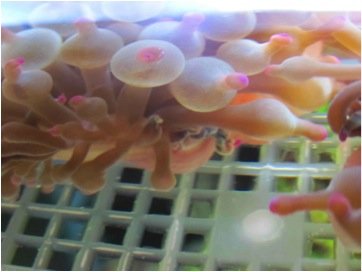
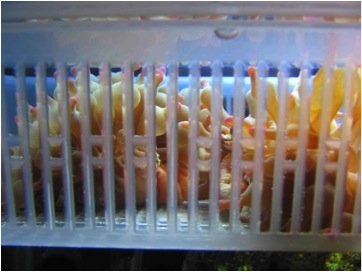
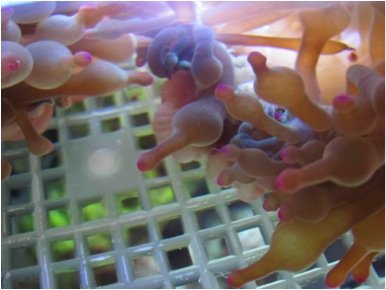
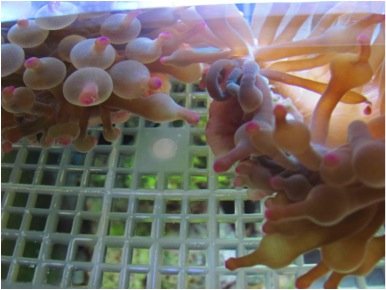
 well I don't know if that's a good thing or not
elegance coral
They call me EC
Dr. Fautin makes it well known that she is not a hobbyist. She is a scientist, specializing in anemones. I personally don't see this as a point to discredit her opinions on the subject, though. IMHO, she is our best source of information on the biology of sea anemones. Her knowledge is priceless to anyone wanting to learn about anemones. A great deal of our understanding of these animals, comes from the work Dr. Fautin has done, and her willingness to freely share her findings with us. I would hate to think of where we would be, as a hobby, trying to keep these animals alive in captivity, without her contributions. Who else donates their book, to be published on the web, so that everyone would have free access to it? I'm not holding my breath for Borenmans book to show up on the web.
WDLV
Skunk Hybrid Freak
That's not how I meant it. Sorry if it came across that way.
I'm simply saying that if I want to know something specific about natural habitats or anemone biology I read Dr. Fautin and Allen's book or I e-mail Dr. Fautin directly.
Dr. Fautin genuinely cares for these animals. That is very clear by both her actions and her willingness to communicate with a number of reefers on an individual basis.
If I want to know something about husbandry that is more specific to aquarium keeping I either come here for advise or I e-mail one or more of my public aquarist friends that I know to have specific knowledge in working with those species.
Usually input from RC or RCF members is sufficient.
I'm simply saying that if I want to know something specific about natural habitats or anemone biology I read Dr. Fautin and Allen's book or I e-mail Dr. Fautin directly.
Dr. Fautin genuinely cares for these animals. That is very clear by both her actions and her willingness to communicate with a number of reefers on an individual basis.
If I want to know something about husbandry that is more specific to aquarium keeping I either come here for advise or I e-mail one or more of my public aquarist friends that I know to have specific knowledge in working with those species.
Usually input from RC or RCF members is sufficient.
Similar threads


- Replies
- 14
- Views
- 317


- Replies
- 3
- Views
- 576