
You are using an out of date browser. It may not display this or other websites correctly.
You should upgrade or use an alternative browser.
You should upgrade or use an alternative browser.
Angelfish fans come on in...
- Thread starter copps
- Start date

Terra Ferma
New member
John,
Is your "spotted Koran" the one that was on BZ a while back?
I was going to purchase that fish until I remembered my previous experiences with "Spotted Korans." Used to always search shipments for "aberrant" Koran juvies. My main take away: they can start changing from 1.5-6", and the rate of change on different areas of their body can vary greatly. Furthermore, the bar/swirl patterns on the juvies can vary greatly (and are not indicative of their adult appearance).
When they are well into the change they reach a time when they are spotted, but still with the bars/swirls. Sometimes the spots break up the bars/swirls, making the bar/swirl pattern look very unique. And you will see every combination in between. The little bit of "orange" on the top fins is not uncommon, and will eventually meet up with the brown/spotted part, and ultimately change to brown. Next time you visit an importer, check out the baby Korans: they all look different. If you look hard enough, you start seeing things!
But that is just my opinion - hopefully yours will morph into something cool.
Is your "spotted Koran" the one that was on BZ a while back?
I was going to purchase that fish until I remembered my previous experiences with "Spotted Korans." Used to always search shipments for "aberrant" Koran juvies. My main take away: they can start changing from 1.5-6", and the rate of change on different areas of their body can vary greatly. Furthermore, the bar/swirl patterns on the juvies can vary greatly (and are not indicative of their adult appearance).
When they are well into the change they reach a time when they are spotted, but still with the bars/swirls. Sometimes the spots break up the bars/swirls, making the bar/swirl pattern look very unique. And you will see every combination in between. The little bit of "orange" on the top fins is not uncommon, and will eventually meet up with the brown/spotted part, and ultimately change to brown. Next time you visit an importer, check out the baby Korans: they all look different. If you look hard enough, you start seeing things!
But that is just my opinion - hopefully yours will morph into something cool.
Last edited:

copps
Premium Member
Hey bud, if you read through the thread you'll see some of the explanations... this is the BZ fish as was also noted... what makes this fish special was not the "spotted" part, but rather the body morphology that shows input from Euxiphipops... this was confirmed independantly, with only shown photos, by Kiyoshi Endoh (author of Angelfishes of the World), Arie De Jong (owner of a huge European wholesaler who has been in the industry forever, and an angelfish nut), Julian Sprung, Kevin Kohen (Director of Liveaquaria and uber fishnerd) and perhaps most importantly Dr. Richard Pyle, the worldwide authority on angelfish and their classification, which is what he did his PhD on. We've all seen many aberrant korans... some with a completed white circle towards the posterior part of the body, and that is why its identity cannot be confirmed yet... but input from both Euxiphipops and Pomacanthus seem near certain... and if I'm wrong at least this fish fooled me with the list of people above! 
Anyone can be right here... and nothing is for certain... but hopefully my lifelong angelfish obsession and their study will reap some benefits... including this little girl...
Oh... and for those who have been waiting... check out this little girl...
Anyone can be right here... and nothing is for certain... but hopefully my lifelong angelfish obsession and their study will reap some benefits... including this little girl...
Oh... and for those who have been waiting... check out this little girl...
John,
I was watching the hybrid angel for quite a while, had it in the basket a few times......and almost picked it up.....glad you got it.
When did the Euxiphipops genus change over to Pomacanthus? (I know a lumper / splitter issue)? I only ask, and if I remember correctly, there isn't any hybridization at the genus level.
I am fairly positive that the base (probably female donor) was P. semicirculatus, and I would also concur that the other donor is navarchus rather than either imperator or xanthometopon
Finally, is anyone importing C. nigriocellus. I haven't seen one in decades. I saw one years ago when the C. resplendens were common!
I was watching the hybrid angel for quite a while, had it in the basket a few times......and almost picked it up.....glad you got it.
When did the Euxiphipops genus change over to Pomacanthus? (I know a lumper / splitter issue)? I only ask, and if I remember correctly, there isn't any hybridization at the genus level.
I am fairly positive that the base (probably female donor) was P. semicirculatus, and I would also concur that the other donor is navarchus rather than either imperator or xanthometopon
Finally, is anyone importing C. nigriocellus. I haven't seen one in decades. I saw one years ago when the C. resplendens were common!
John,
I was watching the hybrid angel for quite a while, had it in the basket a few times......and almost picked it up.....glad you got it.
When did the Euxiphipops genus change over to Pomacanthus? (I know a lumper / splitter issue)? I only ask, and if I remember correctly, there isn't any hybridization at the genus level.
I am fairly positive that the base (probably female donor) was P. semicirculatus, and I would also concur that the other donor is navarchus rather than either imperator or xanthometopon
Finally, is anyone importing C. nigriocellus. I haven't seen one in decades. I saw one years ago when the C. resplendens were common!
I was watching the hybrid angel for quite a while, had it in the basket a few times......and almost picked it up.....glad you got it.
When did the Euxiphipops genus change over to Pomacanthus? (I know a lumper / splitter issue)? I only ask, and if I remember correctly, there isn't any hybridization at the genus level.
I am fairly positive that the base (probably female donor) was P. semicirculatus, and I would also concur that the other donor is navarchus rather than either imperator or xanthometopon
Finally, is anyone importing C. nigriocellus. I haven't seen one in decades. I saw one years ago when the C. resplendens were common!
copps
Premium Member
Hey Barracuda, as you know with lumpers and splitters, and no DNA evidence, there is no right or wrong answer when it comes to taxonomy... but I have gone with Rich Pyle and Jack Randall on considering Euxiphipops a subgenus... they've had it this way since at least the early 90s...
As I think I've mentioned, the only reason I rule out navarchus is because of the size of this fish... I would think with input from navarchus the adult coloration would have materialized in some way so far... but stranger things have happened and it cannot be ruled out...
nigriocella is a fascinating fish... I asked Jack Randall, who collected the second known specimen, about these a while back... they're just VERY secretive... and uncommon... they do have a wide range, but for a shallow water angel with such a wide range it's quite amazing they're never seen in the trade... I've been in touch with collectors at Kiribati to be on the look out... yet it's never been seen... the fish is also documented in the Marianas... and in all my diving at Guam I've never seen or heard of one being seen... although most all of the specimens for science have been "juiced" out... it's amazing the species can sustain itself... especially in such tiny locations as Johnston Island, where the first specimen was caught...
As I think I've mentioned, the only reason I rule out navarchus is because of the size of this fish... I would think with input from navarchus the adult coloration would have materialized in some way so far... but stranger things have happened and it cannot be ruled out...
nigriocella is a fascinating fish... I asked Jack Randall, who collected the second known specimen, about these a while back... they're just VERY secretive... and uncommon... they do have a wide range, but for a shallow water angel with such a wide range it's quite amazing they're never seen in the trade... I've been in touch with collectors at Kiribati to be on the look out... yet it's never been seen... the fish is also documented in the Marianas... and in all my diving at Guam I've never seen or heard of one being seen... although most all of the specimens for science have been "juiced" out... it's amazing the species can sustain itself... especially in such tiny locations as Johnston Island, where the first specimen was caught...
copps
Premium Member
This fish is out of QT and roaming a few hundred gallons... the yellow in the face is developing (trending towards blueface) and its behavior now that it can roam looks like the characteristic emperor a bit... what a fish... that's all I can think... updated pics coming soon...
Copps
Copps

roktsintst
New member
Awesome!
I cant wait...
I cant wait...

HomeSlizzice
Angelfish/Wrasse Nut!
Update?
HomeSlizzice
Angelfish/Wrasse Nut!
This fish has settled into a 292 gallon display... was originally getting tagged a bit by a white bar maculosus of about the same size that I grew out from almost post larval... but that has subsided, although I may yank the mac long term and place in a different system...
OK, Has his appearance changed at all?
copps
Premium Member
There appears to be more yellow in the face... other than that the jury is still out... I'll see if I can get a pic up tonight...
Also, for those of you that were at MACNA, Julian Sprung featured this fish in his talk on hybridization... which was neat... he talked about "accidental hybridization", where a hybrid is formed not through a mixed species pair or harem, but rather concurrent spawnings of two different species pairs/harems, where the sperm from one spawning aggregation fertilzes the egg of another... this has been proven to happen in captivity with companies like ORA, where they've gotten single hybrid clownfish from systems that had no mixed species pairs, but rather multiple same-species pairs linked on one system... mixed species pairs of course also occur in nature, but this "accidental hybridization" may occur when we see hybrids of fish that most likely wouldn't pair...
Also, for those of you that were at MACNA, Julian Sprung featured this fish in his talk on hybridization... which was neat... he talked about "accidental hybridization", where a hybrid is formed not through a mixed species pair or harem, but rather concurrent spawnings of two different species pairs/harems, where the sperm from one spawning aggregation fertilzes the egg of another... this has been proven to happen in captivity with companies like ORA, where they've gotten single hybrid clownfish from systems that had no mixed species pairs, but rather multiple same-species pairs linked on one system... mixed species pairs of course also occur in nature, but this "accidental hybridization" may occur when we see hybrids of fish that most likely wouldn't pair...
psilentchild
New member
Any updates?

skibum9884
Active member
any update on the angel? it's been almost 2 months, i wonder if the coloration has changed at all.

100%hydrophylic
New member
wow when i saw the full body shot it immediatly reminded me of a freshwater discuss

(original posters pic)
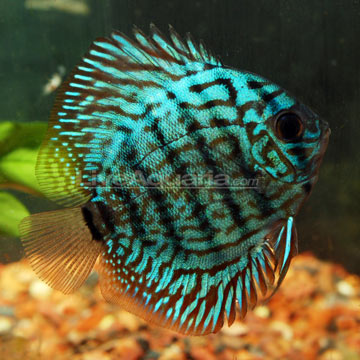
(live aquaria discuss)
idk why though lol. colors a little different but ive never seen an angel like that before. seen discuss with the darker blue like the angel.
i am also curious on how this angel looks now
(original posters pic)
(live aquaria discuss)
idk why though lol. colors a little different but ive never seen an angel like that before. seen discuss with the darker blue like the angel.
i am also curious on how this angel looks now
psilentchild
New member
I still would like to see a updated pic of the fish.Have you been able to tell what kind of angel mix it is?
Similar threads

- Replies
- 3
- Views
- 855


- Replies
- 20
- Views
- 385

- Replies
- 5
- Views
- 2K

- Replies
- 8
- Views
- 2K

