
You are using an out of date browser. It may not display this or other websites correctly.
You should upgrade or use an alternative browser.
You should upgrade or use an alternative browser.
(Another) DIY LED Build - Linear Design
- Thread starter katchupoy
- Start date

katchupoy
New member
Copy. I had it backwards. I hope 8 CW's without optic lenses is about right for decent SPS growth! I will probably pull the trigger on this setup within the next few weeks! Thanks for the help all.
worst come to worst, you can always add the optics...

rguyler
New member
Thanks Katchupoy and The FishMan65. I thought that to be the case based on previous comments but wasn't willing to play with $100+ worth of LEDs to find out. 
Inspired by this thread and others, I bought for my 90G:
20 XP-G CW with 65deg optics
30 XP-E RB with 50 deg optics
5 Meanwell dimmable drivers
(All from RapidLED)
I plan to go with the "linear" style too using alternating rows (RB-CW-RB-CW-RB) of 10 LEDs each but will probably use somewhat larger aluminum stock since I have a good source for it and we can't have too much heatsink I guess.
Inspired by this thread and others, I bought for my 90G:
20 XP-G CW with 65deg optics
30 XP-E RB with 50 deg optics
5 Meanwell dimmable drivers
(All from RapidLED)
I plan to go with the "linear" style too using alternating rows (RB-CW-RB-CW-RB) of 10 LEDs each but will probably use somewhat larger aluminum stock since I have a good source for it and we can't have too much heatsink I guess.
TheFishMan65
New member
1Snapple, if you are using the ELN D or P you must have the 10 volt supply hooked up. Sorry I can't keep everyone build in my head. If this does not help, summarize your build and I will try again
katchupoy
New member
Okay, I just got my LEDs and wired them all up but the potentiometer.
I plugged in the driver, and all the LEDs just glowed, not bright at all.
Please explain more. We want specifics.
katchupoy
New member
Thanks Katchupoy and The FishMan65. I thought that to be the case based on previous comments but wasn't willing to play with $100+ worth of LEDs to find out.
Inspired by this thread and others, I bought for my 90G:
20 XP-G CW with 65deg optics
30 XP-E RB with 50 deg optics
5 Meanwell dimmable drivers
(All from RapidLED)
I plan to go with the "linear" style too using alternating rows (RB-CW-RB-CW-RB) of 10 LEDs each but will probably use somewhat larger aluminum stock since I have a good source for it and we can't have too much heatsink I guess.
Dont forget the pics or build thread.

swenholz
New member
Well here is my LED array. still in the bug-working-out phase and I need to add my greens and reds to the mix, but I am really pleased with what I have got so far.


And my build thread is here: http://www.reefcentral.com/forums/showthread.php?p=18269399#post18269399
And my build thread is here: http://www.reefcentral.com/forums/showthread.php?p=18269399#post18269399
katchupoy
New member
A lot of people ask me if I can explain Series Parallel circuit better. Well I will try my best. Since I am not an expert with this one, I will only tell you the basics of how I understand it.
So here are the basics.

Series Circuit on the left = you add volts (amps stay).
Parallel Circuit on the right = you add amps (volts stay).
Based on the specs ELN 60-48D, it is a 48 volt with a constant 1.3 amp driver.
So lets say you want to put 12 Royal Blues XR-E in one series circuit. Like picture below.

We need to know these...
Current of that LED = 0.7 amp
Forward voltage of that LED @ 0.7 amp = 3.5 volts
So if we do 12 LEDs in series (remember? we add voltage). We are actually adding 3.5 volts 12 times. Or 3.5 X 12 = 42 volts + headroom is still less than 48 volts (drivers max).
If we do 13 LEDs @ 700ma then its going to be 45.5 volts. Still good I believe. Just dont go over 700ma, because the forward voltage changes also.
Now with regards to parallel.
Remember the amps does not add up in series. Remember the picture above (1st pic) on the right? Well if you do that then you will end up adding the amps but keeping the voltage at the same level.

Now here comes the SERIES/PARALLEL circuit...
Say what again? You mean two types together? Well take a look at the picture below.

The one on the left is the typical series style connection. But if you double it, then it becomes two parallel style connection but series per circuit.
So if you have a 12 LED 600ma series circuit, then you can actually double it by doing parallel. It means parallel of two 12 LED 600ma in series.
Remember that when you do parallel, voltage stays the same but amps adds up... So 600ma + 600ma = 1200ma.
You will or can run now (2) series of 12 LEDs running at 600ma each and total of 1200 ma for both. Doable? Yes because our driver can run 1300ma.
Is running at 600ma ok? It depends on your taste. It maybe running dimmer but you are doubling your light source. More spread with the same wattage.
So whats the problem in doing this? Looks simple enough? How come everybody is not doing it?
Well, there is a danger to the Series/Parallel style circuit. So assuming we have 2 series running parallel like we talked about above.
case one:
If one LED goes bad and it died "OPEN" then the whole series circuit will go off. This means that all those 1.3 amps will end up on the other or remaining series circuit. Thats a big no no.... since our LEDs can only handle 1 amp max. The fear is that, this will fry your led/s in an instant.
case two:
If one goes out "CLOSED". I believe that the remaining LEDs on that circuit fill FRY also. Since 42volts/11 leds = 3.8 volts. Way over the forward voltage of 3.7volts. Then after everything on this circuit is fried, see case one above.
Thats the danger.
Solution
Use of a fast blowing fuse. As Kcress pointed out, see pic below.
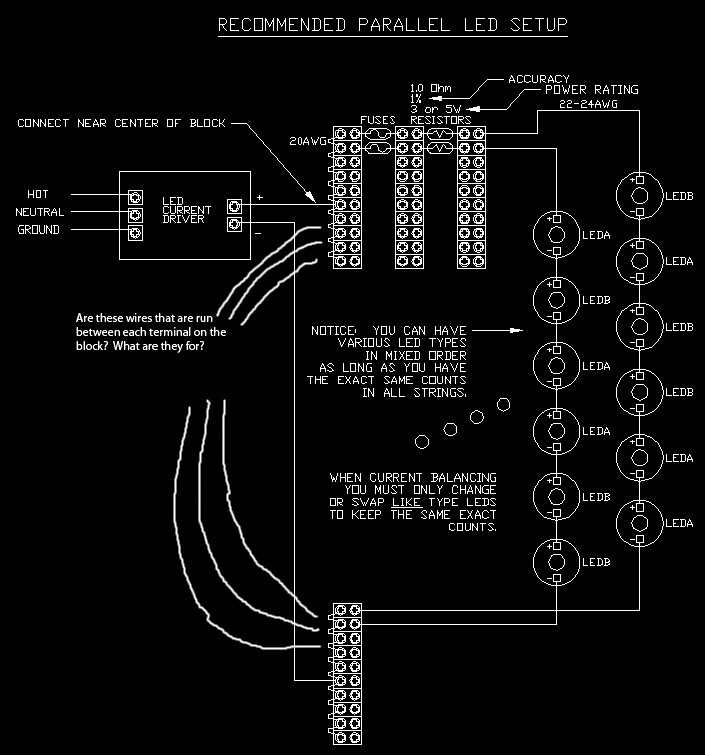
What happens is, when the current goes beyond the max allowed by the fuse, instead of the LED going out, the fuse goes out first. On what fuse current to buy? I dont know. If you can buy 600ma fuse, I will go for that.
Remember guys that this is just how I understand it, Im sure experts here can chime in and correct me on my notes. Also, we only used a simple mean well driver as an example. There are a lot of high powered mean well drivers that can run several parallel strings in one driver.
IF YOU DONT WANT TO USE FUSE AND REALLY WANT TO BE SAFE...
Then run your amps at 500ma each or 1 amp for both. If one string goes out, then 1 amp will go to the remaining string. Still acceptable since our XR-E can handle max of 1 amp.
Heck, you can even run 3 strings in one driver. That means you will be running each string at 1000ma/3 = 333ma.
I hope I explained it well....
So here are the basics.
Series Circuit on the left = you add volts (amps stay).
Parallel Circuit on the right = you add amps (volts stay).
Based on the specs ELN 60-48D, it is a 48 volt with a constant 1.3 amp driver.
So lets say you want to put 12 Royal Blues XR-E in one series circuit. Like picture below.
We need to know these...
Current of that LED = 0.7 amp
Forward voltage of that LED @ 0.7 amp = 3.5 volts
So if we do 12 LEDs in series (remember? we add voltage). We are actually adding 3.5 volts 12 times. Or 3.5 X 12 = 42 volts + headroom is still less than 48 volts (drivers max).
If we do 13 LEDs @ 700ma then its going to be 45.5 volts. Still good I believe. Just dont go over 700ma, because the forward voltage changes also.
Now with regards to parallel.
Remember the amps does not add up in series. Remember the picture above (1st pic) on the right? Well if you do that then you will end up adding the amps but keeping the voltage at the same level.
Now here comes the SERIES/PARALLEL circuit...
Say what again? You mean two types together? Well take a look at the picture below.
The one on the left is the typical series style connection. But if you double it, then it becomes two parallel style connection but series per circuit.
So if you have a 12 LED 600ma series circuit, then you can actually double it by doing parallel. It means parallel of two 12 LED 600ma in series.
Remember that when you do parallel, voltage stays the same but amps adds up... So 600ma + 600ma = 1200ma.
You will or can run now (2) series of 12 LEDs running at 600ma each and total of 1200 ma for both. Doable? Yes because our driver can run 1300ma.
Is running at 600ma ok? It depends on your taste. It maybe running dimmer but you are doubling your light source. More spread with the same wattage.
So whats the problem in doing this? Looks simple enough? How come everybody is not doing it?
Well, there is a danger to the Series/Parallel style circuit. So assuming we have 2 series running parallel like we talked about above.
case one:
If one LED goes bad and it died "OPEN" then the whole series circuit will go off. This means that all those 1.3 amps will end up on the other or remaining series circuit. Thats a big no no.... since our LEDs can only handle 1 amp max. The fear is that, this will fry your led/s in an instant.
case two:
If one goes out "CLOSED". I believe that the remaining LEDs on that circuit fill FRY also. Since 42volts/11 leds = 3.8 volts. Way over the forward voltage of 3.7volts. Then after everything on this circuit is fried, see case one above.
Thats the danger.
Solution
Use of a fast blowing fuse. As Kcress pointed out, see pic below.
What happens is, when the current goes beyond the max allowed by the fuse, instead of the LED going out, the fuse goes out first. On what fuse current to buy? I dont know. If you can buy 600ma fuse, I will go for that.
Remember guys that this is just how I understand it, Im sure experts here can chime in and correct me on my notes. Also, we only used a simple mean well driver as an example. There are a lot of high powered mean well drivers that can run several parallel strings in one driver.
IF YOU DONT WANT TO USE FUSE AND REALLY WANT TO BE SAFE...
Then run your amps at 500ma each or 1 amp for both. If one string goes out, then 1 amp will go to the remaining string. Still acceptable since our XR-E can handle max of 1 amp.
Heck, you can even run 3 strings in one driver. That means you will be running each string at 1000ma/3 = 333ma.
I hope I explained it well....


nuclearheli
Member
Would anyone on this thread be willing to trace the outline of one of the CREE high power led Star? I am starting my build but have not received my lights yet. I want to start on the mounting fixture and I am routing G11 to create insulated cavities for the stars. Will post a thread later. I need the exact size of the star and shape to make my cavities. It would be great if somebody could trace the outline of one and PM it to me.
Thanks
Thanks
nuclearheli
Member
Thanks. Never used it but I am going to try it now. Appreciate the tip.
nuclearheli
Member
That's great, got the file, got the program, see the LED on the screen and have the proper dimensions. Print it out and it's not the right size, it's smaller. The printer setup has it to print the actual size. Anyone know how to use this program enough to help me get the actual size printout of the piece?
katchupoy
New member
bigbear4x43
New member
Thanks. Never used it but I am going to try it now. Appreciate the tip.
were you guys getting supply's looking to build a light setup for 125 display any help would be great
nuclearheli
Member
were you guys getting supply's looking to build a light setup for 125 display any help would be great
Say again?
TheFishMan65
New member
Check out
Cuuter in Australia
Reef LED Lights
Nano Tuners
Heat Sinks USA
Cuuter in Australia
Reef LED Lights
Nano Tuners
Heat Sinks USA
Similar threads
- Replies
- 14
- Views
- 2K


- Replies
- 2
- Views
- 2K
- Replies
- 16
- Views
- 2K

