Are "closed loop" systems old school?

Well yes they can be controlled with a gate valve and change flow rates MPs and Close loop are apples and oranges.
Do you think corals and fish really care about "techy" or just about a healthy environment. Yeah I can't do sun rise and sunset but I can have turbulence flow in more than one area and true vortex flow.
Close loop and MPs are a choice and nothing more of two great ways a hobbiest can add flow to their tank.

I think you missed the point that rocketengineer was trying to make. You are comparing a basic closed loop with an "advanced" powerhead. You are correct that corals might not tell the difference and that you can provide adequate flow with a basic closed loop but if you want to make a comparison it should be at the same level.

What you are doing with your clsoed loop can be done with basic non controllable powerheads that just push the same constant flow, like koralias, maximods, non-controllable tunzes, etc. If you compare your closed loop to that, the closed loop is more expensive to setup and to run.

As I said before closed loops became popular when propeller pumps didn't exists, specially for big tanks where you needed an insane amount of small pumps to provide adequate flow. There were added benefits like a CL is easier to conceal which still applies today. But with how efficient propeller pumps have become and how much easier it is to give regular maintenance to a powerhead vs a CL, choosing propeller powerheads makes more sense as long as you don't mind seeing it or having a couple of extra cables.

If you don't mind the extra costs a well planned CL can work very well and give you a "cleaner" look.
 
I think both have their application in the hobby. 120 gallon tank ph would work. 72/72 cube walk around viewable on all 4 sides a CL might be a better option. Matter of opinion

Corey
 
Reefkeeper, I may have to steal your plumbing design. I am going to do a similar application, except I have purchased the Flowwolf instead of the Ocean Motions. I don't know how it will compare, not having experience in either, but I'm going to give it a go in my new tank design. THanks!

His design looks great, although I don't see a way to drain the closed loop plumbing when he needs to maintenance the pump or OM. (Not saying he doesn't have a drain somewhere, but I can't see one). I suggest drilling a 1/4" John Guest hole at the lowest point in the closed loop plumbing (like at the bottom of the intake pipe before the pump) with a small ball valve so you can drain the water out after closing the big ball valves.
 
Sure there is! We tend to think of 'head loss' in terms of pumping against height, but 'resistance head' is absolutely a factor in closed loops with pipe and fitting friction.

+1
I always referenced it as friction loss and it can be a harsh reality with a closed loop. I am never against a CL but it depends on what it is going on, a 60 cube isn't a good candidate but a large footprint is, this IMO is mainly due to plumbing and pipe size. Using the correct plumbing size on a large tank is easy but not easy with a small tank. The benefits are there with a large system and not there with a small one. It is very difficult to get adequate flow with small plumbing. Improper plumbing and the wrong pump is the biggest reason people saw failure with their closed loops.
 
Sure there is! We tend to think of 'head loss' in terms of pumping against height, but 'resistance head' is absolutely a factor in closed loops with pipe and fitting friction.

Yes but very little, and things can be done to minimize that. What little resistance I get is made up for with my penductors, something you can't add to any controllable power head. I have the MP60 and the CL, once you hit a certain number of gallons power heads just don't make any sense.
 
I agree with you about the finances. I use a reeflo pump and it creates tons of water flow while only using 100watts of power. With all the other costs involved in owning a reef tank, this isn't a concern of mine.

DSC_0653_zps08215dd0.jpg
Have you ever tried to figure out how much flow you are actually getting with all the 90/45s and height to tank?
3600GPH dart split 4 ways.. two 45s, 4 90s under tank. At least 4 90s at the loc lines. Then bent loc lines. Restricted flow with the ball valves. Result at the exits? The Dart I had wasn't exactly silent.
If your goal is to hide the power heads and get some extra flow behind rock/places that need flow nothing wrong with that but, I think you will still have to have some high end powerheads.

And if you went through all that trouble building a nice CL then have to add your ugly powerheads... well. You would have to ask yourself if it was worth it and would certainly depend on the specific tank and the way the owner set it up.
Also .. I am not rich so $$$ is somewhat of a concern to me.
 
My plan is to do a modification of closed loop. I intend on having a sump with external overflows, with lots of returns. So I will be draining my tank the "old-fashioned" way, or perhaps the more" modern" way through a sump. I was just trying to plan how I would set up my diverter. Thanks for the tip about making sure there are enough tru''union ball valves so that I will be able to maintenance the pumps.
 
Have you ever tried to figure out how much flow you are actually getting with all the 90/45s and height to tank?
3600GPH dart split 4 ways.. two 45s, 4 90s under tank. At least 4 90s at the loc lines. Then bent loc lines. Restricted flow with the ball valves. Result at the exits? The Dart I had wasn't exactly silent.
If your goal is to hide the power heads and get some extra flow behind rock/places that need flow nothing wrong with that but, I think you will still have to have some high end powerheads.

And if you went through all that trouble building a nice CL then have to add your ugly powerheads... well. You would have to ask yourself if it was worth it and would certainly depend on the specific tank and the way the owner set it up.
Also .. I am not rich so $$$ is somewhat of a concern to me.

Height of tank makes no difference in a closed loop. They all run at 0 pressure because they are a closed loop.

I get so much flow I had to remove the default reeflo dart impeller (3,600 gph) and put in the smaller snapper impeller (2,600 gph) in place. Even at 2,600 gph and the largest grain reef sand available, I have to dial ball valves back because otherwise I get waves that go over the sides of the tank. The nice thing is that I will be able to open those valves up a bit in the future when the corals grow in blocking the flow around the tank.
 
My plan is to do a modification of closed loop. I intend on having a sump with external overflows, with lots of returns. So I will be draining my tank the "old-fashioned" way, or perhaps the more" modern" way through a sump. I was just trying to plan how I would set up my diverter. Thanks for the tip about making sure there are enough tru''union ball valves so that I will be able to maintenance the pumps.

That's what I did, I run everything off of one large pump, and all water goes into the sump and back out the 8 returns "old closed loop setup". The pump actually has too much flow for the overflows to handle. I added two more overflows and and still not enough. That's with the skimmer plumbed into it also. If I pull one of the returns out of the water, it shoots 6ft. Works great, and everything has ball valves. I use a reef flow hammerhead. It's flow biased, so if you reduce the flow, you reduce the electric bill.
 
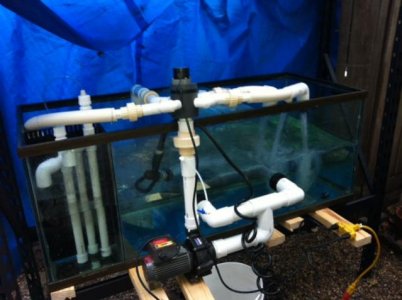
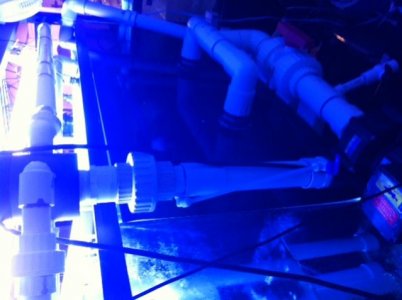
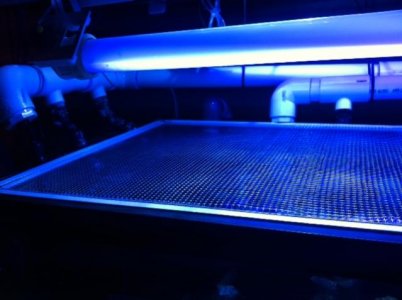
Here are a few (awful) pictures from my phone of my OM/Dart closed loop. The first one is from the FW leak test outside. Things have been modified greatly since then. The 2nd pic is the current setup behind the tank. The 3rd pic is a shot of the left side above the tank.

I have 4 outputs over the top of the tank, with 2-3 locline outputs each. The OM cycles through them all, so I have 10 locline outputs to blast individual dead spots with. This comes in handy hitting behind rocks that the Vortech and Jebao WP40 don't hit.

As you can see in the first picture, with the water gushing out of the outputs, there is not a major friction loss problem. I've run the numbers on the calculator and I'm supposedly pushing ~2800GPH out of 3600. It works for me. It's a lot of planning and work.
 

Attachments

  • OM test.jpg
    OM test.jpg
    40.4 KB · Views: 2
  • om.jpg
    om.jpg
    33.1 KB · Views: 5
  • om2.jpg
    om2.jpg
    35.7 KB · Views: 4
My plan is to do a modification of closed loop. I intend on having a sump with external overflows, with lots of returns. So I will be draining my tank the "old-fashioned" way, or perhaps the more" modern" way through a sump. I was just trying to plan how I would set up my diverter. Thanks for the tip about making sure there are enough tru''union ball valves so that I will be able to maintenance the pumps.

You have a good plan and my system is basically the same as what you are planning. The overflow receives water which travels down to the sump. A DC pump in the sump area returns the water back to the DT. You get tons of circulation this way and since both pumps are low end, efficient pumps, they are inexpensive to buy and power.

My biggest expense was buying $21 true union schedule 80 valves. If I were to do it over, I would save some money and buy schedule 40 valves instead at half the price.
 
Yes but very little, and things can be done to minimize that.

If you actually measure output (which I have done a few times) I think you might be surprised how significant 'friction head' can be. Regardless, you are right that there are things you can do. I never use the standard PVC elbows, for example, opting instead to use the gradual curve 90 connectors that are used in PVC conduit - makes a not inconsiderable difference.
 
One thing some people overlook is the diameter of the plumbing pipe. Going from 1" to 1.5" has a massive, massive impact on flow, while elbows, tees and such have comparatively little impact.
 
You have a good plan and my system is basically the same as what you are planning. The overflow receives water which travels down to the sump. A DC pump in the sump area returns the water back to the DT. You get tons of circulation this way and since both pumps are low end, efficient pumps, they are inexpensive to buy and power.

My biggest expense was buying $21 true union schedule 80 valves. If I were to do it over, I would save some money and buy schedule 40 valves instead at half the price.

I am planning two pumps out of the sump. One will go to the Flowwolf diverter with 6 1"pipes and the other will go to some of the returns in the back of the tank. I will have 3 overflows with a 2" herbie drains draining into the sump, (the tank manufacturer tells me that he usually does 2, 11/2" drain with out any pipe in it and with a lid that he supplies with to cover the overflows, he hasn't had any complaints of noise). I'm skeptical therefore I was thinking herbie drain. I am now concerned I may have to much flow that the overflows cant's handle, can this be possible?
 
I am planning two pumps out of the sump. One will go to the Flowwolf diverter with 6 1"pipes and the other will go to some of the returns in the back of the tank. I will have 3 overflows with a 2" herbie drains draining into the sump, (the tank manufacturer tells me that he usually does 2, 11/2" drain with out any pipe in it and with a lid that he supplies with to cover the overflows, he hasn't had any complaints of noise). I'm skeptical therefore I was thinking herbie drain. I am now concerned I may have to much flow that the overflows cant's handle, can this be possible?

http://www.youtube.com/watch?v=OzernwEtQL8

Now I'm jealous, Flowwolf looks awesome! With everything going out of the overflow, you will be pushing things and I would expect it might be noisy as well. My setup isn't my invention but it is ultra quiet.

A true closed loop has zero head pressure and that makes it very efficient. If you want to push 100% of your water up from your sump, then you will suffer from a bit of head loss too. You can overcome that with a bigger pump but it seems like an unnecessary cost. I think a design like the one I use will serve you better. Just make your Flowwolf a true closed loop, then have a traditional pump for the sump and anything else you are diverting water to. There have been times when I've had one pump off to do sump maintenance and the closed loop would keep running to keep the water oxygenated for the fish and coral. Just some ideas to think about.
 
http://www.youtube.com/watch?v=OzernwEtQL8

Now I'm jealous, Flowwolf looks awesome! With everything going out of the overflow, you will be pushing things and I would expect it might be noisy as well. My setup isn't my invention but it is ultra quiet.

A true closed loop has zero head pressure and that makes it very efficient. If you want to push 100% of your water up from your sump, then you will suffer from a bit of head loss too. You can overcome that with a bigger pump but it seems like an unnecessary cost. I think a design like the one I use will serve you better. Just make your Flowwolf a true closed loop, then have a traditional pump for the sump and anything else you are diverting water to. There have been times when I've had one pump off to do sump maintenance and the closed loop would keep running to keep the water oxygenated for the fish and coral. Just some ideas to think about.

The Flowwolf does look good I hope it is. I have a Reeflo Hammerhead currently and the Flowwolf people are sending me a pump to use with their diverter. I am just trying to figure how I would do a closed loop in the tank design I am envisioning without drilling to many holes. More fuel for thought. Thanks for the suggestion. I'll go back to my graph paper. I now understand why on some of these threads it seems like a year passes before the tank is completed.
 
WOW! I just read the ************ writeup on the Flowwolf. It looks like the Closed Loop just made it to the modern era (random flow, computer control, etc.).

One thing I'd suggest you think about is whether you really want the return pump/s to be so strong. That will mean a very high sump turnover rate, which can lead to difficult microbubbles. Like RK64 mentioned, if you instead do a true C/L (with the C/L drains on the back of the tank), you'll have less head loss. That would also keep you from having to deal with the super-high sump turnover rate.
 
Words I thought I'd never type:

I agree with the LFS.

Anyway...that "flow wolf" just looks like a modern day ocean motion device. One more electrical moving part to fail that I can't replace cheaply when it does. Closed loops IMO are old school and have been on there way out ever since Seio introduced the wide discharge powerhead years ago. I still own one too.

I think on a huge (atleast 1000g) system I'd want one, but like others have said...powerheads are cheaper in every aspect: to buy, to run, to repair, to replace, to keep running in power outages, etc...the only cost is space in your tank.
 
Oh, old school? People are using solar panels now to offset the crazy cost of our tanks. Just saying

I probably have the oldest school tank on here and I also have solar panels on my roof. :dance:
 
Back
Top