Are Deep Sand Beds, DSBs, dangerous to use in a marine aquarium?

dsb are best isolated from the display tank.a container or 5 gallon pail should be plumbed into the system with 8 or more inches of sand. DSB IN DISPLAY tanks will eventually become saturated with detritus and cause what is often called old tank syndrome.IE a nutrient sink. only filtered water should pass over the remote DSB.

That only holds true for those that for some reason think a DSB means maintenance free and resort to what is called LARS, aka lazy _ Reefer Syndrome. Something which effects tanks without DSB's equally.
 
dsb are best isolated from the display tank.a container or 5 gallon pail should be plumbed into the system with 8 or more inches of sand. DSB IN DISPLAY tanks will eventually become saturated with detritus and cause what is often called old tank syndrome.IE a nutrient sink. only filtered water should pass over the remote DSB.

While this is a plausible conjecture, I would like to point out that "Old Tank Syndrome" is a catch all term for unexplained tank problems, e.g., all my coral died. Further, we are stuck with anecdotal data linking deep sand beds with aquarium issues. Notions that "sand beds are nutrient sinks" and "become saturated" though plausible, are also conjectures. No one has actually measured these phenomena over the life of an aquarium. The nature of detritus and trace element accumulation in aquariua are also poorly understood. What is happening between the sand grains in a sand bed is terra incognita.

By the way, water does not flow through deep sand beds. Molecules diffuse into and out of them. If there are a lot of animals inhabiting the sand, water flow may happen to a small degree near the surface.
 
So far, this entire thread is conjecture and consists of absolutely zero applicable information.

Sure, the wisdom of the crowd has its limits.

One approach to using internet forums is to seek help only on simple topics and avoid large open ended questions unless you are prepared to critically go through the feedback. The chart below illustrates how well forums seem to produce useful information. You are pretty much assured a good answer with a question on simple topics but you are unlikely to obtain an answer on complex topics.

If you are willing to work AND the topic goes on long enough or it is repeatedly queried, a critical review of thread/threads can prove useful. I have surveyed several topics over several years of posts on this forum and have learned quite a bit on these topics. Unfortunately, I have not done an in depth review of the deep sand bed topic.

My current state of understanding of a deep sand bed is that the dangers are likely exaggerated as are the benefits. As such, a deep sand bed is probably just an interesting relic that might be interesting to own or study. I am currently studying a shallow sand bed in a fish only aquarium, the results of which might be useful in the deep sand bed discussion.

Dan

image_zpsnpvdbv7u.jpeg
 

I think this applies to much more than internet forums. Even scientific journals have dissent and disagreements on complex topics. :D

The benefit on internet forums is the ability to gain direct access to personal experience. It just needs to be contextualized within a framework of all the variables experienced by the poster.

I like DSBs and I think they work well with sufficient surface agitation and biology to promote greater diffusion. That's based on personal experience. Have I reset my setup without the DSB in my refugium or removed my DT sand to demonstrate that this would be worse? Did I make sure no other variables were changed so my results would be meaningful? No... so my view is clearly biased. It's just my view and experience and I'm open to sharing.
 
Yes. Worms especially but not exclusively.
I use horseshoe crabs and a small army of conches of different sizes as well as nassarius snails, one starfish, and sand sifting/burrowing fish (jawfish, dragon goby).

I keep the predators to a minimum (starfish, fish, crabs) and try to maximize the area so the worms are constantly ahead of the predators.

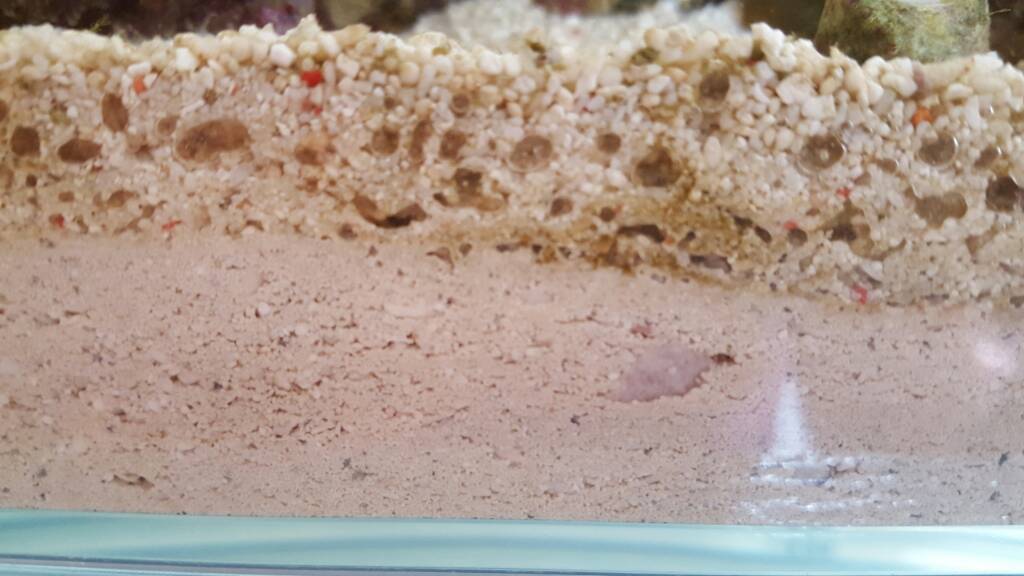
Looking at my glass, I have worms that extend for 2" or more below the surface. For a 3" sand bed, that's a lot of access.
 
So far, this entire thread is conjecture and consists of absolutely zero applicable information.

I'm not sure you read the thread.

There are many variations from zero to deep substrate folks use to their liking.Some provide prescriptive and proscriptive points of view .

The applicable information is about how things actually work not prescriptions and proscriptions,though some certainly have value as anecdotal shared experience.


For example, , not too long ago the paradigm for nitrate control required a 4 inch undisturbed sand bed without free oxygen to ensure denitrifying bacteria survival and anaerobic nitrate activity to convert nitrate NO3 to Well, turns out denitrifying bacteria can use oxygen and create localized hypoxic areas in very shallow areas and thrive just fine going to nitrate for oxygen when the free oxygen is depleted. It also turns out these bacteria are heterotrophic; they need organic carbon as well as other nutrients including phosphorous and nitrogen and can't get very much of any of that in a deep stagnant bed of sand without a force to move them down in significant quantity In a well maintained bed with adequate bioturbation( sand critters) and some advective current they are effective.

This applicable information opens the door to choices other than deep sand beds for nitrate and phosphate control and many have gone to shallower beds or no substrate at all. Some still prefer the aesthetics of a deeper bed and the benthic fuana which if well maitined are not inherenently harmful as some suggest.
 
Last edited:
Molecular diffusion is about molecules spreading equally throughout a solution . It is a slow weak process mostly unrelated to surface agitation which has more to do with advection or just strirring in organic material. Biotrubation refers movement of nutrients via channeling and transport by benthic organisms. In tank sand beds that are well maintained rely heavily on bioturbation and to a lesser extent on advective upwelling currents caused by moving water striking obstruction like the aquascape. Over time these beds can clog with organics or adsorbed elements and stop functioning. They require some replenishment and adequate seeding of sand critters .
 
Last edited:
DSB's are not dangerous. Its their use lacking sufficient understanding...... SO DSB's don't kill, their owners do.
 
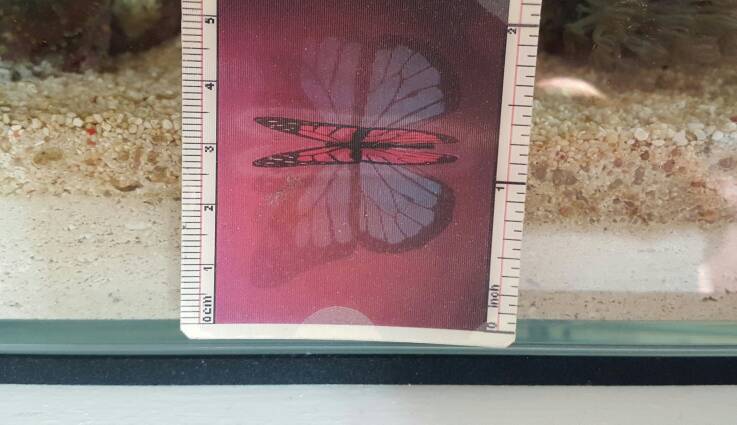
I started my tank since about 5 weeks.
After much reading, my tank is only 15G, I decide to go with a shallow send bed.
I used 2 small bag of live aragonite and after some days I add some more bigger corallin sand, about 5kg

The send bad height is about 1,5 inch / 3,5 cm

There wasn't any air when I started.
I wasn't sure if that empty space in sand was a gas or just empty space full of water, but yesterday I saw a small bubble going up so I assume is some gas

18b25fd4b176937fa5384766084a733f.jpg


377509f729479f706610472a2a0986f3.jpg
 
dsb are best isolated from the display tank.a container or 5 gallon pail should be plumbed into the system with 8 or more inches of sand. DSB IN DISPLAY tanks will eventually become saturated with detritus and cause what is often called old tank syndrome.IE a nutrient sink. only filtered water should pass over the remote DSB.

How do you acquire such knowledge? Have you been running DSB's to get this experience?
 
dsb are best isolated from the display tank.a container or 5 gallon pail should be plumbed into the system with 8 or more inches of sand. DSB IN DISPLAY tanks will eventually become saturated with detritus and cause what is often called old tank syndrome.IE a nutrient sink. only filtered water should pass over the remote DSB.

My current saltwater aquarium project involves keeping local species of fish found near shore in Long Island Sound. I am using all local material for the aquarium. There is no aragonite whatsoever in the system.

My system does not suffer from detritus accumulation that seems to plague reef aquariums that utilize aragonite sand and live rock. I do see and remove fish feces and pieces of macro algae from the surface. I have not siphoned or disturbed the sand in two years. The sand does not seem to be a nutrient sink that is described by aragonite sand users. Ammonia and phosphate levels in the pore water have been constant for over the last year. Tank water has undetectable nitrate and phosphate levels.

I have to wonder if aragonite is such a good material for saltwater aquariums. Yes, I have read about the virtues of aragonite that the experts have expounded upon, but I have a nagging feeling that we should step back and reconsider aragonite. For example, aragonite deep sand beds might be iffy and need maintenance but silica sand deep sand beds might not be so iffy or problematic or difficult to care for.

Anyway, just some fuel (thoughts) for the DSB fire.
 
So far, this entire thread is conjecture and consists of absolutely zero applicable information.

You might not be comprehending the information. You know forest through the trees and all.


As running DSB's for over 25 years, factually no, they are not dangerous.


They do require maintenance however.


In my experience of lazy reefing with excellent results, and my personal tank conditions I get about 5 + years before I need to tear the tank down and clean up the sand stirring and removing clumps cemented together.


The term LARS is a joke. This is a hobby where you get out what your put in which includes time and money. Many of us this is only one of 20 hobbies that we don't live around, we live with it.
 
I've been running a DSB in by refugium for almost 5 years now. My experience has been good, at least I think it has. However as it gets older, I feel like more can go wrong with it than good. I haven't maintained it so far other than removing detritus from the surface, which over time has turned my 6in DSB into more like 5in.

I've enjoyed the debate on the topic going on in this forum. Ultimately, I'm leaning towards phasing it out and leaving more room for liverock and macro algae.

1. If you have an opinion on this logic, please share

2. My plan would be to disconnect my refugium (15G), remove the sand, and do this as part of a larger water change. In your opinion, would this shock my tank (80G)?

3. Pods. I'd lose some but they'd replenish in time.

4. Is there anything else I should be thinking about? Thank you.
 
IME, sand under macroalgae in a refugium will clog up overtime. Algae exudates are mostly refractroy( don't break down easily) and tend to clog it up overtime. When I decided to remove the sand from the macro alge refugium I did it is 4 increments over a few weekas to minimize any shock from changes in the overall reef tanlk's chemsitry/biology
 
I use a DSB 'city' with macro in the middle stage of my sump. It's in the path of main flow:
Stage 1: constant water level + pumps (skimmer, chiller) + heaters
Stage 2: DSB Macro region (constant level except during surges)
Stage 3: return pump (variable level), sensors, GFO reactor, GAC reactor

In the second stage, I created a double stack of sand using many small 8" tall buckets full to about 5". There's two layers separated by eggcrate. Looks like a double decker city with buildings of sand buckets. There are two more eggcrate layers above the buckets and a partial sheet of plastic between them. The water can flow down but the chaeto can't easily fall down into the buckets. There's about 1/5 of the volume of just empty water between the buckets (circular buckets stacked in a rectangular area). So it's relatively open with very slow flow.

In contrast, the macro layer has very high and very agitated flow.

The buckets have different kinds of media: Some coarse limestone, some miracle mud, some oolite sand, etc...

I seeded the area with live sand (worms, etc), a few thousand amphipods, a hundred shrimp (peppermint and glass).

The bottom has nearly no flow except for the motion of the animals there. It's very dark.

So there are three zones

Bright chaeto region with live rock rubble and pods at very high flow + extra pumps for turbulent flow
-------- eggcrate -------
Plastic sheet sections
-------- eggcrate -------
Dimly lit/shadowed buckets of sand at low flow with worms and shrimp
-------- eggcrate -------
Dark no flow cryptic zone buckets of sand (few invading shrimp and few worms)
Floor with coral rubble

The purpose of the buckets is the ability to remove and replace whole sections without the usual chaos of dust and stink in the sump. I haven't had to do it yet.

I use a flashlight to check the zones. The middle zone has the most visible active worm/pod/shrimp population. The lowest zone has almost no motion. White sponges come and go in this area. The top region is chaotic. There's no visible life except for the rapid chaeto growth. When I turn off the flow, I can see the pods and shrimp living in the chaeto.

Finally, I have an actuated surge in my reef so the water level in the middle section of the sump varies by 4" depending on the surge state. This means that the chaeto mass goes from fully submerged under 3" of water to being briefly exposed out of water by up to an inch.

I find that this helps "flush" the macro mass regularly (broken bits of macro) as well as reducing the buildup of detritus.

I have nearly no mechanical filtration anywhere in the system (hard on pump intakes).

The overall effect is that there's plenty of particulate matter floating through the tank, but the fish and coral don't mind.

Am I advocating for it? Not necessarily. I'm just sharing what's worked for me.

I get nutrient export from the chaeto
I get plankton and pods from the breeding shrimp and pods
I get detrivores in the form of worms
I believe I get denitrification from the deep sand/worms
I get sponges, worms, baby stars and other unknown benefits from the cryptic zone :)
I also believe that the miracle mud acts as a trace element dosing pump - more opportunity for angry debate here too - lol

Like I said - just what works for me...

 
Last edited:
Back
Top