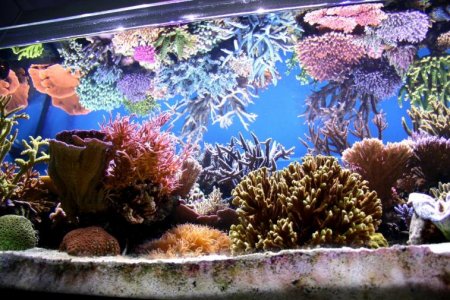
Are Deep Sand Beds, DSBs, dangerous to use in a marine aquarium?

20 years ago people also used under gravel filters and didn't use RO/RI water...I'm just using it as a reference point in that times change and people are still doing what they are comfortable or familiar with.

I'm not sure where you are getting that I am telling people to use a deep bed or not Reefin but I very well could be misunderstanding your comment. I just don't agree when people say they are dangerous to use. At the end of the day what people should care about in this hobby is to teach people to be consciousness of how they manage their "own" little environment. What works for you may not for me. Maybe I don't want a skimmer, maybe I want to use LED's, maybe I want to do only 1 water change a year. Maybe I want to add a iron chain in my tank, or put a bottle in it. Who is to say what is the right thing to do? We don't tell an artist what he or she can paint.

In regards to water treatment plants. I am very well versed in how they work in the greater Sacramento area. Operator to plant super but it hasn't changed my opinion.

Side note - I don't think I could do a bare bottom even to try or test. Kenya trees and green star polyps would make a mess of it unless I changed my maintenance routine. Then cleaning it up off the bottom would be, well, rather interesting to say the least. Does a sump count has bare bottom? Na, that is cheating I guess. So no, I've never had a bare bottom tank so I honestly don't have an opinion on how they work or how different it would be.

I dont have an issue with people using a dsb. They are fine as long as there is some export of detritus at some point. If you operate a treatment plant no one knows better then you that solids stack up in a hurry and when they breakdown leave nothing that does water quality any good.
 
more then 20 years on and off reef keeping over here...so deep sand no good now?? Miracle mud bad now???? bio balls bad ? undergravel filter old school ? LED not sure yet?? stay with MH???.....lol its hard to keep up..
 
20 years ago people also used under gravel filters and didn't use RO/RI water....

Just to clarify this point. 20 years ago I was using bare bottom, Berlin system and RO/DI water. Yes, I was probably on the "bleeding edge" compared to most but this is not a new concept. We were reading about these concepts in FAMA before the internet existed. What comes around goes around.

And guess what? The deep sand bed debate was around then too.
 
lol 18 years ago my 75g was bare bottom with a Berlin skimmer and a refugium and we had RO/DI ....some things dont change ...i dont miss the fish Magazines all over the house lol
 
Ive always used DSBs and had one running for 8 years before selling my house and having to tear it down. I never had algae problems and I used coarse gravel 2 mm+ w some fines for wrasses, etc. I also had plenty of bioturbulation from sand conchs, fish, worms, etc. I had serious internal wave motion, like most SPS tanks and only had a problem when the power went out and my back up failed. O2 levels crash pretty quickly.

What I really wanted to add to this discussion is that Jaubert had a FLOW THROUGH drip on his system on the Mediterranean and large coral rubble fragments comprising his substrate. I have never seen a plenum set up with this configuration on a home aquarium.

I've always like DSBs for the life they bring to our home aquaria. Having said that, I worked in the Keys growing corals on the bottom and this always increased our risks of bacterial and predatory issues vs hanging them in the water column well above the substrate. Is there any data to support this, no. We do what works and this has many variables with each system.
From 1988 to 1995-6, I ran a 110 mixed reef tank (back then mixed was LPS and softies) :) just as you described. Charles Delbeeck did a talk at the Brooklyn Aquarium Society. He went into detail about the Jeubert <sp> system. I was sold. I never had any issues with nuisance algae or really any other pests like aiptasia. The plenum was about 1.5" in total - 1/2" eggcrate and an inch of water below that. There has to be something to allowing the naturally occurring bacteria to filter the water of unwanted nutrients.

I did have a lot of sand stirring critters in the tank. This is a scan of the only pic I can find of that tank (I know there's a box of pics somewhere - no PCs or digital anything then LOL) Had a few of those cucs and lots of crabs. Only snails available then were Turbos. So no sand stirring varieties. Never did well with star fish, but there were a lot of bristle worms. I think these are the creatures that bring a measure of success to a tank with sand. I don't think there's anyway around that. They do in our tanks what they do in nature. They consume the junk.


myreeftank-1.jpg


That tank met it's unfortunate demise from a move. Who knew at the time to not to reuse the sand :(

Oh one other thing, that tank ran off of NYC tap water and some distilled from time to time - had to drive to a distillery to pick up 5g containers. No RO water then - well I didn't have one and really didn't have any knowledge about using them to pre-filter the water for tanks. That sand was always white like it is in that pic. Just thought I'd add my experience here. I know it's anecdotal and I know there were no SPS in the tank - no one had them save Delbeek, Sprung, Paletta and a few others - but it did work for me then.
 
I have to amend and append my post above. I guess I am getting old and my memory is failing LOL I was just reminded of a few things, we moved in 1997 and the tank wasn't started utilizing the Jaubert methodology. I switched to it after the talk and the BAS meeting. Heck I have an autograph but I can't tell if it is from Delbeek or Sprung LOL I also don't remember what "trick" they were referring to in the dedication LOL

The reason I went to the Jaubert method was because I was having issues with nuisance algae. The talk on the Jaubert method was what convinced me to switch. Prior to that it was a wet/dry filter with bioballs and some sand on the bottom of the tank. The bioballs went in the trash and I reconstructed the tank with the plenum/false bottom and DSB. The issues all went away after the change.

Well here's what reminded me of the course of event- well that and someone who was present then too with a better memory than I have LOL


IMG_1410.jpg


IMG_1411.jpg
 
I have to amend and append my post above. I guess I am getting old and my memory is failing LOL I was just reminded of a few things, we moved in 1997 and the tank wasn't started utilizing the Jaubert methodology. I switched to it after the talk and the BAS meeting. Heck I have an autograph but I can't tell if it is from Delbeek or Sprung LOL I also don't remember what "trick" they were referring to in the dedication LOL

The reason I went to the Jaubert method was because I was having issues with nuisance algae. The talk on the Jaubert method was what convinced me to switch. Prior to that it was a wet/dry filter with bioballs and some sand on the bottom of the tank. The bioballs went in the trash and I reconstructed the tank with the plenum/false bottom and DSB. The issues all went away after the change.

Well here's what reminded me of the course of event- well that and someone who was present then too with a better memory than I have LOL


IMG_1410.jpg


IMG_1411.jpg

Nice image, both actually, of the tank and the book. Oddly enough that was the first book I purchased. I believe the second one was a book from Mr. Fenner.
 
Deep sand beds are not dangerous, its the improper implementation or set up that's dangerous.

This is GOSPEL.

I currently run my DSB, 4 inches deep, made with 0.7/1.0 mm sugar size calcium carbonate and all is well.
They key to success is the INFAUNA, thousands of small critters that constantly move the sand bed bringing oxygen and nitrogen to the sand bed and carrying out the products of bacterial digestion.

INFAUNA takes care of detritus, recycling it into new biomass that is given back to the tank as gametes, spores, larvae.
If we are able to build an efficient food-net, then detritus will be used and re-used many times and at the end of the process the small remains will be skimmed or will be incorporated in the sand bed as inoffensive minerals.
DSB tanks allow to create different trophic levels, containing much more life than BB... more biomass means more detritus consumption and recycling, more live food for corals.

Another good point is water movement, as DSB chemical kinetics work on gradient.... good water movement maintains a high concentration gradient of reactants and products of biochemical processes.
Good water movement removes the remains of digested detritus that are skimmed away.

My experience says that if a DSB tank goes wrong it's always an aquarist's fault, as someone wants too much from the sand bed overloading it.

DSB is how oceans work in natural environment.
Regularly feed the (right) fishes, give strong light and current, do not overcrowd the tank, perform light skimming... that's all! :)


In the picture you can sese is my DSB tank, it is 25 months old (and it's still very young):
 

Attachments

  • IMG_8632.jpg
    IMG_8632.jpg
    105 KB · Views: 25
Last edited:
I had a 200 gallon tank that ran from 1999 to 2009 with 2 to 3" of sand and the nitrates where below 5ppm. The rock sat on the glass and I filled in sand around it. Only sold it to move up to my 300. It is amazing what grows in your sand?
 
This is GOSPEL.

I currently run my DSB, 4 inches deep, made with 0.7/1.0 mm sugar size calcium carbonate and all is well.
They key to success is the INFAUNA, thousands of small critters that constantly move the sand bed bringing oxygen and nitrogen to the sand bed and carrying out the products of bacterial digestion.

INFAUNA takes care of detritus, recycling it into new biomass that is given back to the tank as gametes, spores, larvae.
If we are able to build an efficient food-net, then detritus will be used and re-used many times and at the end of the process the small remains will be skimmed or will be incorporated in the sand bed as inoffensive minerals.
DSB tanks allow to create different trophic levels, containing much more life than BB... more biomass means more detritus consumption and recycling, more live food for corals.

Another good point is water movement, as DSB chemical kinetics work on gradient.... good water movement maintains a high concentration gradient of reactants and products of biochemical processes.
Good water movement removes the remains of digested detritus that are skimmed away.

My experience says that if a DSB tank goes wrong it's always an aquarist's fault, as someone wants too much from the sand bed overloading it.

DSB is how oceans work in natural environment.
Regularly feed the (right) fishes, give strong light and current, do not overcrowd the tank, perform light skimming... that's all! :)


In the picture you can sese is my DSB tank, it is 25 months old (and it's still very young):

Your corals are gorgeous!
 
what data are you looking for?

Variable rates of phosphate uptake by shallow marine . carbonate sediments:
Mechanisms and ecological significance


the same mechanism here can occur in the skeletons of the corals. once in the skeleton all kinds of bad happens.

G~

I know you and I have discussed this issue before (which I thoroughly enjoyed) so I don't want to rehash an old discourse but I have to take issue with your use of this article in this thread. The study took place over an extremely limited (6 hour) period so extrapolations to our multi-year systems are tenuous. Further, the authors make a clear distinction between a mesotrophic state (characterized by aquatic plants "up-taking" phosphate and clear water) verses a eutrophic state (characterized by algea up take and dark water). Don't our systems typically fall into a mesotrophic state by nutrient export through "harvesting" or periodic replacement of DSBs?

Interested in your thoughts as always. ;)
 
I run one: just be careful to keep some of nature's own cleaners, like nassarius vibex and fighting conches; I run another dsb in the sump, so if I have to disturb a small area to get at a pocket of not-good, or move a rock and kick up some stuff, there's another entire undisturbed 20g sandbed (30 gallon fuge) to take up the slack until the disturbed bit can get into good order again. Generally, cleaning a sandbed is not a good thing, but this way, with 2 sandbeds, you can do a little bit of cleaning on one without crashing your system. Limit your cleaning to a quarter of a bed at a time.
 
This is GOSPEL.

I currently run my DSB, 4 inches deep, made with 0.7/1.0 mm sugar size calcium carbonate and all is well.
They key to success is the INFAUNA, thousands of small critters that constantly move the sand bed bringing oxygen and nitrogen to the sand bed and carrying out the products of bacterial digestion.

Gospel huh? :(

there is no reason to bring nitrogen into the substrate. there is plenty in there already. the detritus that is slowly working its way downward in the substrate is full of nitrogen an phosphate. the in fauna is key, but not in the way you are saying. the in fauna help in the slow migration of N and P deeper into the substrate, they DO NOT migrate N and P upwards through the substrate. if this were true, then there would be nothing for these organisms to feed on. ;)

INFAUNA takes care of detritus, recycling it into new biomass that is given back to the tank as gametes, spores, larvae.
If we are able to build an efficient food-net, then detritus will be used and re-used many times and at the end of the process the small remains will be skimmed or will be incorporated in the sand bed as inoffensive minerals.
DSB tanks allow to create different trophic levels, containing much more life than BB... more biomass means more detritus consumption and recycling, more live food for corals.

biomass is just a fancy word for nutrient sink. there becomes a point where the only thing feeding on detritus is more bacteria, plus some detritus is not useful to anything. it is this detritus that we must remove from our systems. it is not removed by the in fauna. more biomass just means more N and P. that is all it means. you can not have more biomass without the N and P to support this biomass. any increase in biomass represents an increase in total nutrient level of they system, by definition.

define inoffensive materials? and how is this build up not considered an increase in mass of the system and not an indicator that the system is becoming more eutrophic?

Another good point is water movement, as DSB chemical kinetics work on gradient.... good water movement maintains a high concentration gradient of reactants and products of biochemical processes.
Good water movement removes the remains of digested detritus that are skimmed away.

how? again if this were true, then the substrate would show no life in it because it would be starved. nothing to feed on, so nothing would have resources to live off of.

My experience says that if a DSB tank goes wrong it's always an aquarist's fault, as someone wants too much from the sand bed overloading it.

how does one overload a substrate? if it is constantly working at migrating N and P upwards, then how can it be overloaded? overloaded would indicate that nutrients are entering at a higher rate than exiting, correct? how is this possible if the normal functioning of a substrate is to migrate N and P outwards?

DSB is how oceans work in natural environment.
Regularly feed the (right) fishes, give strong light and current, do not overcrowd the tank, perform light skimming... that's all! :)

no. we all wish this would be the case, but it is not. have a look at any chart that talks about the phosphate cycle on Earth. phosphates come in off of the land, then fall into the abyss, then get pushed back up on land again by plate tectonics.

the best way against nutrient build up is to skim as heavily as you can. the skimmer is the only piece of equipment we have available to us that constantly remove organic material from the system. the only thing better than a good sized skimmer is the siphon. everything else we utilize just holds onto N and P until we remove it.

In the picture you can sese is my DSB tank, it is 25 months old (and it's still very young):[/QUOTE]

your tank is very nice. nobody is saying that DSB's do not work short term. i am the first to agree. they make fantastic phosphate sinks. they can bind a huge amount of inorganic nutrients. there is absolutely nothing wrong with this. the point is that they bind P, they do not transmography it into gold, or export it into some magic worm hole to another dimension. the P goes in, and will stay there until we remove it. either by siphon the detritus out, or by replacing the substrate. in the years i have been on forums. the life of a substrate is approximately in years as it is deep in inches. your system is right in the wheelhouse for making the most use out of a DSB. in fact the substrates in nature near reefs are constantly being disturbed. tropical storms reset the substrates in these area. mixing up the substrate and washing away the detritus that had built up since the last storm. this is how these areas work in nature. they are not static like we make them in our systems.

I know you and I have discussed this issue before (which I thoroughly enjoyed) so I don't want to rehash an old discourse but I have to take issue with your use of this article in this thread. The study took place over an extremely limited (6 hour) period so extrapolations to our multi-year systems are tenuous. Further, the authors make a clear distinction between a mesotrophic state (characterized by aquatic plants "up-taking" phosphate and clear water) verses a eutrophic state (characterized by algea up take and dark water). Don't our systems typically fall into a mesotrophic state by nutrient export through "harvesting" or periodic replacement of DSBs?

Interested in your thoughts as always. ;)

sorry, the point of the article was mainly that phosphates are taken up by calcium carbonate substrates. nothing more. sorry, i was not trying to be misleading.

but if the algae is growing well, then wouldn't it be eutrophic. ;) you are correct though our systems do fall into the mesotrophic state, which is why there is so much confusion about what works and what doesn't. this is also why we are able to keep mixed reefs for any length of time. we can find that balance that can work until the total nutrient level of the system becomes to eutrophic for some of the organisms. old tank syndrome is what it is normally called in our hobby.

G~
 
Reefin' dude,

there's a lot of difference between N and P as dissolved nutriens and the same N and P combined together with other elements inside biomass.

There's plenty of microalgae in my tank and you can bet they get N and P somewhere... you can also bet that those microalgae are eaten by some small critter.
Bacteria, copepods, phytoplankton, sand worms are made of N and P but they are not pollutants, they are coral and fish live food.
I find much more useful to have my corals feed on them instead of pollute the system with the latest industrial "coral food" and have to "skim as heavily as I can".
IMHO

I do not want to change your mind, as your tone seems too polemic and you seem too convinced of what you say to change your way.

DSB works fine for me and for my way to manage my tanks.
Phoshpates are a problem if you disturb them.
I measured phosphate concentration into the sand bed and it's crazy, but my water has 0.01 ppm of phosphates.


OTS is something different.
 
Last edited:
Reefin' dude,

there's a lot of difference between N and P as dissolved nutriens and the same N and P combined together with other elements inside biomass.

why is there a difference? it is still a total increase in net N and P of the system, correct? whether it is bound organically in an organism or not, the nutrients are going to be transferred and converted back and forth constantly. P especially. if the system is being fed externally, then there must be an equal amount of waste being removed to maintain the same amount of nutrient mass in the system. phosphate is an energy source, not so much a building block. there has to be a net increase in the total amount of inorganic N and P to support the bottom rung and above of the food chain. you can not have a growing biomass without a growing food source to support that growing biomass. if the food source was not there, then the biomass would crash.

There's plenty of microalgae in my tank and you can bet they get N and P somewhere... you can also bet that those microalgae are eaten by some small critter.

it again goes back to the needed nutrients to support the algae biomass. is it really necessary? why not just feed the organisms you want to keep directly what they need/want instead of trying to create an entire ecosystem that may or may not be giving the organisms one wants to keep what they need? is anyone sure that the algae is being eaten, or is it just being removed by the skimmer? with the skimmer we know that there is some nutrient export occurring.

Bacteria, copepods, phytoplankton, sand worms are made of N and P but they are not pollutants, they are coral and fish live food.
I find much more useful to have my corals feed on them instead of pollute the system with the latest industrial "coral food" and have to "skim as heavily as I can".
IMHO

they are pollutants. all organisms poo. they also require resources in order to live. no organism is 100% efficient. the poo is a pollutant, whether it is the poo from a pod, bacteria, coral, or worm. the waste needs to be removed. if it is not and is "used" for a food source for other organisms, then it would still need to be counted as an increase in total N and P of the system. a sign that the system is becoming more eutrophic.

the skimmer is the only piece of equipment that we currently have available to us that constantly removes organics from our systems. wouldn't it make sense to make the most of it? doesn't it make sense to "skim as heavily as I can"? the more the skimmer removes, the less i would have to remove later, correct? unless the P is removed it is still in the system. again, an increase in total nutrients in the system.

I do not want to change your mind, as your tone seems too polemic and you seem too convinced of what you say to change your way.

i am sorry, i am not trying to be argumentative. i am just trying to find out if i am missing something with how i understand biology and nutrient imports and exports in phosphate controlled systems. i like you believed that DSB's were the greatest thing to ever come into this hobby back in the early 2000ish. i have no problems changing my mind if enough evidence is provided to prove that the research i have done was incorrect.

DSB works fine for me and for my way to manage my tanks.
Phoshpates are a problem if you disturb them.
I measured phosphate concentration into the sand bed and it's crazy, but my water has 0.01 ppm of phosphates.

there is not doubt that DSB's work short term. it is the way that they are explained to "work" that is the concern. substrates are phosphate sinks, that is all that they are. using either your description or mine. they do not export nutrients from the system. there is nothing wrong with using a DSB as a phosphate sink. replacing or refreshing it on a regular basis and going on with it.

could you explain disturb them, please? if DSB's worked the way we are led to believe, then we would not have to worry about disturbing them. if the measured concentration of P in the substrate is crazy, then how did the P get there? how does this not indicate a slow build up of P in the entire system? if the P is building up, then what is going to keep the P from always building up. i thought benthic organisms are suppose to be doing that. if they are, then what are the feeding on, and how did that food source get into the substrate? something just does not seem to be adding up both logically and biologically.

according to this chart phosphate levels on the reef are 0.005ppm. our inorganic P test kits are not accurate enough to give us the information we need for maintaining reef levels of inorganic P. :( we need to look at other ways of determining what the total P in the system is. using the amount of biomass is a good indicator of the total amount of P in the system. the more support biomass, the more total P in the system.

OTS is something different.

how is it different?

are you referring to the salt study?

sorry, if i am coming across as being argumentative. i am just trying to figure out where are knowledge basses are different.

G~
 
It all revolves around; can you keep your beds interior clear of anything other then protists and bacteria’s that didn’t go in with it originally?
If so, then a calcium media bed of any kind with a raised floor making a gap of roughly 1 inch under it and the media from 2 to 6 inches deep is a must and not just for nitrate reduction either.
You keep it clean like I do and the sky is the limit with its help on reef aquariums water conditioning!
 
even the protists and bacteria will need resources.

what makes plenums work "better" than a standard DSB is that there seems to be a better exchange of elemental carbon in the lower levels of the substrate from below. the main problem of N and P build up are still a concern. it is this mechanism that makes plenums so good at nitrate reduction. bacteria need both a supply of elemental C, N, O, and P to live. the combination of each depends on the bacteria and their "food" source.

the big drawback of course is all of the space taken up by the substate itself.

G~
 
Here is my 8 yr old approx 5 inch dsb, you can see evidence of constant degassing bubbles

It is serviced regularly to remove detritus, agreed they are not able to be permanent catch alls

http://www.youtube.com/watch?v=G8zMWHAkJtM

for a tank this small I just pour 20 gallons of water through it forcefully and it will carry out all the waste in the sink I do this once a year. It ejects all the top layer detritus out from the bowl. True old dsb's show a range of color pocketing that shifts and changes in time. This zone has interesting activity and needs to be serviced correctly, most don't use them in pico reefs. Look at them gas bubbles lol
 
I had a 300g display set up for ten years and I used a 40g breeder as a RDSB and the plumbing allowed me to take it out of line. In that period of ten years I replaced the sand twice.

Doesn’t using a RDSB, that can be taken off line and “cleaned”, really solve the major concern of having an in-tank DSB?
 
absolutely. you are creating a renewable P sink. the problem with DSB's is not that they are DSB's it is the way that we are told they work. if one knows that they are nothing more than a P sink and adjust their maintenance accordingly, than there is nothing wrong with using one either in the display or remotely.

G~
 
Back
Top