Can Eel's catch fish disease?

This is kind of an interesting idea---and a very limited genepool in the tank for something that has to reproduce within 2 months, and go on reproducing, with an increasing number of the fish developing some sort of resistance to their doing so---the same researcher, Burgess, has a paper indicating indeed there might be some resistance developed---would greatly diminish the number of hosts, while the gene pool was getting increasingly inbred, ergo more recessives coming out. And recessives are usually not the strongest traits to have. So---

Exactly what state of the art is now on the question I'm not sure, or whether Burgess is still at it--94 is a while ago. You'd think people would rush to research this ubiquitous pest, but money for grants goes where the money is, and this is a hobby.

Anyway, I've put out a query to some of our resident biologists to get their take on it, but one thing WOULD semi-logically follow from what Burgess is saying: namely that continually adding fish to your tank is reinforcing the gene pool of any ich in your tank.

There are two jokers in this deck: 1) some fish sources do their own quarantine, which leads some people into a false sense of security about not quarantining---and they'll get slammed the first time they buy from a non-safe source; and 2) some people who lose fish rush to replace them---again, without quarantining, sort of like that Roach Motel commercial: they check in but they don't check out. The dogged hobbyist sends in fish after fish after fish, and keeps losing them. MAYBE he's reinforcing the gene pool so well that he has really viable ich going on: a one year moratorium on new fish---easy for us old hands, but for a newbie over-excited and wanting to try every new fish short of a whale shark---disaster.

One might also suspect that the one place where, if no countermeasures are taken, ich strains could breed at will---is the local fish store.

This discussion and specifically this post is one of the best I have seen on Reef Central. I personally rarely introduce fish (no room, no deaths) and do believe the fewer fish introduced, even with a proper quarantine process in place, the better. I do not know about ich and eels so cannot offer much in that area but I think that hypo, carefully controlled, is the best way to go.

I do know that some fish develop resistance to ich after multiple exposures to it. I don't think we know why or at least I have not seen a scientifically based explanation.
 
This is kind of an interesting idea---and a very limited genepool in the tank for something that has to reproduce within 2 months, and go on reproducing, with an increasing number of the fish developing some sort of resistance to their doing so---the same researcher, Burgess, has a paper indicating indeed there might be some resistance developed---would greatly diminish the number of hosts, while the gene pool was getting increasingly inbred, ergo more recessives coming out. And recessives are usually not the strongest traits to have. So---

Exactly what state of the art is now on the question I'm not sure, or whether Burgess is still at it--94 is a while ago. You'd think people would rush to research this ubiquitous pest, but money for grants goes where the money is, and this is a hobby.

Well count me in for a case study. The last Chromis did not make it through the night:thumbdown and now the GDM eel is the sole survivor of the tank. He seems to be acting normal. If I decide to treat, I was wondering exactly how you use the "Transfer method"? I have another QT set up (20gal) with a healthy Red Tail Trigger that is ready to hit the main tank. So I would have two tanks to work with besides my MT.

Thanks,

Robka
 
I hold the belief- through no valid science- only experience- that ich does exactly that- to a point. Namely that after a period of time with healthy fish not allowing more than a occasion gill latch, the ich does not reproduce exponetially, rather the opposite. That there is a very low level of ich surviving to keep the genetics there for when there is the oportunity for a "bloom". This is not dissimilar to other animals that live in balance by breeding to the conditions available for survival. It explains why ich pops up in tanks that haven`t had fish added or any outbreaks in 5 yrs plus.

That makes a whole lot of sense. We see this in the ocean all of the time with the population of "consumers" rise and fall with the population of "their food supply". Look at nudibranch populations in small areas: when their food supply is abundant, they reproduce like crazy and when their food supply shrinks, the population dies off. Remember that nudibranchs, just like cryptocaryon irritans have a very specific single source of food.
 
By the way, if you want to do a search on the most scientific sources, try using google scholar. The paper cited above by Sk8r is Cryptocaryon irritans(Ciliophora): acquired protective immunity in the thick-lipped mullet,Chelon labrosus

Burgess P. J. and Matthews R. A.

The abstract states: Acquired protection to Cryptocaryon irritans has been demonstrated for the first time, using the grey mullet, Chelon labrosus, as an experimental host. Fish, immunized by controlled infections, established immunity against challenge infections with C. irritans, the degree of protection correlating with both intensity and exposure levels, with relatively few fish developing full protection. Protection lasted for six months in the absence of re-exposure to the parasite. There was no evidence of cross-protection in mullet against infection with the closely related fish parasite, Ichthyophthirius multifiliis.

This suggests that what aquarists see is some fish acquiring immunity, while others do not with repeated exposure. Unfortunately, without treatment, some percentage of the fish population will perish which is not so good for aquarists.
 
If I decide to treat, I was wondering exactly how you use the "Transfer method"? I have another QT set up (20gal) with a healthy Red Tail Trigger that is ready to hit the main tank. So I would have two tanks to work with besides my MT.

Someone out there must have tried the "Transfer Method"? How is it performed? Also, is it only effective on MI or does it work on Brook or any other parasites?

Thanks:spin3:
 
The theory behind the tank transfer method is to move a fish from one tank to the other when the parasites fall off the fish. As such the parasites that fall off do not have the ability to complete the life cycle and re-attach. Since the first tank is a QT tank, simply drain it, clean it, and reestablish it for the next tank transfer. This depletes and eventually eliminates the parasites available to reattach and as a consequence will create a parasite free fish. This is not without stress to the fish but it is in some ways better than copper and just as effective as either copper or hyposalinity.
 
The theory behind the tank transfer method is to move a fish from one tank to the other when the parasites fall off the fish. As such the parasites that fall off do not have the ability to complete the life cycle and re-attach. Since the first tank is a QT tank, simply drain it, clean it, and reestablish it for the next tank transfer. This depletes and eventually eliminates the parasites available to reattach and as a consequence will create a parasite free fish. This is not without stress to the fish but it is in some ways better than copper and just as effective as either copper or hyposalinity.

Do you know if the "Transfer Method" works on other parasites or is it only effective for treating MI?
 
Eels tend to practice the transfer method naturally- although they usually transfer to the floor! I personally would just observe at this point.
 
Not forgetting the OP's actual question, or as Cicero said it back BC, "Back to my goats, please!"
---The OP does not trust hypo, after experience. There would then be the transfer method ---and I would say, using the "toss the floss" method I recommend would help a lot here, switching daily between two tanks, each one cleaned to the nth degree, and using floss that might snag any released ich, for export to the trash can. This would thin out the population, giving the eel a chance to develop immunity to a mild infestation.

By what we've been discussing, every ich swimmer that heads back to the fish must implant within 12 hours or die; and I'm convinced that the swimmers don't target like a cruise missile---that they rely on pure chance to land somewhere they can implant, like the gills. This fish has a slime coat par excellence. So the gills are about it. And with high oxygenation and a rarification of ich swimmers going on, few are going to be able to reinfest. Ergo the eel, if it can, would have a chance to become immune to that little gene pool, at least---in absence of evidence, and with apologies to Dr. Burgess, let's take the position that MAYBE immunity to the local ich genepool might be a surer bet than immunity to all ich everywhere. IE, every genetic heritage might have its unique chemical signature, and maybe that's one reason immunity fails to extend to all fish. Hence the wisdom of qt'ing every addition to this hobbyist's future tank, and being sure no new strains of ich are ever introduced...just in case.

One useful thing, I'm hoping that the eel's famous slime coat will be as effective as a mandarin's at avoiding this stuff. You really have to work at bad water to give a mandy ich, though I've seen it done. First thing you have to do to infect the fish is destroy the slime coat---so I would urge the OP to do everything he can to protect that slime coat, including during handling. I leave it to an experienced eel owner to figure out the best mode of transfer to another tank, but I would tend to believe that a bucket of adequate size might be the best, as in not touching the fish or exposing its skin to air. Those CD buckets could help, for a very small one, or a skinny Brita pitcher.
 
---The OP does not trust hypo, after experience. There would then be the transfer method ---and I would say, using the "toss the floss" method I recommend would help a lot here, switching daily between two tanks, each one cleaned to the nth degree, and using floss that might snag any released ich, for export to the trash can. This would thin out the population, giving the eel a chance to develop immunity to a mild infestation.

I agree. This method would also work exceptionally well for fish BUT remember this is stressful for the animal being transfered. I would think, as Sk8r mentions that avoiding net usage would be optimal. I never use nets and always use tupperware containers or my hands.
 
I agree. This method would also work exceptionally well for fish BUT remember this is stressful for the animal being transfered. I would think, as Sk8r mentions that avoiding net usage would be optimal. I never use nets and always use tupperware containers or my hands.

Thanks for the advice. I always use large specimen containers or acrylic traps when transferring livestock. Nets are only for herding:spin2:

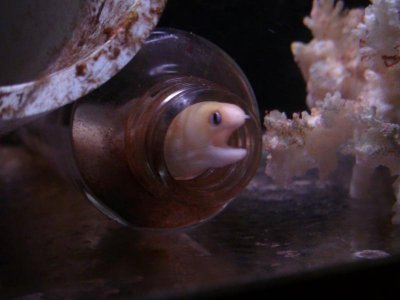
Here is a picture of my GDM Eel:)
 

Attachments

  • DSC01053.jpg
    DSC01053.jpg
    37.5 KB · Views: 13
The problem with the transfer method here is the fact its stressing a animal that has been exposed to parasites- but showing no signs of distress. The biggest risk in transfer is abrading the skin- no matter what the container. Generally a plastic bag is safest- adn whatever it is has to have a tight fitting lid for the actual transfer. Eels are just as fast swimming backwards as forwards- and same goes for out of water. My feeling remains that the likelyhood of injuring the eel and causing a secondary bacterial infection is more risk than I would be willing to take on a animal that does not appear to have parasites, only exposure.
 
The problem with the transfer method here is the fact its stressing a animal that has been exposed to parasites- but showing no signs of distress. The biggest risk in transfer is abrading the skin- no matter what the container. Generally a plastic bag is safest- adn whatever it is has to have a tight fitting lid for the actual transfer. Eels are just as fast swimming backwards as forwards- and same goes for out of water. My feeling remains that the likelyhood of injuring the eel and causing a secondary bacterial infection is more risk than I would be willing to take on a animal that does not appear to have parasites, only exposure.

I am getting worried as today he began scratching his head.:thumbdown He doesn't show any external signs, but I am afraid their attacking his gills. What is the quickest least risky method to help him?
 
I do like sk8rs idea of the floss in a power filter as a no harm way to perhaps help. I am also a big believer in having UV steriliser with eels,sharks and rays.

EDIT-this was not a answer to the above post, which was concurrent.
 
This from Greenbean, who's an expert in marine biology: I posed the queries in Invertebrates, if you'd like to follow it.
http://reefcentral.com/forums/showthread.php?p=18535208#post18535208

The general opinion from GB is that Burgess' results could not be replicated, and the mechanism for ich reproduction is not well understood. So Burgess, while apparently about the only research we can yet find, is not accepted by the scientific community. Seems as if there's a big wide research project waiting out there for someone with a high frustration tolerance and a grant.

GB's general advice seems to be: quarantine, quarantine, quarantine.
 
Re setting up a floss filter: do it as a pot filter with a Maxijet 1200 or equivalent in the bottom of a small bucket, with floss atop. I use poly pillow stuffing from the hobby store: they sell that stuff in man-sized sacks, for not terribly much, which is way ahead of paying huge amounts for silkier dedicated-aquarium floss that, ime, does not trap and hold particulate as efficiently.
 
I still would do nothing at this point other than keep pristeen water conditions, and feeding. Morays very rarely carry ich, so I really don`t think that is your prolem- if there is one. Crypt has a hard time with the slime on the moray due to its toxic nature. The blood chemistry of morays is also diffrent than the other fishes. I think you need to do some long hard study on the physiology of these animals, so you understand where I am comming from when I say what I do. Obviously there could be other issues at play- there has been no diagnosis- but if crypt is the selected issue- I would not be worried.
 
Re setting up a floss filter: do it as a pot filter with a Maxijet 1200 or equivalent in the bottom of a small bucket, with floss atop. I use poly pillow stuffing from the hobby store: they sell that stuff in man-sized sacks, for not terribly much, which is way ahead of paying huge amounts for silkier dedicated-aquarium floss that, ime, does not trap and hold particulate as efficiently.

I have a Magnum 350 pro & small protein skimmer on this QT tank. I can definitely put floss filter in the canister.
 
I still would do nothing at this point other than keep pristeen water conditions, and feeding. Morays very rarely carry ich, so I really don`t think that is your prolem- if there is one. Crypt has a hard time with the slime on the moray due to its toxic nature. The blood chemistry of morays is also diffrent than the other fishes. I think you need to do some long hard study on the physiology of these animals, so you understand where I am comming from when I say what I do. Obviously there could be other issues at play- there has been no diagnosis- but if crypt is the selected issue- I would not be worried.

For now I did a 20% water change and lowered SG from 1.025 to 1.023. I froze one of the fish that died and I am debating about whether or not to buy a microscope so I can truly diagnose this disease. I own Edwad Noga's "Fish Disease diagosis and treatment 2nd edition, so if I had a microscope, I could probably come up with a positive id. Since the water change I have not observed any head scratches.

Thanks again for all your help, I really want to keep this eel healthy, he is beautiful and has lots of character:spin1:
 
Back
Top