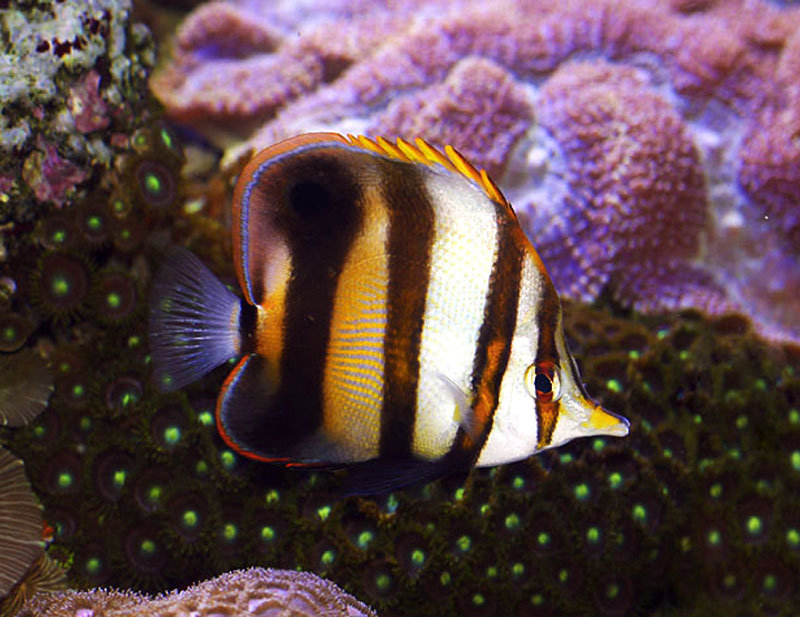
Copperband Butterfly Poll

snorvich

Team RC member
Team RC
I have seen a variety of success stories about this animal but I have also seen stories of no success whatsoever. So I am curious about what experiences you have had with this fish. Did it eat aiptasia? Did it eat aiptasia but not frozen food or blackworms? Did it eat at all? Was it "reef safe"? Was this an Australian CBB? How long did you keep it?
 
I have seen a variety of success stories about this animal but I have also seen stories of no success whatsoever. So I am curious about what experiences you have had with this fish. Did it eat aiptasia? Did it eat aiptasia but not frozen food or blackworms? Did it eat at all? Was it "reef safe"? Was this an Australian CBB? How long did you keep it?

I had one that died after a move. It ate aiptasia sometimes, not often enough. It wouldn't eat frozen food for a while if I remember right. I had to feed it live brine shrimp to ween it onto frozen. Eventually I got it eating mysis.
 
Chelmon rostratus MUST be healthy upon purchase and MUST be placed in an appropriate aquarium environment in order to thrive.

All of the CBB's I've ever dealt with relied on naturally occuring aquarium fare (pods, worms, Aiptasia etc.) heavily in order to survive. In other words, supplemental feedings (alone) would not sustain them long term. This makes them a poor candidate for most fish only systems. There are other better butterflyfish choices for fish only systems.

Established reef aquariums with lots of microfauna are the best choice for this species IME.
 
I had three. The first was a smallish one (2") and ate some frozen brine, but my Yellow Tang kept it hidden most of the time and it died in a few weeks. This was when I was less informed. The second was larger (3") ate frozen brine and mysis and lasted around six months. Ate great until one day it just stopped. Third one was larger too (3") and ate frozen brine & mysis and live blackworms. I had it with a Yellow Tang too. I would feed it frozen with the other fish and every night I'd hand feed it the live blackworms. I'd put the worms in my fingers and let it pick them out, so only he could get them. I had it for a year, then he went to another reefer. I didn't have the time to keep up with the daily hand feedings. My experience with them is: 1 - Don't buy any that don't eat. 2 - Live Blackworms really help these guys. 3 - They don't do well if being harased.

My friend also has one he's had for a while and he's just feeds it frozen with the other fish. Nothing special, buthe feeds his tank way more than mine. So, the daily feedings my not be neccessary in all setups. As far as I know, my wasn't an Austrialian.

 
I've had a 4" one for about 8 months now. At first, it would ONLY eat off of the live rock. It decimated my worm population quickly so I had to start order live blackworms. Finally, after much $$$ spent, it has taken a liking to frozen brine, mysis, bloodworms, etc. It is now the fattest CBB I've ever seen and is the main fish in a 75 gallon tank.
 
I tried 2 or 3 over the years w/out success, just didn't eat, dwindled away.
I'm pleasantly surprised and stoked I finally have one doing well and eating well, almost a year and a half now.
I do admit my system is more together and established this go around, and having anthias my feeding schedule/regimen has stepped up a bit, probably aids in present success.
 
Mine has been with me for 6 months now. it's about 3.5-4. in size. have yet to see it eat. but seems to be putting on weight . my tank is a 265 with Lots of live rock. but I'm still waiting with fingers crossed that he discovers a taste for aptasia.. I believe this one was not from Australia. As far as corals, he has left everything alone. (so far.)
 
How do you tell if it's Australian?
I haven't seen it carry a large knife or any empty Fosters cans or anything, what would be other defining signs?
 
How do you tell if it's Australian?
I haven't seen it carry a large knife or any empty Fosters cans or anything, what would be other defining signs?

the accent. The reason I ask is that Aussie acquisition process is generally superior to other locations.
 
How do you tell if it's Australian?
I haven't seen it carry a large knife or any empty Fosters cans or anything, what would be other defining signs?

In the past, the large, very orange, not copper colored ones were clearly "aussie". Not sure nowadays.
 
this is a fish ive tried several times, never had any fish who who pickers as far as fan worms ect, and ive had them eating frozen aggressively but never had one last longer then 4 months so i finally gave up, 1 did eat aptasia if they were on the smaller side
 
Had mine for 3 months. Ate mysis at the store and still eats them. No pellets eaten. Started eating aptasia first week and ate all of them but ten or so large ones. Now picks on my rhizo, acans, wilsoni, meat coral, and other meaty LPS. Not enough to kill, but does make them look bad. Also picks at maxima clams. Lately, stopped eating aptasia and seems more aggressive with corals. He will be going back to the store this week.
 
I have a beautiful Copperband. Have had him about 3 months now. He eats Frozen Mysis and frozen blood worms like mad. I have tried them in the past without success but my LFS assured me they have been getting them from a great source and a lot of folks have been having success.

It has only been 3 months but he is very fat and does not pick at the LPS. He has gotten rid of the Aptasia as well.
 
I had an Australian for many years which died in a power failure. Adapted to captivity readily but was in a quiet tank. I also had two short lived Indonesian predecessors... IME the latter arrived in poor condition, were very emaciated and had various parasites, making treatment difficult, too. :thumbdown

Since I am local, its easier for me to acquire an Australian one that has been handled well, has a very short flight time and will usually arrive looking fairly solid. But in the US the Australian ones will still need to handle a long haul flight, stay unfed for a few days before shipping etc...so I'm uncertain what condition you receive them in.:confused:

As an aside, none of mine ate Aiptasia.
 
How do you tell if it's Australian?
I haven't seen it carry a large knife or any empty Fosters cans or anything, what would be other defining signs?
the accent :)

I've never heard of any discernable visual differences in appearance of specimens collected from different localities. When I request Australian collected specimens I've had to rely on the honesty of the supply chain, (which is suspect at best).
(IMO/IME) One is better off observing a specimen for a length of time at a LFS than requesting an Aussie be orderd for them.
Here's a feeding video taken yesterday. Note how the Copperband isn't shy and it's very direct about going after food.

<embed width="600" height="361" type="application/x-shockwave-flash" allowFullscreen="true" allowNetworking="all" wmode="transparent" src="http://static.photobucket.com/player.swf" flashvars="file=http%3A%2F%2Fvid7.photobucket.com%2Falbums%2Fy270%2Fgary334%2FMVI_3906.mp4">


tips for keeping Chelmon rostratus can be found in the Reef Central
Copperband Butterflyfish Primer
 
I'm a fan of Muelleri Copperbands, which are endemic to Australia so there is no doubt about point of origin. Currently, I am on my third specimen (my previous Mulleris lived five and three years respectively and my current one has been with me for nearly two). Every one of them ate aiptasia and the first one also devoured Majanos. I've never had a problem keeping them with SPS although I've had them occasionally pick on LPS, especially unhealthy ones. They also relish Blackworms, Mysis, and the occasional feeder bivalve. Completely non aggressive to their tankmates, I wouldn't consider my reef fully stocked without one. Here's what they look like:

Muelleri-11-03.jpg
 
Yes, I love them and would buy one (Chelmon Muelleri butterfly) if available. I am in the process of rereading the CBB primer and may pull the trigger on one for one of my tanks.
 
Back
Top