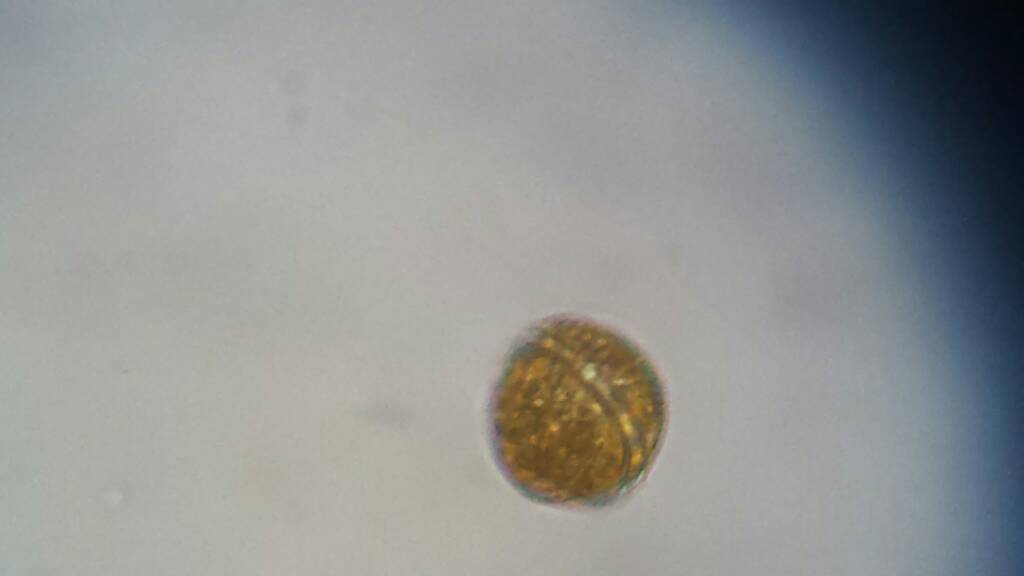
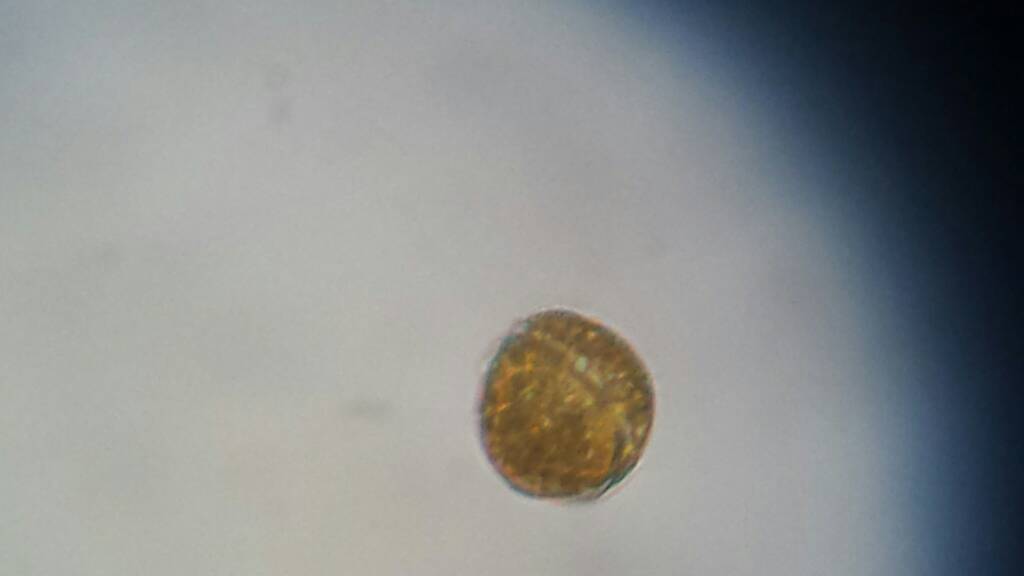
Dinoflagellates.

rallibon said:
34Cygni - are you not being abstemious for the month of January like many of my friends...?!

LOL -- I stand corrected. I don't suppose you know a rhyme for orange or silver, do you?


DNA said:
At that time I thought CO2 was likely to be a big player, but this test showed me it is not. That leaves Calcium and alkalinity as essential elements for dinos.
On a sidenote most of the cyano left as well.

I'm sorry to hear you lost of bunch of corals and that the dinos came back. Is this experiment related to the green stuff you reported punching through the dino mat and then disappearing?

CO2 limitation looks like a nonstarter, as carbonate equilibrium comes into play and HCO3- breaks into CO2 and OH- when CO2 gets low.

If you want to pursue this, I suggest looking at alkalinity. Obviously photosynthesis consumes CO2 and tends to raise alk, so you'd think that a primary producer and its associated bacteria would be into elevated alkalinity. Additionally, alk can affect chemical reactions in the sediment and the bacteria that depend on them to make a living, including the nitrogen cycle reactions and the reduction of manganese, iron, and sulfur. For example, sulfur reducing bacteria need alk to oxidize organic carbon, meaning break apart an organic molecule by removing an electron. Here's the idealized version of that chemistry...

SO4-- + 2 CH2O + OH- ----> HS- + 2 HCO3- + H2O

Since some of the Proteobacteria ostis associate with are facultative anaerobes, you may have found a new way to mess with the dinos' bacteria farms.
 
No the green stuff I have not seen since then and I realize things in reef tanks are often more complex than they look.

What I'm saying is that I may have found the lowest levels of calcium and alkalinity that dinos can live with.
I entered this hobby for the corals and seeing them dying once more is a sinking feeling.

Throughout the years this whole dinoflagellates ordeal has been a pain, but at the same time an interesting challenge like no other.
One of the odd things that shine through are the constant low calcium levels and the total lack of precipitation in the presence of large calcium and kalkwasser reactors running a full efficiency. At the same time the corals grow little or nothing at all.

I'm leaving these findings in the cosmos for someone else to pick up.
Next round is going to be something less deadly.
 
I went from dino hell with dinos covering 30% of the sandbed and rocks and growing:


To this after 8 days using the method I previously posted.


2 months on, no sign of dinos and the tank now looks like this:


As per another who has posted a method to remove them, it's not short or easy. There will be casualties. You may notice I only had 3 SPS and a few softies/LPS, however those who advised me of the methods did the same with large scale SPS tanks. If you want to know what worked, have a look at my previous posts and if you have any questions, feel free to PM me and I'll help as best I can.

Good luck with your battle. It is winnable.
 
Last edited:
No the green stuff I have not seen since then and I realize things in reef tanks are often more complex than they look.

What I'm saying is that I may have found the lowest levels of calcium and alkalinity that dinos can live with.
I entered this hobby for the corals and seeing them dying once more is a sinking feeling.

Throughout the years this whole dinoflagellates ordeal has been a pain, but at the same time an interesting challenge like no other.
One of the odd things that shine through are the constant low calcium levels and the total lack of precipitation in the presence of large calcium and kalkwasser reactors running a full efficiency. At the same time the corals grow little or nothing at all.

I'm leaving these findings in the cosmos for someone else to pick up.
Next round is going to be something less deadly.

I'm confused - Are you saying that dinos need calcium? or the opposite?
 
tasty - your method was to physically siphon them out and maintain ultraclean conditions in an extended blackout with introduction of fauna.

right?
 
These are the dinos in the brown dusting at the front of my tank, different from the amphidinium in the back.

ID help or some names to image search?

Pics at 400x
5cdace4b3a86c5ef27f68fe5597a83e3.jpg


ff1909880263f1a108d5886e6b364fb0.jpg


Video at 100x
https://youtu.be/kB1PvslDOPQ
 
DNA, have you been checking water samples for the presence of coccolithophores?


11/16/2014, 12:37 AM #387
DN

Are there more dino-reefers out there having problems with their parameters?

My system holds 400g, but my kalk stirrer and calcium reactor designed to maintain 2400g are not keeping up.
Correcting the levels only holds for a short time and 400 is the highest calcium level I've been able to maintain recently, but it used to be lower.

11/16/2014, 09:30 AM #389
sculptor

Yes. I dose 2 part via brs dosers and kalk through ATO and I can't get my Ca above 380 and my alk above 7.5 dkh. No precipitation on pumps/heaters here either. I just recently started the kalk, and I almost doubled the 2 part dose( 96 ml per day of each part, up from 55 ml), the only parameter that changed was my pH went up about .2.

DNA said:
Ca of 350, alkalinity of 5 and Mg at 1300.

Maybe low Ca and alk is the result of the system finding an equilibrium point with cocos in the calcium cycle. But eventually, the cocos in your system died off -- or maybe with low Ca and alk they simply couldn't make armor and reproduce as quickly, so predation by the dinos eventually caught up to them. When the coco population went into terminal decline, the dinos went with them. And there's this...

06/06/2014, 01:35 AM #228
DNA
I have even less dinos than last update.
Cyano is still going strong but only half so compared to two weeks ago.
My display tanks algae is at around 25% from its high.

It's been five weeks since I lost most of the dinos and by the rate things are going it could be a clean tank in another five.
The immediate change in the corals was amazing so there is no doubt about the ill effect dinos have on them.
They colored up in a few days and growth that had been none before was noticed.

The most drastic action I did was to turn off the calcium reactor.
Three days later the dinos crashed.

Maybe the cocos crashed first and took the dinos down with them because they didn't have enough food at night to sustain the bloom.

Of course, this all assumes ostis are preying on cocos, but it's a reasonable assumption. As noted, cocos and dinos sometimes co-occur in the wild. Dinos are often seen on the edges of a coco bloom, so I'd guess the cocos are holding the dinos off with chemical warfare, but concentrations at the edges of the bloom are low enough for dinos to nip in and snag themselves a meal.

At any rate, narrowing the parameters to Ca and alk seems to point to a calcifying organism, so it seems reasonable to put cocos back on the table for consideration.
 
Interesting development. I purchased two corals one week apart, both got attacked by dinos while the rest of corals appears dino free and are growing. It appears my other corals developed immunity while new guys need to be blow off several times per day.

Then I decided to dump 16oz homegrown phytoplankton. All dinos disappeared within the hour!
 
Interesting development. I purchased two corals one week apart, both got attacked by dinos while the rest of corals appears dino free and are growing. It appears my other corals developed immunity while new guys need to be blow off several times per day.

Then I decided to dump 16oz homegrown phytoplankton. All dinos disappeared within the hour!

Is dumping that much safe
 
I have speculated about coccolithophores before, but didn't even try to take a look under a conventional microscope due to their small size. If you search for a picture all the identifiable ones are taken with an electron microscope.

I've found some larger calcareous particles sitting on the rocks, but it's hard to figure out if they are produced in the tank or came with the sand. Even though the water looks clear I do have a lot of large floating particles.
 
Then I decided to dump 16oz homegrown phytoplankton. All dinos disappeared within the hour!

This makes one think it is not just the onset of darkness that signals the free swimming period for dinos. I have noticed this in my tank that the dinos start to leave the sand before lights go out.
 
seamonster, have you looked at water samples under your scope before and after adding the phyto? i'm really curious what is happening to dinos...have you (or anyone, really) tried just adding drops of phyto to a slide of dinos?
 
DNA, you should be able to see cocos -- IIRC, E. hux is the smallest coco and it's around 5-6 uM, which is larger than most bacteria, and stained bacteria are visible with a conventional optical microscope. Another approach would be to try filtering a few liters of tank water through a brown, unbleached coffee filter and seeing if you get a whitish residue when it dries. If so, test the residue with vinegar to determine if it's calcareous. Similarly, even if you can't see cocos well enough to identify the species, you should be able to confirm that they're cocos (or at least some form of calcifying phytoplankton) by adding vinegar to a microscope slide and watching bubbles form as their armor dissolves.


DNA said:
This makes one think it is not just the onset of darkness that signals the free swimming period for dinos. I have noticed this in my tank that the dinos start to leave the sand before lights go out.

I theorize that dinos disperse at night to hunt because they need to let their bacteria farms regenerate. Staying in the sand all the time would be safer, so there must be a reason they don't do it... My guess is that if they did, they'd nom through their food supply and crash.

Maybe your dinos leave the sand early because they're running short of food and need to go hunting. Or maybe they've gotten used to the light cycle in your tank and know darkness is coming soon.


seamonster124 said:
Interesting development. I purchased two corals one week apart, both got attacked by dinos while the rest of corals appears dino free and are growing. It appears my other corals developed immunity while new guys need to be blow off several times per day.

Then I decided to dump 16oz homegrown phytoplankton. All dinos disappeared within the hour!

What sort of phyto?

If it's green, that would seem to support the notion that the green phyto is hostile to dinos, and if it sticks, it appears corals can recruit bacteria from phyto to protect themselves. Though it bears mentioning that if your other corals have already recruited dinocidal bacteria, they probably would have spread to your new ones eventually.


PorkchopExpress said:
seamonster, have you looked at water samples under your scope before and after adding the phyto? i'm really curious what is happening to dinos...have you (or anyone, really) tried just adding drops of phyto to a slide of dinos?

Yes, please. If this shows any promise, it would particularly valuable to test different species of dinos against the same species of phyto -- nannochloris, perhaps?
 
I plan on doing that next time I can find some dinos
Where did you start your culture from? I have the concentrated phyto from the lfs..think phytofeast, i do 5 drops daily and i have seen algae show up, should i do more drops to help the dino die?
Just wondering.
Btw i have a 20g
 
Back
Top