Ivy has compiled a spreadsheet to that effect, I believe.Has anyone started a proper log of contributing users that includes
-Species
-theory
-solution attempts
-results?

You are using an out of date browser. It may not display this or other websites correctly.
You should upgrade or use an alternative browser.
You should upgrade or use an alternative browser.
Dinoflagellates.
- Thread starter DNA
- Start date
Done.
I decided last week to get serious about my dinos after 2 occasions where siphoning followed by 3-day lights out only served to beat them back for a month or so. I started reading this thread and thinking what might do it for me, but gave up after the first 20 (!!) pages. This reply is on what, page 124? Is there an executive summary someplace!? lol
Methods I've read that seem to have no success:
-Looking for a magical cure to eradicate an organism that has been around for 500 million years.
-Guessing what you have based on googled pictures.
-randomly trying stuff and giving up when things don't transform in 24 hours.
Where I think I went wrong is a combination of a lot of things, resulting in water that is 'too clean' by stripping too much from the water.
-Wet skimming pulling as much out of the water as I can
-Carbon dosing, stripping virtually all nitrates from the water
-heavy regular GFO use resulting in no detectable phosphates
What I think (hope) will work over time:
-Re-balancing the micro ecosystem to out-compete them and at least keep them visually out of sight.
So far I've
-borrowed a microscope from the lab at work to confirm Ostreopsis. The little sesame seed shaped heathens are spinning about on their point, or in a small circle. I've ordered my own microscope so that over time, I can gauge the health and diversity of the microfauna in my water, sand and on the rock.
-Turned down my skimmer
-gradually dialed back my carbon dosing over a week, to reach 0 yesterday.
-Replaced the carbon source (vinegar) with a bottle of 3% hydrogen peroxide, dosed at 2ml per 10 gal (for now) about 2 hours after lights out. It's on a dosing pump so I know it won't get skipped.
I had two bouts of microbiologist confirmed ostreopsis. They eventually went away on their own, disappearing a quickly for reasons I don't understand. I can tell you that blackout periods do not work with this species. I experimented by placing ostreopsis in a spare tank in total darkness for well over a month. Then, upon placing water samples under a microscope I found them alive and well.

karimwassef
Active member
Does anyone know if ostreopsis is photosynthetic on its own (without cyano farming)?

DNA
New member
Does anyone know if ostreopsis is photosynthetic on its own (without cyano farming)?
Definitely or they would not been classified as mixotrophic and they would not care if they sit in or out of the light.
Molecular Analysis of Genotype Identification
The final alignment of Ostreopsis C5 strain sequence of 5.8-ITS rDNA with all Ostreopsis spp. sequences from GenBank gave 100% of identity with O. cf. ovata ribosomal sequence.
Light and Epifluorescence Microscopy
O. cf. ovata cells (Figs. 1A"“1E) are anterio-posteriorly compressed and show a typical oval tear-shaped morphology pointed to the ventral side. They present many yellow brownish elongated chloroplasts, radiating from the centre of the cell (Fig. 1A). Chloroplasts, when observed by epifluorescence microscopy, show an intense red autofluorescence under blue (Fig. 1B) and also green excitation. This fact is likely to be related to the abundant presence of accessory photosynthetic pigments, such as carotenoids, in addition to chlorophylls. Few small yellow fluorescing rounded bodies are visible in the inner part of the cell under blue light excitation (Fig. 1B, arrow).
Source:
http://www.ncbi.nlm.nih.gov/pmc/articles/PMC3584116/
karimwassef
Active member
So they can't fix nitrogen and are photosynthetic. Agreed?
karimwassef
Active member
Here's where I'm going.
Ostreopsis....... Photosynthetic.... Can't fix Nitrogen (needs organic N)
Cyano............. Photosynthetic.... Can fix Nitrogen (uses N2)
Phyto.............. Photosynthetic.... Can't fix Nitrogen (needs organic N)
I'm leaving off the mixotrophic nature of Ostreo for now.
Is that right?
Ostreopsis....... Photosynthetic.... Can't fix Nitrogen (needs organic N)
Cyano............. Photosynthetic.... Can fix Nitrogen (uses N2)
Phyto.............. Photosynthetic.... Can't fix Nitrogen (needs organic N)
I'm leaving off the mixotrophic nature of Ostreo for now.
Is that right?
karimwassef
Active member
By the way, for those trying the dirty method - anyone considered just adding Miracle Grow directly to the tank? I can't think of a faster way of getting organic N into the system.
It's what I feed my phyto.
It's what I feed my phyto.
Funny you should mention that...By the way, for those trying the dirty method - anyone considered just adding Miracle Grow directly to the tank? I can't think of a faster way of getting organic N into the system.
It's what I feed my phyto.
This is what I picked up at home depot yesterday.
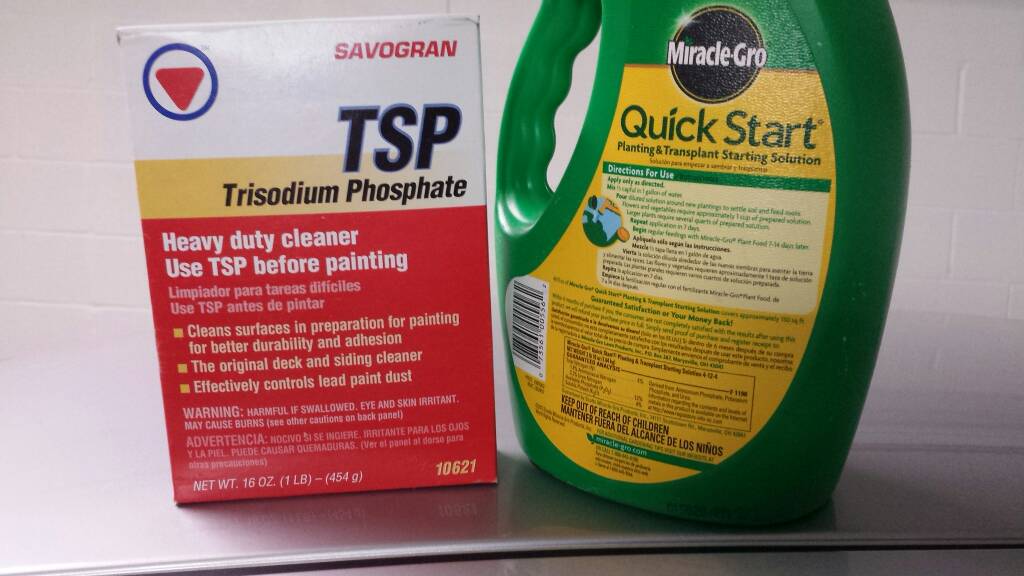
...the miracle grow is heavy P relative to other things, to go along with my KNO3 that I have already been adding.
However, I looked up the metals content on miracle grow , and there are several things present that give me pause.
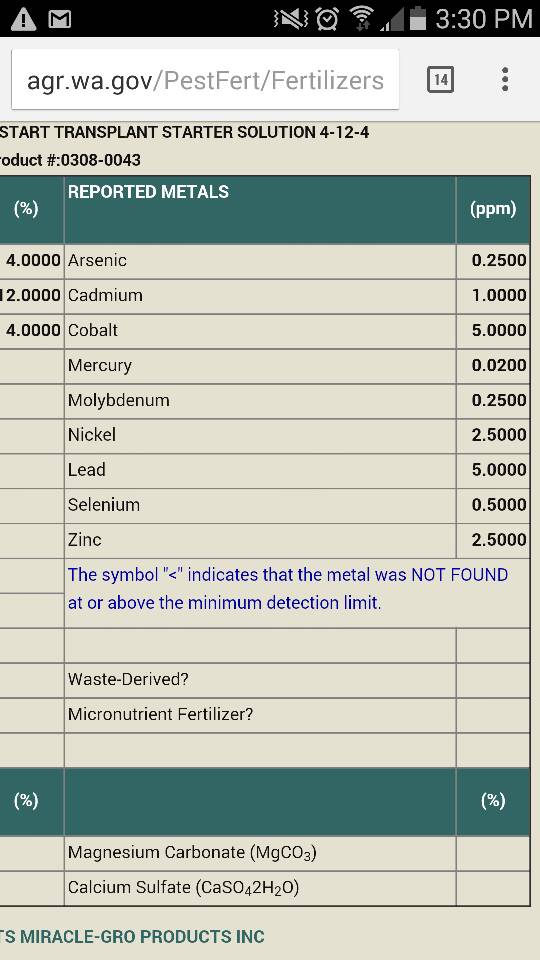
Link http://agr.wa.gov/PestFert/Fertilizers/FertDB/prodinfo.aspx?pname=2099
I'll have to look more closely to do the math on what levels those would actually end up putting in my tank.
Regardless, I'm planning on using miracle grow, KNO3, the trisodium phosphate, a high P fish food, and a freshwater plant additive in small scale beaker tests to see how things go.
Some in combo with trace metals, some without.
What I hope to see, is what aspect of competition with large amounts of micro-life causes the dinos disappear.
I suspect (because it would align with lots of info in the thread) if I dose pure N or P or N+P without access to additional trace elements, that the dinos would disappear. But if I add trace elements then they'll continue to coexist with the micro-life.
OTOH, If the dinos disappear in the presence of heavy micro life with or without trace element additions, then that suggests something more direct like predation.
Oh, by the way, I never reported the results of doing the upturned beaker filled with skimmer "green tea" placed into the sandbed.
Did it in 3 spots in the tank. All 3 spots dinos disappeared after about 3-4 days so I left the beakers in place two days after the dinos were gone to allow the micro-life to colonize the sand more thoroughly and see if they could hold their ground.
This is pic of the area where a beaker was, oval area just behind rocks in the center that isn't brown and dusty.
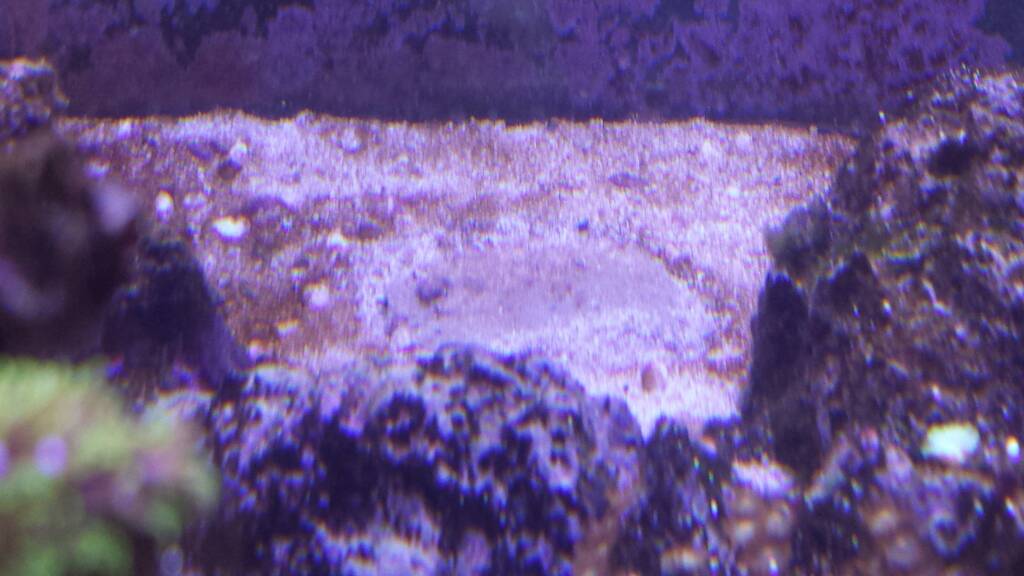
Within a week of beaker removal, the dinos once again ruled the sand.
Did it in 3 spots in the tank. All 3 spots dinos disappeared after about 3-4 days so I left the beakers in place two days after the dinos were gone to allow the micro-life to colonize the sand more thoroughly and see if they could hold their ground.
This is pic of the area where a beaker was, oval area just behind rocks in the center that isn't brown and dusty.
Within a week of beaker removal, the dinos once again ruled the sand.

Quiet_Ivy
New member
By the way, for those trying the dirty method - anyone considered just adding Miracle Grow directly to the tank? I can't think of a faster way of getting organic N into the system.
It's what I feed my phyto.
I thought about this as I have probably 8 kinds of fertilizer kicking around. My problem is, they list nitrogen as "total N", and I don't know how to calculate a target nitrate from that. Assuming it is present as nitrate and not urea or some weird thing. Not to mention MG has a LOT of phosphate -that 2nd number in the list is percent phosphate. It was actually easier for me to buy potassium nitrate and calculate it out. (Now using sodium nitrate for extra safety).
I should start asking this, what phyto are you culturing? Single species or mix?
ivy (I just throw an unmeasured pinch of fertilizer into my watering can for my plants, but by gosh I'm gonna calculate out a stock solution of NaNO3 with a gram scale for my aquarium

@taricha How are you going to reduce trace elements? Very interested in your sandbed idea, hope that works for you.
Quiet_Ivy
New member
Has anyone started a proper log of contributing users that includes -Species-theory-solution attempts-results?
Well I have been tracking the thread, but really the 'data' is essentially anecdotal. The majority of sufferers don't have a microscope so we can't even be sure we're dealing with a dinoflagellate rather than Calothrix or some other cyanobacterium.
Conclusions from this thread:
-It's not necessarily dinos
-Try not to have Ostreopsis, it is especially annoying
-Using One method at a time does not work. (even dino X on its own), and none of the methods are fast. Give it at LEAST 2 weeks, a month is better for the dirty method.
-Add phytoplankton and pods whichever method you go with
-UV plus phyto and pods is the fastest method (2ish weeks). UV has the most positives and fewest negs although recently several people report recurrence and ineffectiveness vs Ostreopsis
-hydrogen peroxide has more negatives than positives
-None of the liverock treatments (dipping in fresh water, keeping rock in the dark, etc) work.
-Tank restarts don't work if anything from the infested tank is used
-Dino X has more negatives than positives in this thread altho reverse in other forums. Several neg reports very serious, mass tank deaths
I'm trying to write a big faq but it is rather incoherent atm.
hth
ivy
NOTE: I'm attaching my faq in progress. It's somewhat out of order and there's no html yet. Please leave lots of feedback and remind me of stuff I missed. (34C, I'm going to add your work, just haven't got to it yet) Feel free to viciously correct my grammar, I don't offend easily.
I'm also considering doing a formal survey by gmail, is anyone interested? I know Pants did one but I haven't seen results posted anywhere.
Attachments
Last edited:
I'm not. Just going to have some samples that I add trace elements to and others I don't.@taricha How are you going to reduce trace elements? Very interested in your sandbed idea, hope that works for you.
If trace elements are removed in a beaker, then it would be through competition.
karimwassef
Active member
Here's what I found:
The nitrogen in Miracle-Gro liquid fertilizers is provided by urea, which is anhydrous ammonia (NH3) and potassium nitrate. Both are water soluble, making the nitrogen immediately available to the plants' roots. Nitrogen promotes the rapid, lush growth of the vines and foliage. By combining nitrogen with phosphorus and potassium, Miracle-Gro fertilizers also provide the nutrients needed for strong root and stem growth, flower production and increase the size and amount of fruit.
http://www.miraclegro.com/smg/products/Miracle-Gro/pdf/All_Purpose_1.5.pdf
<a href="http://s1062.photobucket.com/user/karimwassef/media/0_zpsbx53vwty.png.html" target="_blank"><img src="http://i1062.photobucket.com/albums/t496/karimwassef/0_zpsbx53vwty.png" border="0" alt=" photo 0_zpsbx53vwty.png"/></a>
so about 25% pee?
The nitrogen in Miracle-Gro liquid fertilizers is provided by urea, which is anhydrous ammonia (NH3) and potassium nitrate. Both are water soluble, making the nitrogen immediately available to the plants' roots. Nitrogen promotes the rapid, lush growth of the vines and foliage. By combining nitrogen with phosphorus and potassium, Miracle-Gro fertilizers also provide the nutrients needed for strong root and stem growth, flower production and increase the size and amount of fruit.
http://www.miraclegro.com/smg/products/Miracle-Gro/pdf/All_Purpose_1.5.pdf
<a href="http://s1062.photobucket.com/user/karimwassef/media/0_zpsbx53vwty.png.html" target="_blank"><img src="http://i1062.photobucket.com/albums/t496/karimwassef/0_zpsbx53vwty.png" border="0" alt=" photo 0_zpsbx53vwty.png"/></a>
so about 25% pee?
Last edited:
DNA
New member
I'm also considering doing a formal survey ...
Here is my survey from last year that all, but two couldn't be bothered to take part in.
I was immensely happy with it because it tells you so much about ostreopsis.
It's an Open Office spread sheet.
Enjoy.
---
Edit..It's an invalid file type for RC.
tarcia and Ivy, I'll email it to you if you leave your email in PM.
reefcentral123
In Memoriam
quick update: tank is cleaner than it's ever been. absolutely no sign of dinos, no algae either it blows my mind how I could be feeding this much w/ no water changes and its the cleanest its ever been. some aiptasia is spring up however, gotta get to killing those things

Travis1787
Active member
So I actually got a UV sterilizer to help with ich outbreaks and in very happy to know it may help with dino actually too!
How long of flow are those running UVs going? I have a 210 DT but with sump and 15 gallon holding tank for Frag and or quick water changes my total water is probably closer to 275 gallons.
I went big with the UV as I was instructed I got an emperor aquatics 80 watt unit, they are $600-700, I found one on amazon from a store that was blowing them out for $319 due to no longer carrying them and I couldn't pass it up!
But what should my flow rate be? How slow for a 210/275 total? 200 an hour? 300 an hour? 250? Curious what those using them are at
How long of flow are those running UVs going? I have a 210 DT but with sump and 15 gallon holding tank for Frag and or quick water changes my total water is probably closer to 275 gallons.
I went big with the UV as I was instructed I got an emperor aquatics 80 watt unit, they are $600-700, I found one on amazon from a store that was blowing them out for $319 due to no longer carrying them and I couldn't pass it up!
But what should my flow rate be? How slow for a 210/275 total? 200 an hour? 300 an hour? 250? Curious what those using them are at
Travis1787
Active member
Also when you all say dirty method are you cutting off gfo and pellets completely? And if so how long? Do you re I introduce them back later slowly?
Great thread wow
Great thread wow
Quiet_Ivy
New member
Also when you all say dirty method are you cutting off gfo and pellets completely? And if so how long? Do you re I introduce them back later slowly?
Great thread wow
Dirty method just means 'let your phosphate creep up to 0.03ppm and nitrates 5 or less'. You can do this by reducing media and water changes, or increasing feeding. (I recommend keeping carbon in the system. Some dinos are very toxic)
I wouldn't just yank out the pellets. You could pull out some pellets and not change your GFO as often, watching your system to see how it's going. Keep elevated nutrients until you see green film algae on the glass and no dinos. How long really depends, but with UV you should see strong results within 2 weeks if it's going to work at all.
hth
ivy
karimwassef
Active member
go 200 gph through the UV
Travis1787
Active member
Awesome thank you so much for clarifying and anyone else that can answer on how much gph should be through the sterilizer let me know. I would think for a 210 with roughly 60 extra gallons in Sump and holding tank 180 or 200 GPH would be good
Similar threads

- Replies
- 61
- Views
- 692


