Dinoflagellates.

take before and after pics. I rarely took pics before (too ashamed...) and I regret it now.

It's really important when it comes to helping others... keeping good logs of data, images, etc... it really adds to our collective knowledge.
 
Experiments!
d2e6bc42a10f9fbd2ffa7191dc9e628b.jpg

I have so many dinos to experiment on...


Here is my setup


Here are the problems


My Over flows are always like that highly annoying and other areas of sand are like the first picture. I'm not sure if its dinos but after reading through bits of these pages it sounds like it.

This setup is also very new its about 3 months in but the 110 I transferred from had the same issue. I had already bought a UV recently to help out with controlling parasites and I'm really curious to see what it will do in helping with the algae. Just got the UV in line tonight so it begins now! Here is the setup.


This is in the bathroom closet which is directly behind my tank so its all plumbed right through the wall.

So the UV water drains into the holding tank, which drains into socks in sump which then goes through the Skimmer zone and bubbles traps and then return zone which feeds DT,reactors and UV/holding tank.
 
I'd add carbon - as they die, they can release nasty chemicals.
And wash the socks to remove the dead... or remove the socks and let the skimmer clean them up.
I ran my UV in lights out to export as many as possible as fast as possible.
 
Karimwassef I wish I had taken before and after pics as well but like you too embarrassed lol! Mind you my outbreak was spotted early so never looked as bad as some although the impact on some corals was obvious. I can't add carbon yet as still using the polyp lab medic. Day four of having lights back to normal although have reduced the red spectrum a bit rocks are looking the cleanest they have ever been. All zoos, xenia, colt coral and Kenya trees looking good. Just two tiny spots appearing on them but most of the dusting gone now. 10 micron socks lasting two days now as well. Still dosing bacteria, coral snow and polyp lab medic to help with what seems to be a very slight outbreak of WS just on my coral beauty. I suspect this has been due to me doing so much siphoning! Pretty sure that is helping get rid of the 'dust' as after dosing I get a nice load of bits floating into the water column. Cheato completely clear now and starting to grow again, adding a nice population of pods every day as I now have a nice breeding tank going on. I still can't say it has gone completely but every day there is less and less just two or three strings yesterday on the colt and Kenya tree.
 
I seem to be winning the battle for the moment against my ostreopsis. After a week, visually, it is mostly gone from the rocks and sand surface in the display. It became more abundant on egg crate in my frag tank, so I've banished that for the moment also. Corals seems to be doing better, less closed, and my plate, hammer and torch corals seem to be well inflated and extended more than I've seen in a while. Carbonate (alk) consumption is up as well, but by what percentage I still need to work out.

I still have no measurable phosphates or nitrates in the water column

The theory I've hung my hopes on is a lack of abundance and diversity of microfauna and microbial life, which seems to be improving. I'm basing this on microscopic observations of water samples, which I'm getting after taking a cup of substrate from the most afflicted spots, and taking a sample with a syringe from below the sand in said cup. There seems to be fewer dinos in the sample, and more (at least a dozen) ciliates I think. They are single cell beasties that move about with little hairs as legs. Last week, I only saw two, one each in 2 of 3 samples. There were also 4 or 5 worm shaped microbes, I've no idea what they might be called. Last week I only saw one of them, once, out of three samples.

What I've done so far:
-stopped carbon dosing (vinegar)
-2ml/10 gal hydrogen peroxide
-reduced skimming
-increased feeding
-adding 2 capfulls of Seachem Reef Phytoplankton daily

This is all very anecdotal, but if there's any specific data I can begin collecting, or results I can test for repeatability, please let me know.
 
Last edited:
Any order those need to be done in? Can you start dosing phyto anytime? Do you need to cut out carbon dosing/pellets before adding peroxide?
 
Any order those need to be done in? Can you start dosing phyto anytime? Do you need to cut out carbon dosing/pellets before adding peroxide?

I did them all at about the same time. But I'm no authority on the subject, I'm just a desperate reefer up against a difficult, persistent pest.

From what I've read, ostreopsis is the most resilient type of common dinoflagellate. There's no 'one' cure, it needs to be multifaceted, sustained for several weeks, and probably repeated again periodically.
 
my update

my update

I am just posting an update on my tank. I am assuming what I have in the tank may be amphidinium dino's. We were running the UV lite 24/7 and we noticed a big decrease in the dino's on the corals rocks and sand. Most of what was left was only in patches on the sand. My husband was syphoning out a lot of the dinos on the sand weekly as well. Then we added the macro algae and pods and that also helped. Last weekend we added Seachem Stability and shut off the UV for 24 hours as directed on their website. Today I am looking in the tank and the dino's are returning. So it is either from adding the Stability, shutting off the UV for 24 hours or a little of both? I have a question mark there because I am speculating. So I don't think I will be adding that anymore. Oh, and we have also been running a little dirtier tank than usual for the last few months no longer aiming for zero nitrates.
 
why stop UV?? I left my UV on for months after I got the dinos out. It gave the other benthic microorganisms time to take hold.

the UV was not stopped altogether. Just for 24 hours per the Seachem Stability instructions to allow the spores to dilute and turn into bacteria and then make its way to rocks or sand. It is so the UV doesn't kill the beneficial bacteria while in the water column. The UV was turned on again after the initial dose of the Stability was added and allowed to settle.

I am wondering if the dino's were feeding on the added bacteria.
 
I am all for adding bacteria, but I add it directly to regions with high surface area.. Sandbed, rockwork, especially between and around the rocks, cryptic zones, etc...

IMO - I would turn flow off at night and apply the bacteria to the regions with the highest dino populations by day and give it some time (an hour?)... Then turn flow on again.

If some are killed by UV- it's casualties of war.

They usually also say to stop skimming. I don't do that. The extra bacteria population could consume a lot of oxygen, so I keep everything on.
 
Thanks for taking on the task of developing a useful FAQ, Quiet_Ivy.

So You Think You Have Dinos said:
Dosing peroxide at 2mL/10gallons has helped a few people, but has NOT worked for the majority. Whole tank dosing of peroxide is dangerous to small ornamental shrimp and clams.

H2O2 + UV was a thing back in 2014...


11/09/2013, 03:19 PM #82
Josh40996
Frag-nem-style /><{{{">

I have been battling Dinoflagellates for some months now and have tried lots of methods to eradicate them in conjunction with lights out, with each only providing a Dino. free reef for several seconds after lights back on.

Recently, I invested in a 24 watt UV sterilizer for my 30 gallon reef and installed it on my tank. I turned off my lights and covered the aquarium for 3 days. During the 3 days of darkness, I continued to dose H2O2. 1ml of 35% H2O2 per day.

The results are spectacular! Once lights were resumed, no Dino bloom and any remaining Dinos. have slowly disappeared. The skimmer went nuts for the 3 days the lights were off and after the 3rd day, the skimmer collection jug overflown. I have been Dino. free now for 3 almost 4 days now and have done my first water change in almost a month and still no Dinos. bloom as a WC always promoted. For me, even a week free from Dinoflagellates is worth anything as it is the most problem free the tank has been for months.

I am a very happy chap.

...UV in conjunction with the H2O2 really did the trick

08/23/2014, 05:02 PM #318
LelandF.

Well I've been fighting dinoflagellates for over 2 years in my 200gal reef, and I feel I've finally beat them. I've literally tried everything over the last 2 years. I replaced my sand bed, I did a 3 day blackout, I changed large amounts of water every week, I didn't change any water for months, I tried large amounts of GFO, I tried large amounts of activated carbon, I tried vodka dosing, I tried replacing the light bulbs, I tried UV, I tried adding a brightly lit refugium, full of caulerpa and chaeto, etc. I am a very educated, long time aquarist, and I've always had successful reef aquariums, but this tank has been a headache to say the least.

After trying everything I decided that I was going to go at the Dino's hard, or tear the tank down and start it over with new rock and sand. I figured that I would spend a large sum of money on starting over, and with my luck the Dino's would probably just come back.

So, my current tank is 7'x2'x2', with 2-vortech mp40's, one on each end facing each other. I normally have them on quick pulse, but changed them to 100% power on continuous mode, and increased the size of my return pump to increase turnover through my sump & skimmer. I added a filter bag to my sump, and added a aqua UV unit that I hung on the main tank w PVC and a mag drive to help sterilize the main tanks water quickly. I changed my dosing pump to dose the kalkwasser make-up water during the day instead of the night, to raise the daytime pH. I also added 2mL/10gal of fresh peroxide for 8 days. I also started blasting my rocks and whole tank with a power head, in the morning and evening.

Within 2 days the Dino's were almost gone. In 5 days, there weren't any Dino's to be found.

...but it didn't catch on because the dinos always came back.

I don't know as anyone has tried H2O2 + UV and followed up with the dirty method or pods & phyto to keep the dinos down, but it looks like it might be worth a shot.


taricha said:
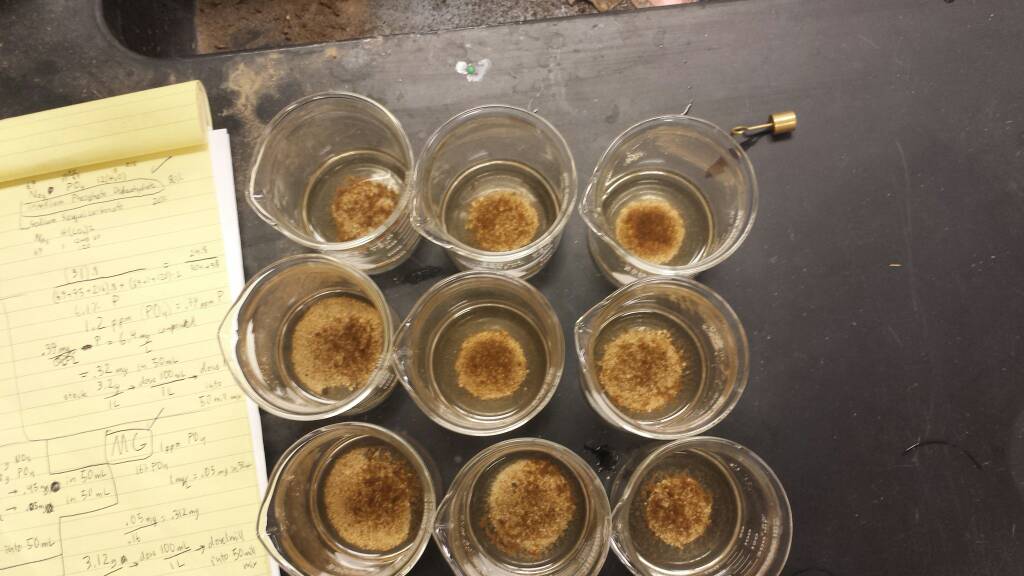
I have so many dinos to experiment on...

Not to mention what looks like a proper lab bench to work on. Neat. Where are you doing your mad scientist thing?

Have you tried transplanting a beaker of dino sand into your 10G live sand culture tank? That is, have you tried the reverse of the experiment with the phyto tea in an upside-down fish bowl?

Or if you don't want to risk that, have you played around with feeding dinos to your phyto tea? The idea being to increase the populations of whatever creatures, be they bacteria or protists or microfauna, are eating the dinos before you dose your tank.


justthewife said:
I am wondering if the dino's were feeding on the added bacteria.

Seachem Stability contains a lot of nitrogen cycle bacteria, but in a fully cycled tank, at any given moment there are about as many N-cycle bacteria as the tank can support. Even if the bacteria in Stability successfully hatch and take over the appropriate ecological niches in your sand bed, their success will come at the expense of an established population of nitrogen cycle bacteria, so large numbers of bacteria are dying somewhere and providing a burst of fresh nutrients for the dinos' bacteria farms.

Or maybe some OTC bacteria products are dino chow, as you suggested.

Quiet_Ivy may have better info in her chart, but IIRC PorkchopExpress and cal_stir reported OTC bacteria-in-a-bottle did nothing and stopped dosing. There doesn't seem to have been much enthusiasm for it until relatively recently, though this is an exception:


02/06/2015, 08:41 AM #743
GilliganReef

I beat DINOS by:
running a GFO reactor, Carbon reactor
every other day siphon into filter socks/replace
weekly 10% W/C, every other week 25%
3 days lights out once a month.
The thing I found to help really fight it was adding beneficial bacteria into my tank.
Started 15 day prodibio Bioclean
6 weeks prodibio reefboaster.
Been doing this for 3 months now and No DINOs.
 
Not to mention what looks like a proper lab bench to work on. Neat. Where are you doing your mad scientist thing?
In my physics classroom. [emoji12]

Have you tried transplanting a beaker of dino sand into your 10G live sand culture tank? That is, have you tried the reverse of the experiment with the phyto tea in an upside-down fish bowl?
Nope, still waiting for my live sand culture to get more algae filled (getting close), but it's pretty live with tiny pods already. But you're exactly right. I will add dinos to the culture sand first.
Besides, if the culture live sand can't kill a few ml of dinos, then there's no point going through with the sandbed transplant.

Or if you don't want to risk that, have you played around with feeding dinos to your phyto tea? The idea being to increase the populations of whatever creatures, be they bacteria or protists or microfauna, are eating the dinos before you dose your tank.
Thanks so much for crystalizing the idea for me. That idea connects a lot of things I've had knocking around in my head for a couple of days:

Most of my beaker tests are based on the theory of the skimmer green tea outcompeting dinos for some resource like trace elements, but as I looked at papers on the topic, depletion was having an effect on the dinos over like 4 weeks or 8+ weeks. It just doesn't match what I'm seeing (dinos gone in 4-7 days). The short time scale strongly suggests predation (or poisoning etc). Realized this only after I set up my beaker tests.

The skimmer tea is practically dino free (my dinos don't leave the sand) and likely concentrates stuff that eats dinos.
In the right ratios it can eradicate a patch of dinos.
In insufficient ratios, the dinos are unaffected.
I put the skimmer stuff in light for 24-48 hours to try to concentrate whatever is in there, but it looks thin under the scope. Maybe it would work better straight out of the skimmer.
After a few days of putting the mix with the dinos, at the time the dinos are decreasing, under the scope the mix looks absolutely packed with zooming life.
I've also thought maybe I should cultivate the skimmer mix in the dark, that way the organisms in the mix would be undisturbed by lights out, and I could hit the dinos with a 1-2 of darkness + skimmer mix. I couldn't call it "green tea" though, Maybe I'll call that skimmer "black tea."
Thank you again.
 
Back
Top