jason2459
Well-known member
Yep, tardigrades are masters at it. Son and I are bear hunting but haven't found one yet. As it warms up and moss and such grows again I'm sure we'll find one.new word for me - cryptobiosis
Google it.

Yep, tardigrades are masters at it. Son and I are bear hunting but haven't found one yet. As it warms up and moss and such grows again I'm sure we'll find one.new word for me - cryptobiosis
Google it.

Spores or cysts can survive through most conditions like freezing, fresh water, being completely dry, desiccation, or even baking. I don't know if boiling works either. It depends on the structure of the protective shell and the water content inside.
http://www.scientificamerican.com/article/how-do-one-celled-organis/
It's like a hard shell with a very simple seed hidden away in a molecular form deep inside. It can probably go into space and survive unless it gets hit by high energy particles to destroy the nucleus. Normal UV (like sunlight) won't destroy it either. Higher UV might, but the shell may still provide sufficient protection.
Here's cyano surviving in space on the ISS
http://phys.org/news/2010-08-microbes-survive-year-space.html
and even higher forms
http://morgana249.blogspot.com/2014/08/6-organisms-that-can-survive-travel-in.html
Acid will dissolve the tissue directly, so it literally removes the material it is made from.
Vinegar and H2O2 may not be strong enough though?
Yeah, I agree the vinegar may not be enough but he was not wanting to go the muriatic acid route which I don't blame him. Using vinegar I would let it soak for at least several days.
Sent from my SM-G930V using Tapatalk
Tell me the steps of the muriatic acid please? I'll do it. If this is the best way.
I am going to put all my rocks (30 lbs) in a 5 gallon bucket. How much vinegar would I need? They sell it by the gallon I believe. How long should the dip be also?
And quick question. Why would I need to acid bath the rocks if they are dried out? Is it really possible that some dinos can survive on rocks that have been dry for a week?
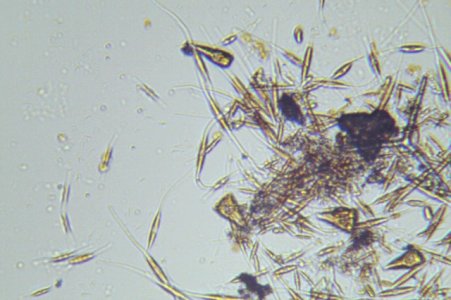
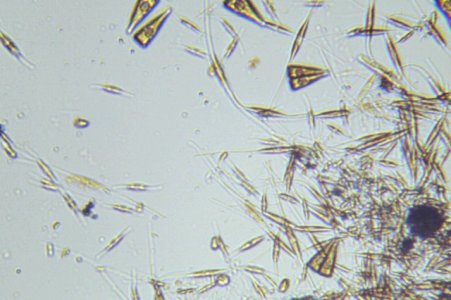
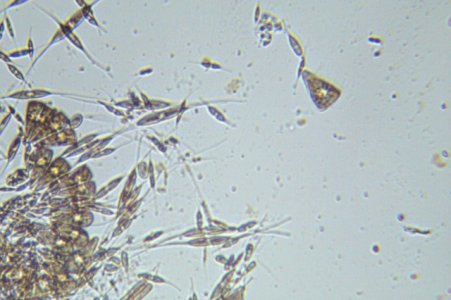
Nice shots. That's a healthy crop of diatoms. Where in your system is it from?
Sent from my SAMSUNG-SGH-I337 using Tapatalk
Maybe some dino but there's a lot of variety out there. Looks like you mainly have a diatom issue.I used a brush to scrape the frag discs that had some brown/air bubbles on them. Before that I tried just water column but couldn't see a single particle.
The little oval guys - not dyno? I that they were. Going to do a sample tomorrow off the scrubber.

I couldn't either. I don't think anyone could see them.Can anyone verify if they could see the pictures I posted two pages back.
I know of one that apparently could not.
Can anyone verify if they could see the pictures I posted two pages back.
I know of one that apparently could not.
Looks like diatoms to me.
Go for a few more spots for samples to be sure and don't forget to use scale and movement.
Do it outside
Don't let pets or children near it
Add the Acid to water never the other way around
Be Careful
Wear protective clothing, gloves, mask, goggles, etc
Baking soda can help neutralize it
http://www.reefcentral.com/forums/showthread.php?t=2142685&page=2
Dinoflagellates might survive in spore form even if the rocks are dry. A vinegar dip likely will kill them. I might try a 50:50 mix, and let them sit with some circulation for 30 minutes or so. Bleach would be cheaper for killing dinoflagellates, though.
For treating rock for mineral deposits like phosphates, I'd add 1 part muriatic acid to 10 parts water, and let the mix sit for 20-30 minutes, but muriatic acid requires careful handling, as indicated.
Updates.
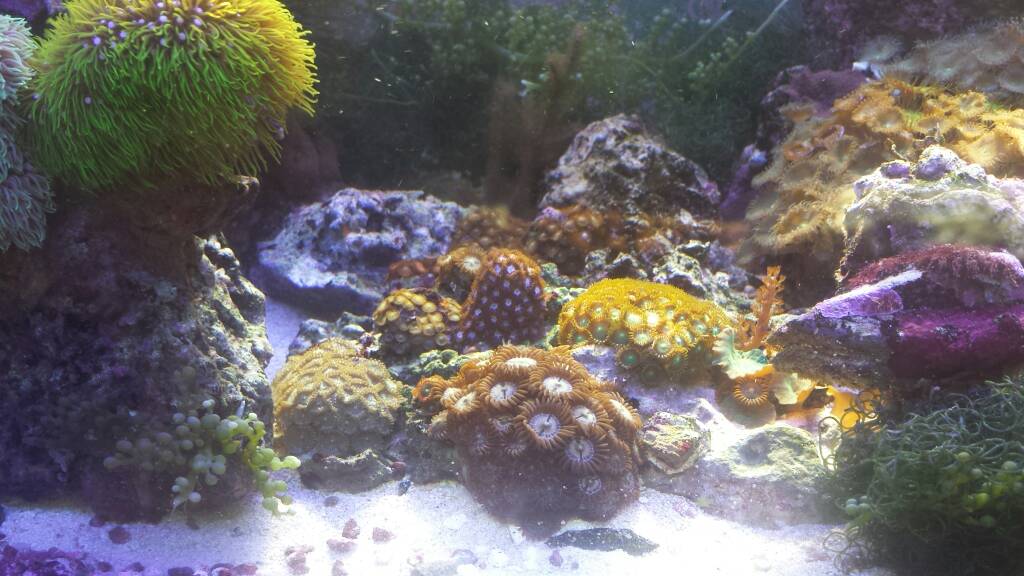
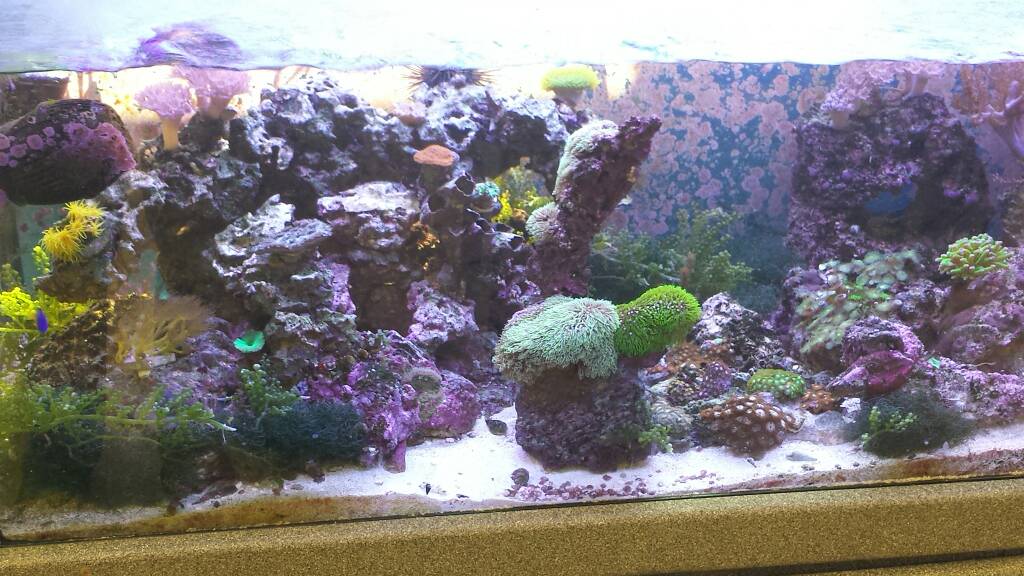
My tank looks better than it ever has.
And a FTS
But I suppose I still "have dinos."
Every day I wring out, then FW rinse clean the filter floss strip that I have mounted in front of my biggest powerhead.
It's always ostreopsis that comes out, virtually nothing else - pure ostis.
So that's my daily dose to do experiments on. No sign of dinos anywhere else in the tank. I do have one corner with a little patch of cyano. I still have a massive amount of caulerpa and chaetomorpha in the tank. Not ready to remove it yet.
As for experiments, I repeated the iron B12 trial using a different B12 vitamin with different fillers than the other one.
Last time the control had very few dinos, B12 grew more, and Fe grew more than double the amount of others.
This time the B12 did worse than the control at growing dinos. It grew cyano and bacteria much more. I suspect much of the effect either way is fillers in the vitamin, going to stop testing B12 unless anyone knows of a pure b vitamin source.
The iron treatment again did by far the best at growing dinos. The dino population in the Fe was at least double that in the control or B12 every day for about a week. In the end, Fe had almost 3x dinos (ostreopsis) that the control did.
I feel pretty comfortable saying that in my tank with high levels of available N & P & light and tons of macroalgae, the low presence of iron limits the dino growth. (I'm sure it slows the algae growth too). To me it's not far fetched to think that it might happen in other healthy systems where algae growth keeps Fe low and keeps dino population growth below predation levels and out of sight.
If anyone knows of a method other than algae competition - faster hopefully - that can take iron down below biologically usable levels that might be an interesting thing to look into. Triton Detox looks intriguing. But remember we're talking about levels way below what Triton test (or any other easily available test) can detect.
That seems in Randy's wheelhouse but I haven't seen any posts of his about stripping Fe out of water, except to tell people don't do it.