
Dinoflagellates.

It's well known and studied how much carbon, phosphorous, etc are absorbed ("sink") by calcium carbonate rock or substrate. Not a myth.

I wanted to believe that and I couldn't find the evidence for it. To be clear, I believed it for years before being challenged on a thread here. Try and find it... I couldn't substantiate it. Do a reefcentral search- maybe you'll be more successful than I was.
 
I wanted to believe that and I couldn't find the evidence for it. To be clear, I believed it for years before being challenged on a thread here. Try and find it... I couldn't substantiate it. Do a reefcentral search- maybe you'll be more successful than I was.

No need to search reefcentral. Chemistry of the Sea by Pilson.

It's an equilibrium thing. So, can't say it will or will not release or attract anything right away.
 
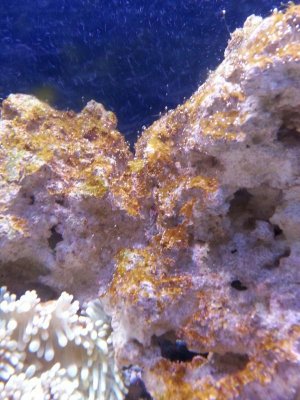
Is what i have dino? What can i do to treat it that will not hurt my BTAs? Thanks in Advance!
 

Attachments

  • aq.jpg
    aq.jpg
    79.9 KB · Views: 8
I sure if you were to ask Santa Monica he would have 5 or 6 scholarly articles on this subject.

But I think it's also proven with the scrubber only users out there. What happens is people don't change their CFL light bulbs every 3 months. Because it's still growing green and there is no algae in the tank everything seems fine. But really the scrubber is way under powered and some or most of the nutreints are being sucked into the rocks. It's not noticeable until it reaches saturation and dt algae blooms.

Sent from my SM-G930V using Tapatalk
 
what is really difficult for me to understand is I am dumping quite a food in the tank, skimmer is off, and dinos are everywhere - yet my Chaeto starts turning white and dies on me....I use to double the size of cheato in a couple weeks no problem....how can I get the chaeto or other algae to grow? Should I cut my display lights down to a couple hours a day? I still have a few sps holding on, so don't want to get to crazy, but I want to give chaeto and other algaes a chance to compete....fuge is currently lit 24/7
 
Well it might be a situation similar to a scrubber that's not properly built. That is that it's not doing much filtering. I think the dinos, rock and sand are eating up the nutrients and your Chaeto is dying. It's being over powered by light compared to the amount of nutrients it's receiving.

Try to increace your flow around the chaeto. This will deliver more nutreints to it. Also turn down the number of hours the fuge light is on. This might help.

Sent from my SM-G930V using Tapatalk
 
I agree that the dinoflagellates might be outcompeting the Chaetomorpha for nutrients. The dinoflagellates might be producing a toxin that affect the alga, as well. It's hard to be sure, but problems like that are common. You might consider trying fresh carbon to see whether that helps, but that often seems to be a losing battle.
 
if it's well known and studied, post the link or references. Diffusion is very slow and doesn't go very deep because the water doesn't go deep. There's no transport mechanism deeper than the surface few mms.

I make my own rocks. So, to promote diffusion through the rock and into a denitrification zone, I suggested a sponge center core within a thin rock shell... uncle objected to the fundamentals:

http://www.reefcentral.com/forums/showthread.php?t=2406583&highlight=diffusion
 
Last edited:
Mmm.... Had an idea for an experiment.
During phase when we are heavy feeding, it would be nice to know what dinos are actually good at uptaking and removing from our water.
Take a couple hundred mL or so of dinos + water. Microfilter out a few mL with no dinos, and N+P test the water. Then lyse or liquify the dino cells somehow (peroxide? FW? Freeze/thaw? boil?) and N+P test the dino soup. Or better yet, a side by side Triton test for water with dinos filtered out, vs dino soup water. Would love to know what elements (if any) dinos can actually deprive our tank of.

Tons of experiments on dino composition, but none under our tank conditions while dirty method.
 
Some people believe that when you have a clean tank and rocks, any excess nutrients will get sucked into the rocks.
I'm not sure what is meant here. It's not making any sense to me yet. I agree that diffusion won't do the job. Bulk flow will move water through the sand to some degree, but only phosphate will bind to the sand.
 
if it's well known and studied, post the link or references. Diffusion is very slow and doesn't go very deep because the water doesn't go deep. There's no transport mechanism deeper than the surface few mms.

I make my own rocks. So, to promote diffusion through the rock and into a denitrification zone, I suggested a sponge center core within a thin rock shell... uncle objected to the fundamentals:

http://www.reefcentral.com/forums/showthread.php?t=2406583&highlight=diffusion
Is that to me? I did post my reference. A well published and peer reviewed resource and a very good read. I highly recommend it. I'm not sure you are even responding to what I stated.
 
Personally during my phase where I was dumping nutrients in and getting almost no algae. When I found the missing biomatter, it was in the form of 100s of grams spread between detritus in sand bed, asterina stars, micro brittle stars, and most of all - bristleworms.
Algae growth finally did take off, but it lagged the nutrient input by weeks.

Sent from my SAMSUNG-SGH-I337 using Tapatalk
 
I'm not sure what is meant here. It's not making any sense to me yet. I agree that diffusion won't do the job. Bulk flow will move water through the sand to some degree, but only phosphate will bind to the sand.
The point is... if people are dumping in all kinds of nutrients into a tank how do the nutrients remain low? I just feel like there is no way dinos can be using all of these extra nutrients. So where do these extra nutrients go?
 
The phosphate can be removed by skimming or with a binder like GFO. Live rock and sand should be able to bind phosphate for some finite period of time until the matrix is at equilibrium with the water column, although calcification might continue to incorporate some phosphate into coralline and coral skeletons. Nitrate can be removed by conversion into nitrogen gas, and skimming can remove fixed nitrogen before it becomes nitrate.
 
The phosphate can be removed by skimming or with a binder like GFO. Live rock and sand should be able to bind phosphate for some finite period of time until the matrix is at equilibrium with the water column, although calcification might continue to incorporate some phosphate into coralline and coral skeletons. Nitrate can be removed by conversion into nitrogen gas, and skimming can remove fixed nitrogen before it becomes nitrate.
OK. How does a skimmer remove nitrate and phosphates? It might take the food out that would eventually break down into n/p. but it would not remove them directly. So again, where do all these nutrients go when someone is not using any inorganic filtration?

Sent from my SM-G930V using Tapatalk
 
I ordered the Pilson book from Amazon. I've read lots of theory, but no work with data showing how it work (or even if it works).

Randy mentions live rock and sand as denitrators - http://www.advancedaquarist.com/2003/8/chemistry

he references it as nitrate generation on the surface of rock and sand can help it diffuse into the rock and sand for denitrification. That goes back to my discussion of the sand bed surface as a potential battle zone for dinos vs. algae where the dinos have the advantage.

but I don't see any supporting evidence showing depth of penetration of different elements inside rocks.

Equilibrium is fine, but that's a very slow process and through a very thin shell of rock.

It wouldn't be that hard - put a rock (one where a portion has been removed to test for nutrient content) in a controlled tank with very high nitrate and phosphate and measure the rate at which those elements are removed... and then remove the rock and cross-section to measure the nutrient content at different depths...

data...

It doesn't matter for the purpose of this thread - the question here is how to promote algae uptake of nutrients before dinos take it up. Looks like flow is one key variable in addition to the replenishing the missing nutrient (phosphate or nitrate).
 
OK. How does a skimmer remove nitrate and phosphates? It might take the food out that would eventually break down into n/p. but it would not remove them directly. So again, where do all these nutrients go when someone is not using any inorganic filtration?

Sent from my SM-G930V using Tapatalk
Considering a skimmer will remove anything that will attach to or be pushed up by a bubble this will account for DOCs before they break down and organisms that have consumed those nutrients like bacteria. I've also seen many micro fauna swept up by the foam like various pods and even worms like bristle worms as well as things like algae.

Otherwise, the nutrients will be picked up by a lot of things like binding to CaCO3 surfaces or consumed by a myriad types of life like bacteria and the diversity of surfaces coated with periphyton. Don't forget the life you can see like your corals with the dinoflagellets in them.

Then any other filtration one may have especially GAC which is shown to be much more efficient then a skimmer. Even GFO will bind more then just phosphates.
 
Back
Top