DIY Conductivity Probe/Meter

It is look encouragingly, but i'm a electronical noob :), co i will need more direct assistance for example a sample application suits for my needs :-)
 
Let's back for a moment to IL3000
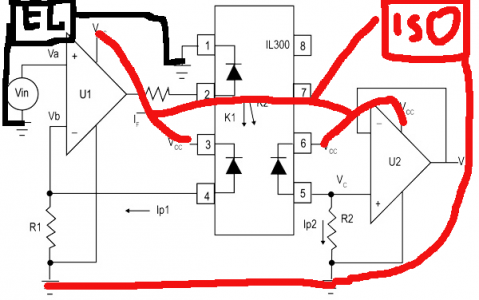
Pls look in the attachment, i know how it looks like :blown: :-) i want to show the idea where should be my EC meter connected and where ISOlated power supply.
 

Attachments

  • iso.png
    iso.png
    52.6 KB · Views: 10
OK
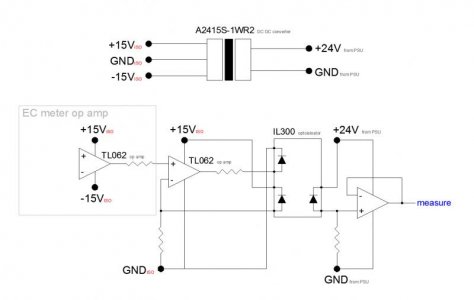
here is a schematic concept
I don't have eagle on the pc I'm on now so I had to do it in CAD
please note that the voltages are not actual values but rather a representation of their origin in terms of isolation. you will have to add the proper voltage regulators as needed
concept.jpg
Hope this helps
 
"the circuit in Figure 16 is essentially the same as the circuit in Figure 12a. Amplifier A1 is comprised of Q1, Q2, R3 and R4, while amplifier A2 is comprised of Q3, Q4, R5, R6 and R7. The circuit operates in the same manner as well; the only difference is the performance of amplifiers A1 and A2. The lower gains, higher input currents and higher offset voltages affect the accuracy of the circuit, but not the way it operates. Because the basic ircuit operation has not changed, the circuit still has good gain stability. The use of discrete transistors instead of op-amps allowed the design to trade off accuracy to achieve good bandwidth and gain stability at low cost."

I think that the version with amps will be better because of better accuracy.

I find the calculations for IL300
http://ea.elportal.pl/crozukl004.html
It is all in Polish and that is fine for me :-).
Anyway, I post the link here because math is universal language, so the mathematical equations and schemas can help even if someone do not know Polish language.

I want to thanks You for Your help, now i must order DC-DC converters from China :) i will take 30days when i will receive it.. or maybe You have some cheap alternative, but i think that this is the cheapest. I already do some research and do not find anything more fitting.

Because I will have some free time in my project maybe I will try build Your EC meter.
Can You post Eagle format of scheme and board ?

I have also a couple of questions:
1) What about probe calibration, You write earlier that, resistor R16 can be changed by trimer to compensate constant K of the probe, that is correct ? Where is the measurement point of this calibration and what voltage should I receive on it ? It should be done when electrode is in dry state ?
2) What about overall circuit calibration, how to set the resistors R17,18,19 if I want for example output 0-10V (that is the range of my AI input) for 0- 2000uS. Can You provide what calculation have to be made ?
3) Can You show Your probe ? how do you calculate the constant K, yes I know the theory that You write earlier but there it could be difficulty in the physical way :-)
 
are you going for the converter i suggested? what kind of price are you getting from china? i am buying some converters off ebay tomorrow but they are not differential so might not do you any good.


i am working on a more elegant design that doesnt use any op amps or differential power supply. it has 7 tds channels and automatic temperature compensation. as soon as i finish the design and tests, ill share it. i would appreciate any ideas or whishes that you might have that i coult incorporate into this design to make it the best it can be.

i think it might be worth waiting for this new design to build and test as i might just finish it before you get your parts from china

best of luck
 
one more thing..
do you think you can run a test on your circuit for me?
i need to asses the characteristic of the output of your circuit to compare with this new design im working on
the test involves conecting a trimmer instead of the probe and taking note of the voltage of your output at different resistor values of the trimmer
so put a 10K trimmer pot on the probe wires and measure the output at as many linear increments of the pot as you can (10k 9k 8k 7k ...) or even denser 10K 9.5K 9K ... (if you can) (you have to dissconnect the pot from the circuit each time you set it to a new value) depending on how you tuned the circuit to work with your probe you might have to go to lower trimmer values (it doesnt matter what the values are as long as the string of readins are based on a linear array of resistance values)
if you could do this it would be much help
 
I order a DC-DC converter A2424S, i send a link to spec note a couple of post before, in Poland that kind of converter cost about 18USD, i found it on alliexpress for 2.4 USD per pice.

http://www.aliexpress.com/item/A242...d-dual-output-24V-2watt-sip7/32537229738.html

This seller have no comments or references and his offer is the cheapest, so it can be hoax, but there is a buyer protecting program on Alliexpres so in the long term I can loss only time.

For the AI input i will use IL300, in PL one cost 1.8USD so, I will order it directly from local suppliers, HCPL-7840 cost two times more than IL300.

I suppose that You new project will be based on microcontroller ?, I like opamps :-), and I have no experience about microcontrollers project, do not have a programing cables etc. and it can be to complicated for me. So i would like to try You old project for now If you don't mind :-) So I You find a moment please answer my previous questions, before I start to build it I want to fully understand the idea :-) It will be very helpful.

That do not exclude that later I will try to build You new project anyway, we will see that do I'm able to handle it when You finish.

Of course I will make that test for You :-), I will be glad to help, I do it today but at evening because now I am in work.
 
yes the module is MCU but don't worry I will send you a preprogramed MCU if you decide to try it out (I need betta testers) you just have to have a way to communicate with it (serial or i2C does your PLC have any of those?)

I have attached the eagle files of my design (its the version without galvanic isolation as the one with is still under tests)
View attachment EC.zip

so to explain the way it works:
if you design the meter to work with a probe of K=0.1 for example..
(if you don't know the K of your probe you can determine it by connecting a resistor of known resistance instead of the probe and measuring the conductivity. if you get a conductivity in tds you need to convert that into S/cm)
to get the K you need to calculate it using this formula

K=EC/(1/R)

K= cell constant
EC=conductivity of solution in S/cm
R=resistance

once you know K (it doesn't have to be precise) you can continue. I will carry on with the assumption that K is 0.1 as this is a common constant for tds measurements.

if you know k and you know the range you need the circuit to work in for example K=0.1 and desired range is up to 4mS/cm which is about 2000tds, than using the formulas above you can calculate the resistance you need to measure which in this example is 50KOhm to about 25Ohm for a range of 0.002-0.4 mS/cm
so in my circuit R17,R18,R19 should be 50K and that means that for a probe resistance of 50Kohm the voltage output from the instrumentation amplifier is 0V the voltage output at the other end is controlled by R16.
writing this I realise that it is going to be a bit difficult to implement for you as the calculations of tds and temperature comp are done in the MCU. but it would be good if you can have a try and tell me what you think
since this is essentially an ohm meter the voltage output is linear to the measured resistance so the ec and tds are calculated in the MCU
calibration is done in mcu as well by compensating for slope and offset with one point calibration and 0 (so actually two point if you count the probe in air)

hope this is clear for you to have a go
I have some boards for this already made I will gladly send you one if you like but you will have to pay for postage

thanks for agreeing to run the test
 
bogdanaioane said:
yes the module is MCU but don't worry I will send you a preprogramed MCU if you decide to try it out (I need betta testers) you just have to have a way to communicate with it (serial or i2C does your PLC have any of those?)

Unfortunately it does not :( only AI DI and DO, of course there are some modules with many communication format available but i do not have it :(

bogdanaioane said:
if you design the meter to work with a probe of K=0.1 for example..
(if you don't know the K of your probe you can determine it by connecting a resistor of known resistance instead of the probe and measuring the conductivity. if you get a conductivity in tds you need to convert that into S/cm)
to get the K you need to calculate it using this formula

K=EC/(1/R)

K= cell constant
EC=conductivity of solution in S/cm
R=resistance

I'm not understand :( What do You mean by "œconnecting a resistor of known resistance instead of the probe and measuring the conductivity."
Do I have to connect resistor to the probe an check the measurement of EC in my commercial EC meter ? But my commercial EC meter have a fixed electrode and I can't change it to my DYI.
In other scenario If I disconnect the probe and connect a resistor, to the input of DYI EC I will not measure it my probe because it will be unplugged. Third scenario if I connect the resistor to my probe connected to my DYI EC meter the measurement could be not correct because my DIY EC is not calibrated yet, because I do not have a calculate the constant K.

bogdanaioane said:
once you know K (it doesn't have to be precise) you can continue. I will carry on with the assumption that K is 0.1 as this is a common constant for tds measurements.

if you know k and you know the range you need the circuit to work in for example K=0.1 and desired range is up to 4mS/cm which is about 2000tds, than using the formulas above you can calculate the resistance you need to measure which in this example is 50KOhm to about 25Ohm for a range of 0.002-0.4 mS/cm
so in my circuit R17,R18,R19 should be 50K and that means that for a probe resistance of 50Kohm the voltage output from the instrumentation amplifier is 0V the voltage output at the other end is controlled by R16.
writing this I realise that it is going to be a bit difficult to implement for you as the calculations of tds and temperature comp are done in the MCU. but it would be good if you can have a try and tell me what you think
since this is essentially an ohm meter the voltage output is linear to the measured resistance so the ec and tds are calculated in the MCU
calibration is done in mcu as well by compensating for slope and offset with one point calibration and 0 (so actually two point if you count the probe in air)

I do not use TDS ppm units because is hmm not deterministic, it is depends of some calculation method. More reliable is Siemens, micro or mili per cm .

"œexample is 50KOhm to about 25Ohm for a range of 0.002-0.4 mS/cm" if I put this the mathematical formula I get K=100 not 0.1.
I want to measure the quality for water from my osmotic filter too, so I need from almost 0 uS.
All resistors R17,R18,R19 should have the same value and it depends of minimal possible measurement, so if I want to measure a 0,0001mS I will have use 100Komhs to all 3 resistors for K=100 ?
R6 set the gain of current to voltage transformation, for example if I want to 0,1mS give me a 100mV I should set it by R6 ?

We can skip temperature compensation for now I will do it in PLC controller 2% per 1 degree/
 
More mS means more salt and more ppm and less resistance. So in this R17-R19 will be bigger i set the minimal possible mesaurment ?
 
I mean you connect the two terminals of a known resistor to the two electrode plates of the probe (when in air this means that the only conductivity you are measuring with the electrode plates is the conductance of the resistor)

note that the values in the formula are in ohms and S/cm so for a 25ohm measured resistor connected to the ec module, if you get 4ms/cm which is 0.004s/cm your constant is 0.004/(1/25) which is 0.1 (I guess we where both incorrect its 4ms/cm for 2000tds not 0.4)

yes all 3 resistors have to be as close to identical as possible and highly accurate 1% or better

R6 set the gain of current to voltage transformation, for example if I want to 0,1mS give me a 100mV I should set it by R6 ?

im afraid its not that simple. both my and your circuit essentially measure a resistance and for a linear progression of resistance values you get a linear response of voltage output in my schematic. you then calculate the EC and tds from that (in my case this is done in the MCU) so for a constant rise in output voltage you have a constant drop in resistance and a curved characteristic for conductance and conductivity as well as tds.
this is one of the reasons why my circuit might not be the best to use for you application

in your circuit for a constant rise in the measured resistance you have a constant rise in the gain of the op amp and a non linear voltage rise (I haven't actually plotted these curves for your design but it might be that this is an advantage in the end as by the time you convert the values to s/cm you might get a linear characteristic IM NOT SURE) it may be a good exercise to make an excel sheet with columns linear progression of resistance against calculated voltage output and calculated s/cm and tds and see if the s/cm values are linear (does that make sense?) if the values are not linear then a simple two point calibration cannot determine correct measurements without implementing an equation of the trend line of the output values (another reason why I thought the use of a MCU is advised)

I think im wright but I could be wrong
 
You right its S=1/ohm it's curved .. hmm. My DIY EC meter should have linear characteristic at the voltage in EC function on output, author write that on his project page.

PPM VEC Ohm
2K 4 250K
1K 2 500K
500 1 1M
250 0.5 2M

I will check this today by myself like I promised and send You the results.

I mean you connect the two terminals of a known resistor to the two electrode plates of the probe (when in air this means that the only conductivity you are measuring with the electrode plates is the conductance of the resistor)


I think that will be true only when all surface of electrode will touch the pins of resistor ?
What I should do next ? with ECmeter I should use to measure EC of the connected resistor to my probe. I suppose that one that is already fully operational, but like I say I can’t switch the electrodes in my commercial one, and even if I do, it make automatically temp compensation so it can affect the measurement ever if I connect my probe to it. How-to measure EC when electrode is connected to a resistor, can I just measure the resistance and use the calculation to S=1/ohm ?

You are right a made a mistake in my calculations :(, anyway .. so R17-R19 determine the lower measuring range if I want to be for example 1 uS I should use a 100K resistors, that is correct ?

And what the R16 doo ? :-)

I think I can use You project, if on output o Your EC meter voltage is in a linear function of resistance I can do the math in PLC controller, S=1/ohm it’s not difficult :-)
 
Last edited:
i am doing a spredsheet that will shed some light on this linearity issue as i think it is very important.

I think that will be true only when all surface of electrode will touch the pins of resistor ?

no that is only true in liquids that touch the electrode terminals if youmake metal contact with the terminal it then becomes 0ohm link

What I should do next ?

1) You use an ohm meter to measure a trimmer pot and set it to an arbritrary value R1
2) you connect the terminals of the trimmer to the ec probe input on your circuit (the one you built)
3) you adjust the trimmer until you get in range for your circuit do show a voltage on the output (say 0.5V)
4) you detach the trimmer and measure it with an ohm meter
5) record the values for mesurement 1 as R1 and V1
6) you adjust the trimmer to R2=R1+X (where x is the incremental constant and you make that whatever you want the smaller the number the more measurements you have to make to get to the end of the voltage swing)
7)reconnect the trimmer to the circuit and record the voltage obtaining measurement 2 as R2 and V2
and so on until you get to the point where you saturate your op amp and get the maximum voltage (in your case i think its 10V??)

don't worry about temperature at this point

if I want to be for example 1 uS I should use a 100K resistors, that is correct ?
yes

I think I can use You project, if on output o Your EC meter voltage is in a linear function of resistance I can do the math in PLC controller, S=1/ohm it's not difficult :-)

im not sure yet
i designed my circuit for use with higher conductivity values to measure salinity in the range of 35ppt. the output is linear function of the resistance but this might not be such a great ideea when you measure low ec in the range of ppm values (i will explain if you need to (just let me know) it has to do with the use of the ADC in the PLC or MCU and the resolution distribution across the entire measuring range)

it will become clear once i finish the spread sheet and plot the relevant lines and then you can make the right decission.

the more i look at this the more i realise that this type of measurement is not really very good unfortunately. once we conclude on this topic, please remind me to expand on the other measuring sistem that im using for tds (the same system that they use in the commercial tds meters)

ill get back to you with the spreadsheet hopefully tonight
 
forget to say
R16 is the gain resistor
you can use a trimmer provisionally to adjust the output so that it is 10V at the end of the measuring range and then measure it and replace it with a fixed resistor
 
Back
Top