bogdanaioane
New member
I think I found a better solution for you
stay tuned
stay tuned

 . i will take 30days when i will receive it.. or maybe You have some cheap alternative, but i think that this is the cheapest. I already do some research and do not find anything more fitting., and I have no experience about microcontrollers project, do not have a programing cables etc. and it can be to complicated for me. So i would like to try You old project for now If you don't mind So I You find a moment please answer my previous questions, before I start to build it I want to fully understand the idea It will be very helpful. , I will be glad to help, I do it today but at evening because now I am in work.
bogdanaioane said:yes the module is MCU but don't worry I will send you a preprogramed MCU if you decide to try it out (I need betta testers) you just have to have a way to communicate with it (serial or i2C does your PLC have any of those?)
 only AI DI and DO, of course there are some modules with many communication format available but i do not have it
 bogdanaioane said:if you design the meter to work with a probe of K=0.1 for example..
(if you don't know the K of your probe you can determine it by connecting a resistor of known resistance instead of the probe and measuring the conductivity. if you get a conductivity in tds you need to convert that into S/cm)
to get the K you need to calculate it using this formula
K=EC/(1/R)
K= cell constant
EC=conductivity of solution in S/cm
R=resistance
What do You mean by "œconnecting a resistor of known resistance instead of the probe and measuring the conductivity." bogdanaioane said:once you know K (it doesn't have to be precise) you can continue. I will carry on with the assumption that K is 0.1 as this is a common constant for tds measurements.
if you know k and you know the range you need the circuit to work in for example K=0.1 and desired range is up to 4mS/cm which is about 2000tds, than using the formulas above you can calculate the resistance you need to measure which in this example is 50KOhm to about 25Ohm for a range of 0.002-0.4 mS/cm
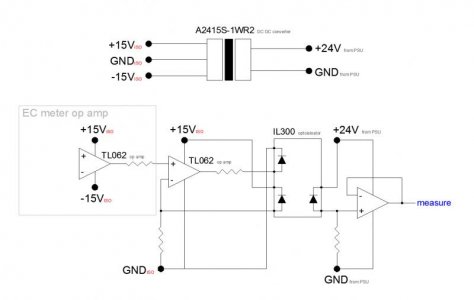
so in my circuit R17,R18,R19 should be 50K and that means that for a probe resistance of 50Kohm the voltage output from the instrumentation amplifier is 0V the voltage output at the other end is controlled by R16.
writing this I realise that it is going to be a bit difficult to implement for you as the calculations of tds and temperature comp are done in the MCU. but it would be good if you can have a try and tell me what you think
since this is essentially an ohm meter the voltage output is linear to the measured resistance so the ec and tds are calculated in the MCU
calibration is done in mcu as well by compensating for slope and offset with one point calibration and 0 (so actually two point if you count the probe in air)
, anyway .. so R17-R19 determine the lower measuring range if I want to be for example 1 uS I should use a 100K resistors, that is correct ?