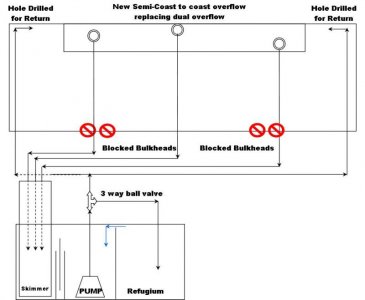
Okay, I'm warming to this idea, and I think I'm going to go this avenue.
I read the bean animal site and it seems like this is going to be the easiest long term solution, so while I'm at it, going to tear the dual overflow out and adopt a semi coast to coast overflow.
Good plan. A bit of work, but the end result is well worth the effort.
I've contact Marc at Melevs reef to get a quote. I was going to make it 48" in length, not going to the full coast to coast, as I don't want to see the L up against the sides of the tank, at 48" that is plenty of surface area to skim, and if the sides are are toothed to it will skim the area that a coast to coast would do also. This eliminates the 'L' shape being up against the glass side.
48" will probably be ok, but it depends on the flow rate. The overflow calc, though off, can give you a rough estimate of the length you need. It needs to be noted that teeth in the weir, cut the linear length often by 2/3, and are not recommended. You want to use a flat top weir, with no teeth. It is more efficient, and quieter. (the teeth channel the flow, and that creates noise, and they restrict the flow, raising the water level higher, and reducing skimming efficiency.
I have attached a diagram for the plumbing, let me know if you think that looks about right.
The three holes in the back of the tank should all be at the same level. (Will get to that below.)
Also, it would be better flow wise, to use a single return line. Friction loss is not insignificant, and can cause the need for a larger pump to do the same amount of work. The extra plumbing adds friction loss, especially running the flow into a tee. A single line up over the top is the most efficient means, and using the power heads for what they are for: dispersion.
I you really must,

run two return lines, do not reduce the size, this will help keep the friction loss to a minimum.
Often friction loss can cut your flow by 300 gph or more, in some cases turn a 14' static lift, into 42' of dynamic head. That is not insignificant. depending on the plumbing size, and how well the pump handles the additional head pressure along with the additional velocity head.
Can you tell me how deep the 3 holes need to be cut? and with this overflow box, only the water in the overflow box (not display tank water) will drain down to the lowest pipe, correct?
The holes need to be 1 x the hole diameter down from the top edge of the glass, to the top edge of the hole. The holes also need to be a bit lower than that, to account for the water drop over the weir, and the distance from the water level to the center of the hole. From the top edge of the glass to the hole center line, the minimum is 2.75". More (by a half inch or so) is better as it brings the upturned elbow down below the top edge of the weir. That is for a 1" bulkhead, 1.75" hole. I have gone over this several times in the later part of bean's thread, and several others within the last week or so.

From what I have read, the tank is not tempered on the sides, so it should be good to drill. I will drill 2 holes on either side of the overflow box to have a dual return.
See above, for efficiency a single return line is better. And let the power heads do their job. You can't get away from them, often even if you use a closed loop.
I was wondering if there are any specialists out there that I can hire to drill the holes for me? maybe not specifically aquarium drilling specialist, but another industry that uses glass drilling that can also do this?
Local glass shop can punch the holes. If you are looking for high end, a glass fabrication (that make shower doors, table tops etc.) shop may have a Techni Waterjet.
Thanks uncleof6 for your help, it's a pain in the *** and I wish you were wrong, but a little extra effort now will pay off in the long run I think. If a jobs worth doing, its worth doing right as they say.
You are welcome, sorry for the side track. It happens sometimes.