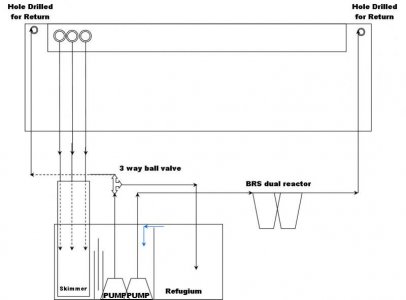
Again, first before anything else, lol,

a 1" ABS bulkhead uses a 45mm hole saw. (1.75" hole.) BRS makes things complicated by TMI.
The hole CENTERS should be at least 2.75" down from the TOP edge of the GLASS. This is well within the 1x rule: The TOP edge of the HOLE, will be 1.875" down from the TOP edge of the GLASS.
You may be thinking the h*ll you say, where is the top edge of the glass on a rimmed tank. Well the TOP edge of the GLASS, is 1/2" down from the TOP of the TRIM (the very top of the tank.) K got that?
The BOTTOM of the TRIM on the outside of the tank, is 1" down from the TOP of the Glass. K got that? You may think what the heck is up with the caps lock. What I just said is important, or you won't get what I am going to say next, as I am not going to use caps, and you will be able to find the location several different ways.
The top of the weir, is placed 1" down from the top edge of the glass. This hides the water line above the bottom of the outside trim. The water level in the overflow will be ~ 1" lower than that, or around the top of the down turned elbows for the drains, ~3/4" above the hole center line.
It is not a bad idea to drop the holes down another 1/2" give or take, as this will draw the up turned elbow on the dry emergency down below the top edge of the weir. This will increase the length of the drop inside the overflow box, but with sufficient length it should not cause noise.
In a power out situation you will have around 1" of water drain from the overflow, and perhaps 1" out of the main tank, as long as your return outlet is within 1" of the water surface. Armed with that information and (pi x radius squared x length of the siphon pipe)/231, plus volume in the skimmer, you can fairly accurately determine the amount of power out drain down and adjust your sump volume accordingly.
On the return: It is common practice, though some try to debate it, to up-size the return plumbing one pipe size above the actual size of the pump outlet. So with the dart, you would want to use a 2" pipe on the output. Any larger than that, and you would want to increase the inlet piping accordingly, to help prevent cavitation, because this is an external pump, and the inlet is 2". The 2" inlet pipe could appear as a restriction at the pump inlet, if the outlet pipe was over 2". The inlet and outlet size has nothing to do with the plumbing size, however, the needs of the system determine that.
The idea here is to reduce the friction loss to a point where it IS almost negligible, but that often will take some pretty large pipe, depending on the flow rate. One size up generally reduces the friction loss by ~ 2/3.
I run a single line up over the back of the tank, keeping it simple, and allowing other parts of the system to do their job, e.g. the power heads. You don't need to use a bulkhead.
This should give you some idea:
However your drains system look like the graphics in Bean's article and thread.