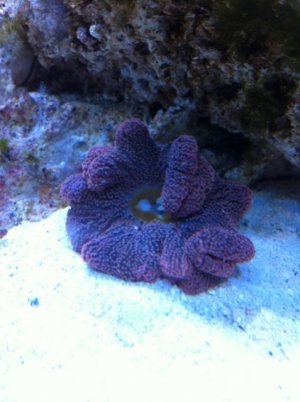
***Fragged my Heteractis Magnifica***

"Given the importance of siphonoglyphs, I would think (total hypothesis coming) that you would have to be really careful about maintaining the integrity of the siphonoglyphs when cutting an anemone in half"

I have always thought the same thing.. This is the one obvious feature of bi-lateral symetry to me and if I were ever to cut an anemone I would focus on cutting evenly through the siphonoglyphs.
 
Can we try and not have a moral debate weather it is right or wrong to split Heteractis magnifica.

I am not questioning the morality of cutting an anemone in half. Rather I am questioning the morality of doing it over and over, with poor results, and not trying to improve your success rate. I am challenging people to IMPROVE their processes - and if they don't work, move on!
 
I have always thought the same thing.. This is the one obvious feature of bi-lateral symetry to me and if I were ever to cut an anemone I would focus on cutting evenly through the siphonoglyphs.

I was actually thinking you would want to MAINTAIN the siphonoglyphs and make the cut equidistant between the two siphonoglyphs so that each piece of the anemone is left with a complete syphonoglyph after the anemone has been cut in half.

But... you raise an interesting question.

We just need to find someone with a splitting E. quad, and ask them if it is splitting THROUGH the siphonoglyphs or BETWEEN the siphoglyphs.

I seem to recall a thread where someone cut an anemone in half through the middle of the two siphonoglyphs, and both halves died outright. Let me see if I can dig it up via search - it was a while ago.
 
Last edited:
IF it has not been tried...

In regards to cutting and trying something different, I think it would be interesting to look at giving cut anemones a bath in antibiotics for 5-6 hrs each day or every other day for a week or so - say, with enrofloxacin (Baytril).

Make the cut as Bonsai suggested, then 1.5 mLs per 2.5 gallons for 6 hours. Then, return to display/quarantine tank. Heck, keep two separate systems, bathe one and not the other daughter. Repeat several times for stats, etc.

I realize getting Baytril might be difficult, but... perhaps someone has an understanding vet he/she could work with.

Cheers
Mike

(If it has been done, then... well... oh well...)
 
I was actually thinking you would want to MAINTAIN the siphonoglyphs and make the cut equidistant between the two siphonoglyphs so that each piece of the anemone is left with a complete syphonoglyph after the anemone has been cut in half.

But... you raise an interesting question.

We just need to find someone with a splitting E. quad, and ask them if it is splitting THROUGH the siphonoglyphs or BETWEEN the siphoglyphs.

I seem to recall a thread where someone cut an anemone in half through the middle of the two siphonoglyphs, and both halves died outright. Let me see if I can dig it up via search - it was a while ago.

Yes this is what I meant. avoiding any damage to the siphonoglyphs
 
i can tell you when i divide my quadricolors i am not looking for any particular feature to navigate between with my blade. i lay them flat on my cutting board and press down somewhere i can cut evenly.

if you can get me a diagram or point me in the direction of the structures youre referring to, i can attempt to identify them with both my magnificas and my roses.
 
I can't find a good image on the 'net, but here is a decent illustration:

img002.jpg


By the way, I just heard from a BTA breeder who said that BTA's split BETWEEN the siphonoglyphs, and not THROUGH them. In most cases the split is perpendicular to the axis that runs through the two siphonoglyphs.
 
Has anyone tried using a soft tissue dental laser or perhaps an electrosurge to make sure that the cut is somewhat cauterized? That would possibly help the healing process.
 
Has anyone tried using a soft tissue dental laser or perhaps an electrosurge to make sure that the cut is somewhat cauterized? That would possibly help the healing process.

I have wondered about this as well - but I wonder how it would impact the anemone's ability to come back together into a circular creature. I think it would all depend on how an anemone heals. My sense (based on personal observation) is that when an anemone is cut in half, each half curls in upon itself and tries to heal the cut ends together. I believe the most important thing is for the mouth to heal - because until that happens the anemone cannot maintain internal water pressure, cannot manage internal water flow, and ultimately, cannot breathe, process wastes, or circulate energy from zooxanthellae. Once the mouth is healed and the two ends are healed together, the anemone can work on growing another siphonoglyph and any other internal structures that were damaged in the process.
 
Tony, I hope this isn't hijacking your thread. I just thought it would be nice to have as much info, on this subject, in one place as possible. Here's the pics of my mag from today.

Closeup of, what I'll call anemone "A".
cutmagnificaon3-25-11003edited-1.jpg


Closeup of anemone "B". Sorry about the quality of the pic.
cutmagnificaon3-25-11005edited-1.jpg


Here's both of them side by side.
cutmagnificaon3-25-11001edited.jpg


I know they don't look very well, but they honestly look better than they did while they were attached. I'm sure it's way to early to say this, but I think cutting this anemone in half may have saved its life. I guess we'll find out in a few months.
 
Last edited:
I have wondered about this as well - but I wonder how it would impact the anemone's ability to come back together into a circular creature. I think it would all depend on how an anemone heals. My sense (based on personal observation) is that when an anemone is cut in half, each half curls in upon itself and tries to heal the cut ends together. I believe the most important thing is for the mouth to heal - because until that happens the anemone cannot maintain internal water pressure, cannot manage internal water flow, and ultimately, cannot breathe, process wastes, or circulate energy from zooxanthellae. Once the mouth is healed and the two ends are healed together, the anemone can work on growing another siphonoglyph and any other internal structures that were damaged in the process.

One of these days I'll try it out on some Rhodactis to see what happens.
 
Has anyone tried using a soft tissue dental laser or perhaps an electrosurge to make sure that the cut is somewhat cauterized? That would possibly help the healing process.

I would be a little hesitant to do this for several reasons. I could be wrong, but cauterizing wounds kills tissue in order to close blood vessels. Anemones mainly have permeable membranes. Cauterizing wouldn't serve to close blood vessels because I don't think they have many, if any, similar structures.
Also, what think BonzaiNut is getting into, cauterizing could burn (kill) the surface cells next to the blade. Fusing into a circle over already dead cells might make it more difficult.

Like I said, I could be wrong. Let us know what happens.
 
Back
Top