How do I control diatoms?

Bpham80

New member
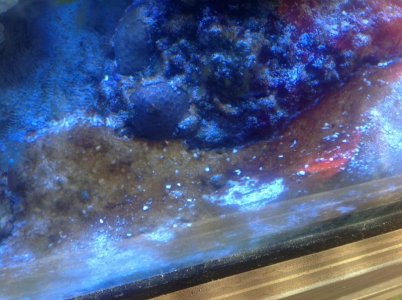
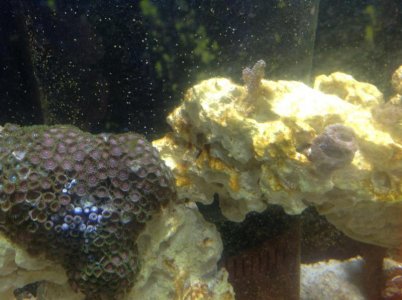
I'm pretty sure I have diatoms starting to cover everything in my tank. I want to get it under control before it becomes out of control, hoping some of you can give me your input.
A little about my tank, it's a 110 gallon with built in over flows and a 20 gallon sump/refugium I have an oceanic 65 or 125 skimmer. Mag 900 return. Two hydor 1400 GPH power heads. Two exotic sun 120watt LEDs with 1watt bulbs. 9 smaller fish biggest is yellow headed goby. About 40 snails, 6 are large Mexican turbos the rest are Astraea and nasarius. About 30 or more crabs, and a serpent star fish plus two cleaner clams and a peppermint shrimp. Parameters are salinity 1.027. Temp 78.4 ph 8.1 alk 474 calcium 480-500 mag 1380ish. Nitrates 0 nitrite 0 ammonia .25 and I use only rodi water for everything


Any advice is helpful. Thanks you
 

Attachments

  • image.jpg
    image.jpg
    73.7 KB · Views: 6
do you use RO/DI water ? with TDS zero ?


does the algae get bigger in day time and develop bubbles ? if yes, then it might be dino, which is a curse ! have to siphon it out.

if not and just diatom, then it will go away with time. part of initial tank cycle.
 
u dont. diatoms are related to silica in sand. once silica depletes so will diatoms.
 
do you use RO/DI water ? with TDS zero ?


does the algae get bigger in day time and develop bubbles ? if yes, then it might be dino, which is a curse ! have to siphon it out.

if not and just diatom, then it will go away with time. part of initial tank cycle.


I do use a rodi and tds is 0.
 
wait for the sponges to uptake the silicates instead of the diatomic algae. just part of starting up a tank. the silicate cycle is yet another cycle that is not explained to us when starting out our systems. :(

G~
 
wait for the sponges to uptake the silicates instead of the diatomic algae. just part of starting up a tank. the silicate cycle is yet another cycle that is not explained to us when starting out our systems. :(

G~

That's what I'm confused about I've had my tank up since late August. I know it cycled to the point where everything's healthy(with the exception if my powder blue tang that suddenly died overnight).

Also you said wait for the sponges, I was reading somewhere about using live sponges to remove silicates, but couldn't find much more about the sponges, what type of sponges, coral?!?! Where can I get them?
 
you should start seeing sponges growing under the LR in dark places. you may also see small pineapple sponges showing up in low flow dark areas around the tank. they may be small now, but you should be seeing some now unless you re-aquascape your system fairly often. sponges like consistency. it will take a few months for them to get going even in perfect conditions. as long as you have seeded LR from somewhere, or a small CUC from somewhere there should be sponge spores in your system.

i have had sponges in just about every color of the rainbow. white, yellow, green, blue, black, orange, and grey. i am not a fan of grey though, it seems to be able to grow within soft colonial colors and cause issues.

as with any "nutrient" finding organisms to use a nutrient does not actually remove the nutrient, until that organism is removed from the system. silicates are like phosphates. they are not off gassed, they need to be exported physically. the CUC that most people get are actually diatomic algae eaters and not true algae eaters. yet more confusion in this hobby. the Ceriths, the Trochus, the Stomatellas. the object is to get the sponges uptaking the silicates and holding enough of them to keep the amount of diatomic algae low enough that the CUC can take care of it and hopefully some of the free floating diatomic algae is exported through water changes and skimming to keep up with any new silicates coming in from food or other material imports.

G~
 
chemipure is a silicate binder (it is actually listed on the package). so it can be used to export silicates if replaced often. it all goes into what critters you want to keep and how many of them you want. i like sponges, they give good interest to the undersides of LR, so i would want to maintain a certain level of silicates. others think differently.

G~
 
have you recently added anything to the tank? new sand, non-rodi water, rocks, anything?
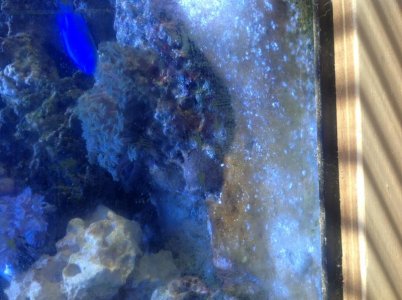
If you've been set up since august...diatom originally should have depleted the silicates from the system over the course of a week or 2. A return of diatom (if that's what it is) would need a new food source. If not, it may be something else. Do you have any pics of this?
 
At the look of your picture, it looks more than diatoms.

How is your light cycle? Bulbs age?

Running a phosphate reactor yet?
 
Diatoms can and do grow almost everywhere. They will grow wherever there is light, nutrients and soluble silicon. Unless you happen to have Portland sand in your tank, the soluble silicon is usually depleted rapidly (days) to the point where there isn't enough left to support the diatoms and they die. Unfortunately, the diatoms use the soluble silicon to build shells that will not decay in your life time, but are great for building beaches.
 
My bulbs are LEDs and only a few months old. The light cycle is 7am to 630pm I run actinics only. 8am to 430 I run sun lights(along with the actinics) 630pm to 7am I run moon lights. My sump/refugium is on the opposite schedule.
As far as new additives about three weeks ago I added a hippo tang and the powder blue tang. About a month ago I added dryrock I bought from LFS.

Also again what are these sponges? Where do I get them?

Also not running a phos reactor yet was looking online to buy one today. I am torn between the Kent marine reactor or the Two Little Fishies reactor.
 
have you looked closely under the LR lately? they may already be starting to grow.

the best place to get sponges is to find a small piece of LR with it already on it and get it. i have not needed to do this though. the spores come in on just about anything you put in the tank. either from the water itself or from being on the critter. snail shells etc.

i am not a fan of any kind of after the fact phosphate binders. whether they are reactors or algae. i find it better to actually go after the source of the phosphates, the detritus.

G~
 
i am not a fan of any kind of after the fact phosphate binders. whether they are reactors or algae. i find it better to actually go after the source of the phosphates, the detritus.

Phosphate and detritus will always be present in the form of food and fish poop. It is a matter of keeping it under control and not let it get out of hand so it is why a phosphate reactor is so valuable in order to keep the phosphate under control and to a point where it would be starving the nuisance algae. Light, Nitrate, and Phosphate fuel algae. He uses LED and his Nitrate is at 0, so the only thing left is phosphate.

I recommend testing for phosphate. Get yourself a Hanna Tester and DON'T GET THE API TEST (Api lowest point is .25ppm and you want reading between 0.00 and 0.25). I have read that anything over .03 is enough to fuel algae. My SPS tank is at .01 and still have occasional algae on the Sand bed.
 
no, it will only be present if you allow it to be. if one designs a system around detrital control, then one does not need to worry about phosphates supplying energy for algae.

food and poo are totally different types of phosphates, and this leads to a lot of the confusion in this hobby. food is organically bound phosphates. animals need this. this is where they get their energy from. algae on the other hand can not make any use of food. algae is only able to make use of the phosphates in food/poo after bacteria have processed it and release it into the water column. wouldn't it make more sense to just remove the detritus (leftover food/poo) before the bacteria can make the phosphates available to the algae? this is why algae, GFO, whatever the binder du jour is an after the fact phosphate binder. it is only able to bind phosphates that have become available to algae in the display.

have you ever wondered why you have algae on your substrate even though your readings are 0.01ppm phosphates? BTW- the level of phosphates needed to grow algae is 0.009ppm. with open water NSW levels being 0.005ppm. in other words if algae is growing there are phosphates. our test kits are just not accurate enough. use the best tool for the job, algae. if it is growing, then there must enough nutrients for it.

G~
 
Here's another pic of it. My cameras not the best and it doesn't help thattheglass is not 100% cleaned.
 

Attachments

  • image.jpg
    image.jpg
    80.1 KB · Views: 7
Back
Top