
You are using an out of date browser. It may not display this or other websites correctly.
You should upgrade or use an alternative browser.
You should upgrade or use an alternative browser.
How this Geezer did it in the beginning
- Thread starter Paul B
- Start date
- Status
- Not open for further replies.
saltwatertanker
New member
Paul, love this thread. Especially your concepts on trying to achieve a natural type environment. A lot of people don't understand that the ocean is not all that sterile! I've lived by the water all my life and seen how the ocean changes. Many would be surprised on how resilient corals are. Sometimes while snorkeling/diving I will observe cyno occurring naturally and clearing up the next week. Corals bleach and all out in the sea. Water temps fluctuate during low and high tides, but still the corals survive! I know its different in an aquarium but im just saying its not all controlled as we may be led to believe. I do believe in having a stable tank, but also remember that life can adapt to certain changes.
Some people are all about purchasing the latest and next best thing in reefkeeping. lol
Some people are all about purchasing the latest and next best thing in reefkeeping. lol

Paul B
Premium Member
Saltwatertanker. Thanks for posting, I see you live in Guam. I never dove there or even visited there. It is on my list, mainly because of the military history of it.
I have also seen cyano and plenty of hair algae in the sea especially in the Caymans.
I know people in the hobby go nuts over it and I don't know why. Hair algae is viewed as a disease instead of a health giving, natural substance that should be cultivated in a way that benefits the system. We farm crops and they help us live but we don't let them grow in our living room. Well I don't anyway.
Hair algae is a plant, it makes oxygen and removes all of the things that people spend a fortune on trying to remove with vodka, vinegar and pellets.
It seems like every other post reads something like "I have Hair algae and I am about to throw in the towell".
I don't want it to grow all over my corals either but I do want it in the system someplace. If you have no algae, something is wrong. Tap water doesn't have algae in it but if you leave it out in the sun for a couple of weeks without putting anything in it, it will grow plenty of algae. I have ponds filled with tap water and no livestock. Algae grows all over them, it is natural and just need to be controlled.
Cyano is a little different but it is part algae and dependant on light. It is also part bacteria and seems to grow sometimes for no reason. It will grow profusely with excess nutrients and look horrible but it won't harm anything unless it covers corals.
That is easily removed with an oxidizer like Chemi Clean which means you may have too much DOC and are probably feeding too much or not exporting enough.
It seems to run in cycles and sometimes just grows for no noticable reason, then sometimes it disapears for no aparent reason.
Some filthy tanks have it and some pristine new tanks have it.
Tanks with no circulation and tanks with tidal waves.
Living in Guam I am sure you know that.
I have been in the South Pacific during a mild typhoon and it is amazing anything is growing.
I have also been in the Caribbean after a hurricane and there were sea fans 100' up on the mountains. Brain corals bigger than my car turned up side down. Reefs covered in 5' of sand.
I do this to my reef a few times a year, these events are the vacuum cleaners of the sea. I feel corals need this cleaning and I power wash my rocks whenever I get time. Rock is porous but it doesn't stay like that, all those creatures in there die and deposit their skeletons all over the nooks and crannies. You need to do a little maintenance like the sea does and clean this stuff out. This is the main thing I have against DSBs. They can't be maintained, they are static. No, the tiny creatures that may inhabit them for a few years will not do it. That is why we don't see a bunch of 10 year old DSBs.
I blast my gravel down to the UG filter. Everything flies all over the place and I have always done that. The sea does it and I feel it should be done. :wave:
I have also seen cyano and plenty of hair algae in the sea especially in the Caymans.
I know people in the hobby go nuts over it and I don't know why. Hair algae is viewed as a disease instead of a health giving, natural substance that should be cultivated in a way that benefits the system. We farm crops and they help us live but we don't let them grow in our living room. Well I don't anyway.
Hair algae is a plant, it makes oxygen and removes all of the things that people spend a fortune on trying to remove with vodka, vinegar and pellets.
It seems like every other post reads something like "I have Hair algae and I am about to throw in the towell".
I don't want it to grow all over my corals either but I do want it in the system someplace. If you have no algae, something is wrong. Tap water doesn't have algae in it but if you leave it out in the sun for a couple of weeks without putting anything in it, it will grow plenty of algae. I have ponds filled with tap water and no livestock. Algae grows all over them, it is natural and just need to be controlled.
Cyano is a little different but it is part algae and dependant on light. It is also part bacteria and seems to grow sometimes for no reason. It will grow profusely with excess nutrients and look horrible but it won't harm anything unless it covers corals.
That is easily removed with an oxidizer like Chemi Clean which means you may have too much DOC and are probably feeding too much or not exporting enough.
It seems to run in cycles and sometimes just grows for no noticable reason, then sometimes it disapears for no aparent reason.
Some filthy tanks have it and some pristine new tanks have it.
Tanks with no circulation and tanks with tidal waves.
I am glad you mentioned that. A tank has a fairly stable existance but the sea is vastly different.I do believe in having a stable tank, but also remember that life can adapt to certain changes.
Living in Guam I am sure you know that.
I have been in the South Pacific during a mild typhoon and it is amazing anything is growing.
I have also been in the Caribbean after a hurricane and there were sea fans 100' up on the mountains. Brain corals bigger than my car turned up side down. Reefs covered in 5' of sand.
I do this to my reef a few times a year, these events are the vacuum cleaners of the sea. I feel corals need this cleaning and I power wash my rocks whenever I get time. Rock is porous but it doesn't stay like that, all those creatures in there die and deposit their skeletons all over the nooks and crannies. You need to do a little maintenance like the sea does and clean this stuff out. This is the main thing I have against DSBs. They can't be maintained, they are static. No, the tiny creatures that may inhabit them for a few years will not do it. That is why we don't see a bunch of 10 year old DSBs.
I blast my gravel down to the UG filter. Everything flies all over the place and I have always done that. The sea does it and I feel it should be done. :wave:
Last edited:
saltwatertanker
New member
You are definitely spot on about what happens out in the ocean during typhoons! Corals break, flip over, water chemistry changes vastly. But yet when you go back into the water there is still life. Its called resiliency! I am a strong believer that there is no substitute for natures food source, natural bacteria, etc. In nature only the strong survive! I know that I am fortunate to have all these natural resources around me.
I am very impressed with all these tanks on this forum from around the world. I believe it proves awareness and appreciation for all to see on what our oceans have to offer. It also demonstrates the different ways people are able to sustain sea life in an enclosed enviroment. Well not just sustain but THRIVE! These examples of different methods/setups on this site only enforce the theory that life can adapt in certain conditions. Not everyone's setups need to be the same. What works for some may not work for others.
I am very impressed with all these tanks on this forum from around the world. I believe it proves awareness and appreciation for all to see on what our oceans have to offer. It also demonstrates the different ways people are able to sustain sea life in an enclosed enviroment. Well not just sustain but THRIVE! These examples of different methods/setups on this site only enforce the theory that life can adapt in certain conditions. Not everyone's setups need to be the same. What works for some may not work for others.
saltwatertanker
New member
You are definitely spot on about what happens out in the ocean during typhoons! Corals break, flip over, water chemistry changes vastly. But yet when you go back into the water there is still life. Its called resiliency! I am a strong believer that there is no substitute for natures food source, natural bacteria, etc. In nature only the strong survive! I know that I am fortunate to have all these natural resources around me.
I am very impressed with all these tanks on this forum from around the world. I believe it proves awareness and appreciation for all to see on what our oceans have to offer. It also demonstrates the different ways people are able to sustain sea life in an enclosed enviroment. Well not just sustain but THRIVE! These examples of different methods/setups on this site only enforce the theory that life can adapt in certain conditions. Not everyone's setups need to be the same. What works for some may not work for others.
I am very impressed with all these tanks on this forum from around the world. I believe it proves awareness and appreciation for all to see on what our oceans have to offer. It also demonstrates the different ways people are able to sustain sea life in an enclosed enviroment. Well not just sustain but THRIVE! These examples of different methods/setups on this site only enforce the theory that life can adapt in certain conditions. Not everyone's setups need to be the same. What works for some may not work for others.
saltwatertanker
New member
sorry double post
Paul B
Premium Member
I am very impressed with all these tanks on this forum from around the world. I believe it proves awareness and appreciation for all to see on what our oceans have to offer. It also demonstrates the different ways people are able to sustain sea life in an enclosed enviroment. Well not just sustain but THRIVE!
I also feel this and some of the tanks on here make me jealous. I have dove all over the world and some of the members tanks not only mimic nature but sometimes surpass it in beauty. There is a lot of love of the sea and creatures in general from the people here and I doubt there are many who don't have a love for life.
There is no one way to do things and it seems that any set up can work and all set ups have advantages and disadvantages. I think it depends on what you are trying to acomplish

humaguy
Premium Member
excellent thread!
I miss some of the equipment from years ago...those hob filters made by Eugene F Danner- the Aquaking and Supremeking were terrific filters...had a beast of a motor- think it was a 1/4 hp..was really a great filter and I never had any issues them...
Thank You for Your Service!!
I miss some of the equipment from years ago...those hob filters made by Eugene F Danner- the Aquaking and Supremeking were terrific filters...had a beast of a motor- think it was a 1/4 hp..was really a great filter and I never had any issues them...
Thank You for Your Service!!
Paul B
Premium Member
I remember when Kalk dosing came out and I had to build this plexiglass container with a stirrer in it, the water would enter and the stirrer would mix it all up and put it in my tank. The tank never looked so bad and had more problems than when I was adding kalk. I don't know if it was something I was doing wrong but the corals were not happy. Stupid invention if you ask me. Now I just use Randy's home made two part calcium and there is no problems. Before Kalk I did experiment with lizzard calcium. They sell this calcium supliment that you are supposed to put on iguana food. You are not supposed to put it in fish tanks but the fish didn't know the difference. Fish, lizards, they are all cold blooded animals with scales so I figured it was the same thing. It didn't hurt anything but It probably didn't help either.
I don't ever remember dosing anything else but I probably tried a few things.
I never used any of that Purple Up or Marine Snow, vitamins or anything else.
I did use vitamin C for a while to try to cure HLLE and for some reason it seemed to work on a French Angel but I was also giving him fish oil so I am not sure which made it better or if it was just luck. A fish like a French Angel really looks lousy with HLLE because they are black.
What even happened to French Angels, they used to be one of the most common fish but now you rarely if ever see them. They must come from some place where collecting is banned. I think I saw them in Hawaii
I don't ever remember dosing anything else but I probably tried a few things.
I never used any of that Purple Up or Marine Snow, vitamins or anything else.
I did use vitamin C for a while to try to cure HLLE and for some reason it seemed to work on a French Angel but I was also giving him fish oil so I am not sure which made it better or if it was just luck. A fish like a French Angel really looks lousy with HLLE because they are black.
What even happened to French Angels, they used to be one of the most common fish but now you rarely if ever see them. They must come from some place where collecting is banned. I think I saw them in Hawaii
Megatrev62
New member
Cmon Paul don't give up yet. Bump
Paul B
Premium Member
Cmon Paul don't give up yet. Bump
I didn't give up, Did you read that stuff I just wrote about 3" above your last post?
Today is a boating day and my dingy is langing on the back of my boat so if the tide is right I will go to shore in the tide pool and check it out. Of course after going there for 30+ years I doube to will find anything new. I have been looking for manta rays but so far, no luck. :strange:
I strongly feel this stuff I add from tide pools helps heep the tank running well but I really don't know exactly how. I do know that from the first day I started the tank, I have added this stuff.
I also found a new source for that red sponge I used to feed my moorish Idol but I don't have an Idol any more so I don't collect it. So If you have an idol, No I don't want to collect it for you because it is on the south shore and about 45 minutes from my house. So now I have a source on the north shore and south shore.
I may just collect a little and see if my other fish still eat it but Idols are really the fish that go nuts for the stuff. I wish I could keep it alive but it doesn't even live until I get it home. I think it has heard the reputation of my tank and doesn't want to be anywhere near it.
Today I will just bring home amphipods. I do not take hermit crabs or horse shoe crabs because they don't live in a tropical reef and I have enough grass shrimp.
At one time my tank was more local NY life than tropical stuff. In the beginning it was hard to get livestock and I used a lot of local rock crabs, shrimp, eels and whatever creature I found that was small enough. I also know a place where huge mantis shrimp live. They are about 7" long and brown, not colorful like tropical mantids. But you have to dive for them about 30' deep and I have only seen them at night. I did have one for about a year in a five gallon tank, cool creatures.
Cool rock crab

Local codium seaweed from Montauk

Paul B
Premium Member
I know I put this picture on here someplace but I wanted to show some local animals. There are two local purple urchins and a bunch of local barnacles.
This picture or a very similar one was published in "FAMMA" magazine.
Thats a maroon clown over the center urchin and some of the "rocks" are asphalt that was submerged for over 50 years and loaded with life such as amphipods, worms, etc.
Circa 1980s or 90s.

This picture or a very similar one was published in "FAMMA" magazine.
Thats a maroon clown over the center urchin and some of the "rocks" are asphalt that was submerged for over 50 years and loaded with life such as amphipods, worms, etc.
Circa 1980s or 90s.
Paul B
Premium Member
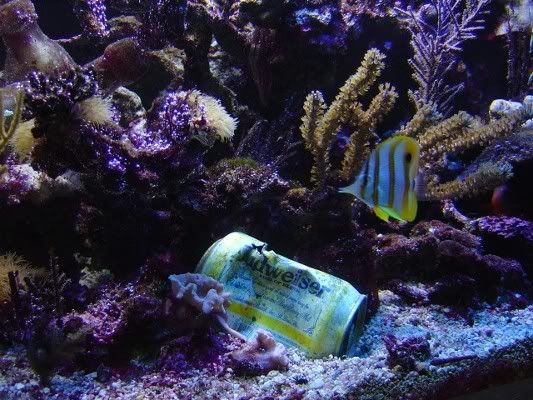
That bottle is still in there.
Here it is to the left of these hermits. I don't have them any more, they died last year. They were 13 years old and I think they used to breed.

This guy has a bottle fetish.


If you look closely at the gravel you will see countless sea urchin spines from the years I would put in local purple urchins, then sell them. There are also small black pieces of asphalt that broke off of my "live asphalt". There are probably broken shells, fish bones, fishing sinkers, pieces of antique pottery, and I used to find plastic soldiers from when I was a kid.
Last year I found a marble.
Here it is to the left of these hermits. I don't have them any more, they died last year. They were 13 years old and I think they used to breed.
This guy has a bottle fetish.
If you look closely at the gravel you will see countless sea urchin spines from the years I would put in local purple urchins, then sell them. There are also small black pieces of asphalt that broke off of my "live asphalt". There are probably broken shells, fish bones, fishing sinkers, pieces of antique pottery, and I used to find plastic soldiers from when I was a kid.
Last year I found a marble.


Paul - when collecting sand/mud/pods etc... how much travel time are you comfortable with? I know that isn't clear. Let me try it this way.. If you collected at 9:00am, how long would things have in to be in the bucket/out of the ocean before you would decide that it wouldn't make sense to add them to your tank?
- Status
- Not open for further replies.
Similar threads


- Replies
- 9
- Views
- 325

