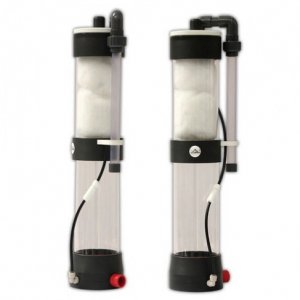
LaCl Reactor

Slief,

how do wash them in vinegar? do you soak them in a bucket or put them in a washing machine with some amount of vinegar?
I can see using Vinegar would break the "hard" stuff down.

rich

I throw mine in the washing machine. I fill up the soap tray & fabric softener tray with the vinegar. I also pour about a cupful into the washing machine before I start the load. That said I always make a point of washing the soap trays before washing the socks. The soap, bleach and fabric softener trays come out of my washing machine together as they're in the drawer. I always wash them before I clean my socks to make sure there is no soap or fabric softener left behind.
 
Thanks! Since tank water will also be running through the socks i figured both calcium precipitate and normal detritus would get caught in the pores. Maybe both vinegar and bleach to clean?
 
Thanks! Since tank water will also be running through the socks i figured both calcium precipitate and normal detritus would get caught in the pores. Maybe both vinegar and bleach to clean?

If you do that, do the bleach wash first then the vinegar wash or vice versa. Vinegar and bleach together will result in chlorine gas which is toxic. Be sure to do a 2nd rinse with each cycle and let them air dry completely between washes.
 
I wash them in the washing machine, hot water, smallest load size possible, no soap. Adding the vinegar is something that would be aid in breaking down the hard stuff. I did wash a 5 micron sock on Sunday, just hot water, and it came out clean, noticeably different.

rich
 
If you do that, do the bleach wash first then the vinegar wash or vice versa. Vinegar and bleach together will result in chlorine gas which is toxic. Be sure to do a 2nd rinse with each cycle and let them air dry completely between washes.

I wash them in the washing machine, hot water, smallest load size possible, no soap. Adding the vinegar is something that would be aid in breaking down the hard stuff. I did wash a 5 micron sock on Sunday, just hot water, and it came out clean, noticeably different.

rich

Roger that! Thank you
 
I found this reactor and decided to give it a shot. Along with reactor i ordered what they claim is pure 100% Lanthanum Chloride (1000ml). I plan to run a slow water flowand do 20ml LC mixed in 1 gal of RODI water dose the diluted mixture say 6ml per day. 6ml will also be cut into smaller dosing quantity. Probably 0.5ml every 2 hrs.
Reactor will flow out to a BRS canister with a 5 Macron sediment filter then into sump with a 5-10 macron filter sock.
here are few pics of items i purchased. (havent installed them yet still waiting on few items to arrive)
 

Attachments

  • lth100-lanthanum-reactor.jpg
    lth100-lanthanum-reactor.jpg
    21.5 KB · Views: 13
I am just going to say this.., these posts are all talking about SeaKlear. Which I don't believe is 100% pure, there is water in it I believe. Lots of folks are using 20ml of SeaKlear to a gallon of RO/DI. If you have that pure stuff, I would start with a whole lot less, like 4 or 5 ml to a gallon or Ro/DI.

As Gary M. says, start slow and build up.

rich
 
Hey guys. I bought this lanthanum reactor from a company in Spain. The reactor is $260 plus $30 for 2 bottles of pure lanthanum chloride 500ml each plus $49 for shipping via ups.
Company is http://www.derkroon.com
Haven't got it yet, once I get it I'll post pics and reviews here.
 
I set up my 2 RO canister reactor 30 days ago. The outflow is directly into my skimmer. So I checked the outflow and it is dripping. Ok, all clogged up.

I clean the T. It is mostly clogged up, but not enough to cause the outflow to drip. So I figured the floss is all clogged up. I remove all the floss, new floss and carbon.

And back in business... so I thought. It is still dripping. After numerous attempts at airlock, removing floss, etc etc, I can't figure it out.

Finally I remove the inner resin canister with the packed in floss, and notice the part of the bottom (that screws off) has some sort of material. It is a brown color. It was totally clogged. It is like a cloth material to keep DI resin or material you normally use to keep the material in place.

I removed this "cloth" and I am now getting great flow.

So if any of you are using the cartridge in the second canister, remove that material from the screw on portion.

otherwise, phosphate has been at .00 or .01. So I am loving it.

rich
 
little update:
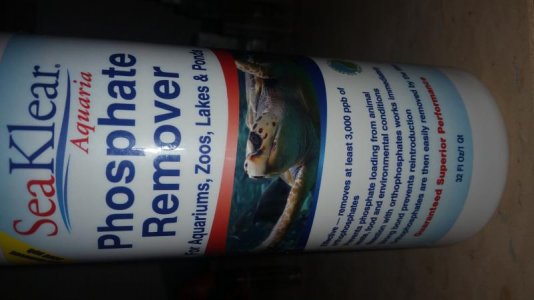
i bought seaklear aquaria phos remover. i know its a weaker solution than a regular pool version, but the good part of this product is that you can dose the tank directly with it. no residue or harmful white debris to collect in filter socks etc.
in my 300 gal tank Hanna checker ULR was showing over 200 ppb (out of high range)
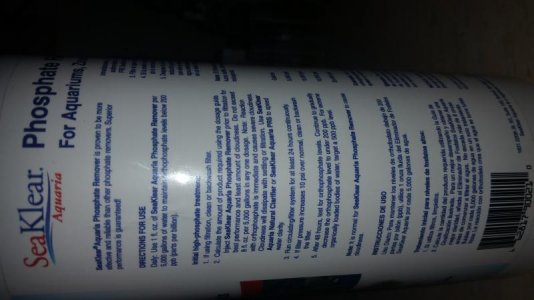
according to the directions on the bottle 1oz to 5000 gal, which in conversion comes to 0.0625oz to 300 gal. because tank had over 200 ppb i tripled the initial dose (0.2oz).
mixed it in some rodi water and poured it directly near the intake of skimmer.
Tank got slightly milky for 30 min and got cleared up. after 3 hrs i checked phos levels which were 70 ppb or 0.215ppm.
Bottle says to dose 0.06oz per day in 300 gal tank to maintain phos levels near 0.
though it cost the same or a bit higher than pool version i think paying $5 more for a quart is much better for not having to dose slowly with a doser or drip and clogging filter socks or floss in reactors etc.
At this time i dont have any livestock in the tank to see the effects of milkiness that last 30 min or so. but in order to reduce any effects of that i plan on mixing 0.5oz in a gal of rodi water and dose 600 ml (20oz)per day lasting a gal 6.5 days. which breaks down to same 0.0625 oz per day as directed on bottle.
Apex is setup to deliver 6ml then off for 9 min so 24 ml in 1 hour.
 
dose in my tank is 0.06oz. which is barely 4-6 drops. but again there is precipitation/milkiness of water for about 30 min or so. if you stagger such a small dose diluted in water over 24 hrs it may not cause milkiness like a single dose does.
But this is just a single dose here and there. not sure how the precipitation will accumulate over time on daily dosing basis. i bet filter/sock will be required when dosing daily.
 
dose in my tank is 0.06oz. which is barely 4-6 drops. but again there is precipitation/milkiness of water for about 30 min or so. if you stagger such a small dose diluted in water over 24 hrs it may not cause milkiness like a single dose does.
But this is just a single dose here and there. not sure how the precipitation will accumulate over time on daily dosing basis. i bet filter/sock will be required when dosing daily.

I would be VERY careful. That "milkiness" of the water would be hurting your fish if you had livestock. It attaches to their gills. if you are seeing any cloudiness in the water, you are doing it wrong. The precipitate should always be captured and never allowed into the water column. Also, the other issue which many seem to overlook is the drop in alkalinity which will accompany the LaCl dosing. if you are seeing cloudiness, now only are you harming your fish but you are also likely dropping your alk faster and more than you might realize which can also harm the corals. FWIW, the 10 micron or smaller sock should always be used when dosing directly into the water and even when using the reactor method, the effluent should be filtered to capture the precipitant if there isn't some sort of medium in the reactor to prevent 100% of the precipitant from escaping. I know some may disagree with me but I've been using this stuff for many years and I've also had long discussions with marine curators on this very subject.
 
I would be VERY careful. That "milkiness" of the water would be hurting your fish if you had livestock. It attaches to their gills. if you are seeing any cloudiness in the water, you are doing it wrong. The precipitate should always be captured and never allowed into the water column. Also, the other issue which many seem to overlook is the drop in alkalinity which will accompany the LaCl dosing. if you are seeing cloudiness, now only are you harming your fish but you are also likely dropping your alk faster and more than you might realize which can also harm the corals. FWIW, the 10 micron or smaller sock should always be used when dosing directly into the water and even when using the reactor method, the effluent should be filtered to capture the precipitant if there isn't some sort of medium in the reactor to prevent 100% of the precipitant from escaping. I know some may disagree with me but I've been using this stuff for many years and I've also had long discussions with marine curators on this very subject.

I agree with you 100%. I plan on using 3 chamber unit with floss and 5 micron filter with out straight to input of skimmer.
I been dosing directly because there is nothing in the tank except for water and rocks.
It's funny that seaklear makes this product Aquaria phosphate remover just for aquarium use and in direction or warning no where they mention to use a filter or sock etc. Their directions says to put 1oz for every 5000 gal straight into tank and if cloudiness occurs to use an other of their product to clear it.
 
SeaKlear Aquaria Phosphate Remover effectively removes phosphates and prevents phosphate loading from animal waste, food, and environmental conditions.
Fast-acting reaction starts working immediately
Creates a strong bond to prevent reintroduction
Captures orthophosphates to allow for easy removal by the filter.


SeaKlear Aquaria Natural Clarifier is an all-natural marine biopolymer that clears cloudy water. It is made from the shells of crustaceans making it 100% biodegradable and non-toxic. Our exclusive formula provides superior water clarity without harming the environment.
Quickly clarifies cloudy water
Removes oily residue
100% natural & biodegradable

Call us at 1-866-99-KLEAR
Email us at info@seaklear.com
 
so they are expecting the biopolymer to absorb the lanthanum powder in the water?

I am not sure what they are saying. I am not a chemist just a doctor. But from the bottle itself of seaklear aquaria phosphate remover it instructs to dose is directly into Aquarium and does not warn anywhere to watch for precipitation or to filter it with a sock etc. Does say to keep skimmer/filtration on.
Product may cause cloudiness and to use their water clarifier to remove cloudiness. Also says to inject it closer to filtration for least cloudiness.

I am not sure if they made this product just for aquarium use so they modified the formula to better assist marine life or simply ignoring the fact it can cause damage.
 
This is the instructions on the bottle.
 

Attachments

  • 1486623059945-446159211.jpg
    1486623059945-446159211.jpg
    40 KB · Views: 11
  • 14866231202041348645382.jpg
    14866231202041348645382.jpg
    44.3 KB · Views: 11
Back
Top