low flow or high flow through refugium?

monkeybiz

New member
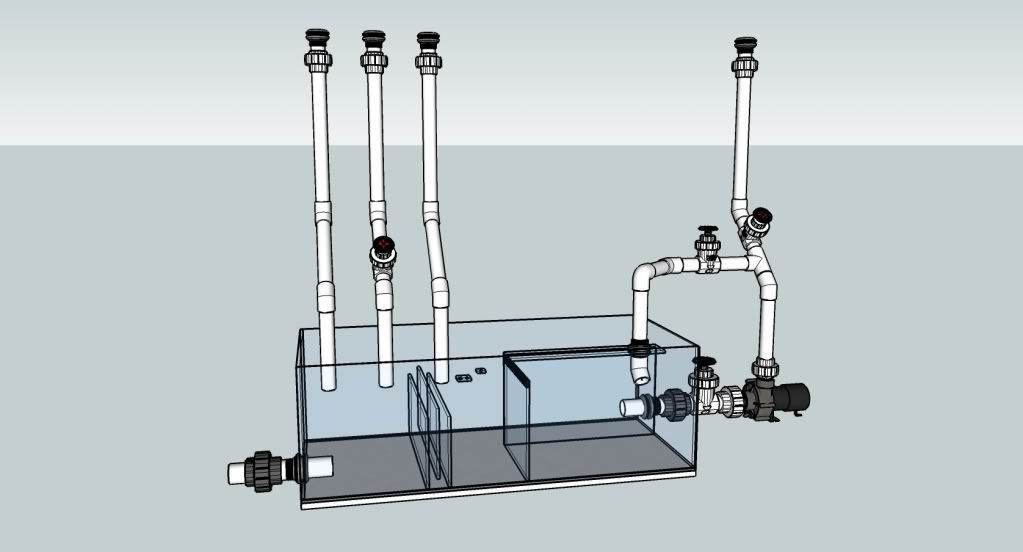
so im in the process of redesigning my sump/refugium as i read that it is better to have slow flow through refugiums.

my new plans for my sump/refugium will have two seperate drain pipes. one going to a skimmer section on one side and another drain pipe going to a refugium on the other side. the return pump will be in the center chamber and flow to the refugium will be controlled by a ball valve.

but if slow flow is not required for a refugium it would be much easier to just have my sump set up as skimmer/refugium/return since the drain pipes would just have to be routed to one side.

so im just looking to see the pro's and con's of slow/fast flow through a refugium.

here is a paint diagram of my sump/refugium. its not to scale

4148307099_8d3a11502d_o.jpg
 
i also read that slow flow through refugium is best. I just so happen to be designing the sump section myself and my basic layout is the same as yours. After a long discussion with the guy that's helping me make it, we decided to make 2 drain pipes for each section instead of a valve as we think it will be simpler.

Hope that helps XD
 
slow flow is best, you could also put a 90 to make the flow bounce off the side of you fuge to decrease flow.
 
I was considering an aquarium set up with a sump. The pet store suggested that I consider a refugium in the 30 galllon sump that was part of the bid. When discussing pump size for what would have been a 48 by 24 by 15 Lexan tank, they mention that it was better to have a LOW flow accross the refugium part.

I still may consider this set up in the future but since I had success with a 28 gallon nano tank I decided to go with a similar set up, a 66 gallon Red Sea Max 250 about a week ago with about 35 lbs of live rock from an existing aquarium and 40 lbs of new live rock form Tampa Bay Salt Water. I bought their 40 gallon "package" which included a clean up crew however, after about 5 days I noticed an outbreak of brown agle so I purchased an addition 10 red legged hermit crabs yesterday to assist the others.
Hopefully, coraline agle will take over asap.

So far so go. Everything is functioning perfectly; however, no refugium.

Good luck with your project.
 
I was considering an aquarium set up with a sump. The pet store suggested that I consider a refugium in the 30 galllon sump that was part of the bid. When discussing pump size for what would have been a 48 by 24 by 15 Lexan tank, they mention that it was better to have a LOW flow accross the refugium part.

I still may consider this set up in the future but since I had success with a 28 gallon nano tank I decided to go with a similar set up, a 66 gallon Red Sea Max 250 about a week ago with about 35 lbs of live rock from an existing aquarium and 40 lbs of new live rock form Tampa Bay Salt Water. I bought their 40 gallon "package" which included a clean up crew however, after about 5 days I noticed an outbreak of brown agle so I purchased an addition 10 red legged hermit crabs yesterday to assist the others.
Hopefully, coraline agle will take over asap.

So far so go. Everything is functioning perfectly; however, no refugium.

Good luck with your project.

I don't mean to go off topic, but a diatom outbreak on a week old tank is a normal part of the cycle. I wouldn't add any more creatures for a while until your cycle completes and things level out. The brown algae will most likely disappear as fast as it came.

Back on topic, I'm planning a sump almost exactly the same as your setup and I've also read that slow flow is best.
 
slow flow through, high flow in :)
I always recommend higher flow in than most, but it is what I do and I have good success.
 
i've also read everyone recommending slow flow but why do we need slow flow?

slow flow through, high flow in :)
I always recommend higher flow in than most, but it is what I do and I have good success.

how to get high flow in and slow flow through? assuming you mean high flow into the refugium and slow flow through it.
 
Well, I think the flow rate would depend on what you want to keep in the refugium. Higher flow rates might be better for live rock, lower flow rates would be okay for algae. I might target 5x the volume per hour or less for algae, for example.
 
monkeybiz
You can also put a tee/valve in your return line to feed the refugium. That would make it easy on the drains.
Sometimes doing what your trying will make a loud drain line due to some gurgling.
This will also stop detritus from building up in the refugium.
 
I have done it two ways...
by using a surge device to fill the fuge, this could be a simple toilet valve surge device, therefore same throughput, but higher flow (I did this until I tired of the noise)
or
by supplementing with a powerhead (what I do now)
 
monkeybiz
You can also put a tee/valve in your return line to feed the refugium. That would make it easy on the drains.
Sometimes doing what your trying will make a loud drain line due to some gurgling.
This will also stop detritus from building up in the refugium.

+2 I wouldn't take dirty drain line to the fuge THEN to the return. Take it straight from the return and ball valve from it to the fuge
 
Well, just to cause trouble, and be a heretic: higher flow through the sump, and lower flow through the "fuge" section. A couple have previous touched on this, but I will put it graphically, because that is just what I feel like doing, because you have to change the flow logic.

sump3-1.jpg


And for those that swear by external return pumps as I do:

Untitled-8.jpg


Jim
 
It will also allow you to uae a filter sock on the drain line - but that's another thread.
 
why? doesn't make sense to me, loosing head pressure and why not have it come directly from the tank? this way your feeding what ever lives in the fuge? what if your skimmers that efficient? i can see both sides but id prefer to run it off the drain line at a slow enough pace to allow up take to algae growing?

+2 I wouldn't take dirty drain line to the fuge THEN to the return. Take it straight from the return and ball valve from it to the fuge
 
Back
Top