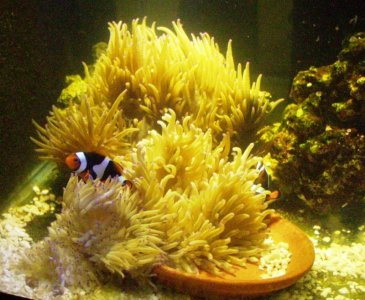
Malu pedal disk injury/rott

ThRoewer

New member
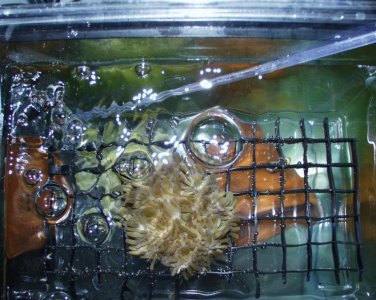
I noticed that my malu wouldn't attach it's foot. It only holds itself with its verrucae.

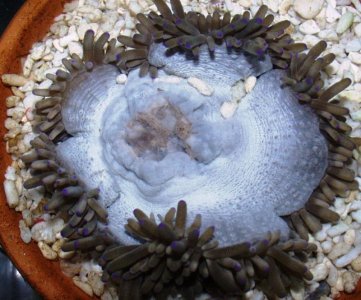
When I turned it over to check it didn't look nice

attachment.php


It looks like the pedal disk is rotting and mesenteries are coming out.

From the top it looks OK

attachment.php


It doesn't deflate or has an open mouth.

Is this something that can be treated?
Would cipro work?
 

Attachments

  • P5040195-1.jpg
    P5040195-1.jpg
    89.9 KB · Views: 1
  • P5040197-1.jpg
    P5040197-1.jpg
    101.3 KB · Views: 1
OK, I will try treating with cipro in a small volume this time.

Can the anemone sit on its food or would it be better to place it on a small frag rack so that the medication can reach the injury?
 
I started treating it with cipro last night.
Since it's only in a half full one gallon tank I dissolved 1/2 of a 500 mg tablet in 20 ml RO water and dosed the tank with 1 ml of this solution. I stored the rest of the solution in the refrigerator.

Since its pedal disk is injured/infected I placed it on a piece of eggcrate to prevent further rot and enable the medication to reach the damaged area.

attachment.php


Circulation has to be kept to a bare minimum or the anemone will just tumble around in the tank as it isn't able to attach anywhere right now. So all I use is an air bubbler.

I will do full water changes every night before the next dose and see how it goes.

To my experience malus are very prone to this kind of damage and often won't recover on their own.

If this works I will try it next with a small gig in a 2.5 or 5 gallon tank.
 

Attachments

  • P5070239-1.jpg
    P5070239-1.jpg
    94.4 KB · Views: 2
OK, It's been a while now since the treatment was completed and it looks so far as if it worked. It took about another week for the anemone to finally attach firmly ...

attachment.php


...and then it decided to rather move onto the rock behind it than stay on the gravel in the dish.

attachment.php


The slightly shriveled up look comes from the anemone crab pair having a bit of a fight over it - I guess it is too small for two crabs.

The good news from this is that it seems that you can dissolve a cipro tablet in RO water and store that solution for at least one week in the refrigerator.
I used 20 ml RO water to dissolve 250 mg cipro. The solution had some cloudiness and some sediment so it is required to shake it before extracting partial doses.
But at least this allows for easily dividing one tablet to several smaller doses.
 

Attachments

  • P5240315-1.jpg
    P5240315-1.jpg
    69.7 KB · Views: 2
  • P5150295-1.jpg
    P5150295-1.jpg
    63.2 KB · Views: 1
Last edited:
Thought it may be time to post an update.
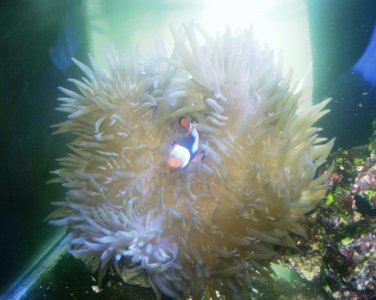
This is how the malu is now, more than twice as big as in the beginning. The rock it's on is the same as in the previous pictures above:

attachment.php


Sorry for the bad picture - I got a bit of an algae bloom problem in that tank.
 

Attachments

  • P6210341.jpg
    P6210341.jpg
    57.5 KB · Views: 2
This one crawled up the rock and stayed there throughout several rearengements and full tank cleanings. It obviously likes it there.

I still have it in a 10 gallon QT. The last few weeks I had a bad algae bloom that didn't even go away with a 100% water change. At times the soup was so thick that I could hardly see the anemone, but it seemed to like it and only got bigger.
The issue is the rock the anemone sits on - it was for weeks in a tigger pot culture tank and is soaked with nanochloropsis algae.
 
Looking good. I think that is crispa rather than malu.

It's a malu for sure. The tentacles are not long enough for a (healthy) crispa and have the malu typical reduction ring on their bases. But it looks as happy and healthy as it gets.
I feel malus are more suited for a mixed reef tank than any other host anemones since they stay small , normally don't wander around in the rocks and seem to be well accepted by ocellaris and percula. I also think their collection is way more sustainable than gigantea and doesn't impact wild clownfish populations as much.
The only thing you need to watch for is to put them into a spot with very low flow.
I have a strong pump in the tank but directed the flow so that the anemone only gets a very gentle "breeze".
I also feel that malus don't mind nutrient rich water. BTW, my gig doesn't mind it either but if I forget to feed it for a day it gets upset.
 
Actually the tentacles of crispa are often quite short when new to a system. Usually malu have more pronounced rings around the tentacle, yours look more indicative of crispa. Also, more convincingly, the column appears to be that of crispa. If it eventually gets quite large, attaches to rock or coral rather than buries in the sand, and the tentacles get the 3-4 inch range, then you'll know for sure it's crispa. Whatever the case, it's a nice looking anemone and I'm glad you've been able to nurse it back to health.
 
Certainly looks like a Malu to me, and I personally prefer them to a crispa, brighter colors and stays smaller, sand dwellar usually means no crawling on rockwork stinging corals, better choice for a mixed reef IMO.
 
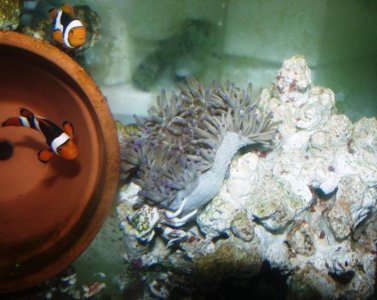
I added the two new malus to the tank, very much to the delight of my percula pair 4.

attachment.php


I'm thinking about getting a few more and make a 20 gallon tank full of malus.
 

Attachments

  • P6270363-1.jpg
    P6270363-1.jpg
    96 KB · Views: 1
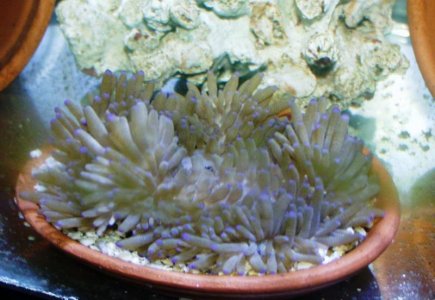
All 3 malus together:

attachment.php


The oldest has grow a lot since I got it. I also found that it prefers 5000 Kelvin daylight LEDs (75W Philips from Home Depot) over more actinic light sources. I tried a Chinese Reef LED bulb and it looked nice but under it the anemone contracted significantly so I switched back to the "ugly" yellowish daylight.
 

Attachments

  • P6290009-1.jpg
    P6290009-1.jpg
    82.1 KB · Views: 2
I am with Gary. That largest one looks like a Crispa. "Grow a lot" usually mean Crispa. Malu max out at 7 inches or so
 
Last edited:
I wouldn't mind it being a crispa, but I'm still pretty sure it's a malu.
According to Fautin a malu can grow to a mouth disk diameter of 200 mm (8 in). That is without counting in the tentacles in. This one is (without the tentacles) only about 5 in.
Also the longest tentacles are with 40 mm too short and the tentacles overall too irregular in length for a healthy crispa.
 
Back
Top