
You are using an out of date browser. It may not display this or other websites correctly.
You should upgrade or use an alternative browser.
You should upgrade or use an alternative browser.
multicolor gigantea
- Thread starter Gary Majchrzak
- Start date
Frank Giacobbe
New member
WOW what a tank. Very Very Cool


BonsaiNut
Premium Member
BN,
Do you think that this is eggs in my (18 inches) S. gigantea?
Probably, Minh. Put a bright light over your anemone and look closely. They will be clusters of small dots - perfectly round. With strong backlighting they will look black. Otherwise they will look pale whitish (like what you see in Gary's photo).
Once your anemone spawns there will be fewer of them however they will not necessarily all be gone. In the case of E. quadricolor there are generally eggs in development, mature eggs, and empty mesenteries all present at the same time.

OrionN
Moved on
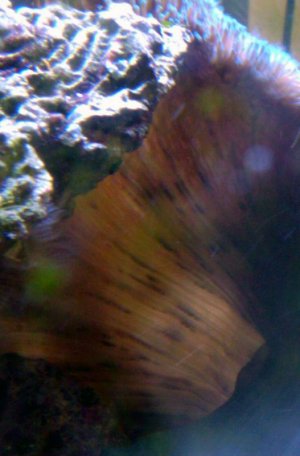
I hope my Gigantea will not spawn, at least if she is a female, but keep them and take in the sperm and release fully formed babies. I took this picture with my cell phone from below. The other side is the top thus some back lighting. I will see if I can use a strong light to look at/for the eggs.
Sorry to hijack Gary's thread.
Sorry to hijack Gary's thread.

Gary Majchrzak
Team RC
I don't mind the hijack- I learned from it. Thanks!
Several months ago I noticed the tail end of a massive spawn in my aquarium and now you got me thinking it might have been my gigantea....
Several months ago I noticed the tail end of a massive spawn in my aquarium and now you got me thinking it might have been my gigantea....
Gary Majchrzak
Team RC
I coined the description "multicolor" gigantea. I've never heard the term used before on any anemone 
The Reef Central Anemone FAQ (stickied to the top of this forum) is one of the best sources of information you'll find on anemones and it's worth printing out.
The Reef Central Anemone FAQ (stickied to the top of this forum) is one of the best sources of information you'll find on anemones and it's worth printing out.

ChuckG
New member
Thx Gary.. So do you think your specimen is a brown variety that is sometimes offered? For instance Diver's Den sometimes has specimens they list as brown (and they look plain brown) and I'm wondering if these would display any similar coloring to yours once they were properly acclimated and thriving. Or is it more of an individual animal thing?
Your success with the gigantea is definitly an inspiration. I hope to keep one eventually when I can upgrade to a proper size tank.
Your success with the gigantea is definitly an inspiration. I hope to keep one eventually when I can upgrade to a proper size tank.
Last edited:
Gary Majchrzak
Team RC
I'm thinkin' it's an individual animal kinda thing.
Lighting and choice of foods can affect coloration.
Now we can add sex to that, too.
Lighting and choice of foods can affect coloration.
Now we can add sex to that, too.
OrionN
Moved on
From what I know female Gigantea should not spawn. If you Gigatea is full of eggs, you should not have a spawn event due to her.......
Several months ago I noticed the tail end of a massive spawn in my aquarium and now you got me thinking it might have been my gigantea....
Gary Majchrzak
Team RC
female gigantea never release any gametes?

WDLV
Skunk Hybrid Freak
I like that thought.... With BTAs it could probably even be done in our own systems??? Liquid nitrogen isn't that hard to get ahold of but transport might be a #####.Also... I found it notable that the biospsies were non-lethal. What's to stop someone from going out to the reef, "harvesting" eggs and sperm using this method, and then artificially raising the offspring?
Given the results of the Carribean elkhorns and stags that were recently collected and frozen and or raised, I would imagine this technique would yield an excellent survival prospect.
BonsaiNut
Premium Member
I hope my Gigantea will not spawn, at least if she is a female, but keep them and take in the sperm and release fully formed babies.
It is my understanding that giganteae are internal brooders and that they behave exactly as you describe. This is based on second-hand, but pretty reputable observation from someone who was indirectly successful raising them in Palau. (I say indirectly, because it was not the primary purpose of the facility, so very little effort was put into formalizing and improving the aquaculture process - it "just happened"). Based on this person's experience, S. gigantea males trigger the spawning behavior when they release their sperm into the water. The females ingest the sperm where it internally fertilizes the eggs. At some point in the future (unknown), the females release tiny juveniles which then broadcast colonize the area. They are apparently very small at this stage and look like hydras and not at all like adult giganteae. It should be noted that other species of anemones are also internal brooders, so this behavior is not unique to S. gigantea.
I have very little additional information on S. gigantea reproduction. The best I can do is to try to draw parallels from other anemone species. Dr. Anna Scott has been doing the most current work in this area, but she is only working with H. crispa and E. quadricolor due to her location. I have asked her about S. gigantea reproductive behavior and she cannot provide any additional information at this point since she has no first-hand experience with the species.
Based on some of her recent work, it may be that the internal brooding period within S. gigantea is 14 days or less (since this is roughly the point at which there are almost no free-swimming larvae left with related broadcast spawning anemones). With H. crispa and E. quadricolor, larvae can settle out and start to develop arms as soon as 10 days after spawning, if conditions are optimal. E. quadricolor is a little faster because the eggs are larger and the larvae are also larger. The eggs of E. quad and H. crispa both contain zooxanthellae, and the larvae and juveniles develop with zooxanthellae already present in their tissues. It appears to be the only source of nutrients for at least the first three weeks of life, since it takes around three weeks for juveniles to develop a mouth. There is a lot less known than unknown at this point.
One thing I can say pretty certainly - rearing gigantea babies from the juvenile stage forward will require a specialized setup. The environment of a typical reef tank probably does not provide for the needs of the juveniles, and they would also be easy prey for any critter in the tank that wanted a quick snack.
Last edited:

Gary;
I can't tell from the pictures I've seen, but is the foot of this one buried into the sand, or up on the rock, or in between? I'm trying to decide how to try to place mine (as if I actually have any control over it )
)
TIA
I can't tell from the pictures I've seen, but is the foot of this one buried into the sand, or up on the rock, or in between? I'm trying to decide how to try to place mine (as if I actually have any control over it
) TIA
Gary Majchrzak
Team RC
I'm quite certain (but not positive) that my anemone released gametes back in September of 2009. I'll have to pay more attention and get pictures next time this happens. Thanks for this information.
OrionN
Moved on
From personal experiences, H. malu also interanl brooder that release the larvae between 48 to 60 hrs after the spawned. This happened twice in my tank but I am not able to setup any way to catch or raise the larves. Both time they release it during the night. One day I can see the fertilized larve inside the female the next day they are all gone.
Gary Majchrzak
Team RC
good question.Gary;
I can't tell from the pictures I've seen, but is the foot of this one buried into the sand, or up on the rock, or in between? I'm trying to decide how to try to place mine (as if I actually have any control over it
TIA
This anemone was anchored on top of (and around) an angular grapefruit sized rock since I aquired it 3 years ago. It never budged an inch from it's perch until a month ago when I placed a larger flatter rock next to it. It took roughly two weeks for the anemone to sense the larger rock. It then moved over to wedge itself between the new rock and the old rock. The new position allows the anemone to expand much larger now.
The old "perch" on the original rock is quite obvious as it's the only spot totally devoid of coralline growth.
I don't know if this helps you with placement, Randy.
If it were my new gigantea I would place it at the sand/rock interface.
Very helpful, thanks.
OrionN
Moved on
Similar threads

- Replies
- 13
- Views
- 1K

- Replies
- 0
- Views
- 195
- Replies
- 0
- Views
- 210


- Replies
- 4
- Views
- 513