
You are using an out of date browser. It may not display this or other websites correctly.
You should upgrade or use an alternative browser.
You should upgrade or use an alternative browser.
Natural enemy to those liitle worms in the sand bed that have those nasty tentacles!
- Thread starter koll12
- Start date

Agu
Premium Member
Beauty is in the eye of the beholder. I have a fishless junk tank (so called because it's set up with junk I had laying around.) Primary mobile life forms are bristle worms.
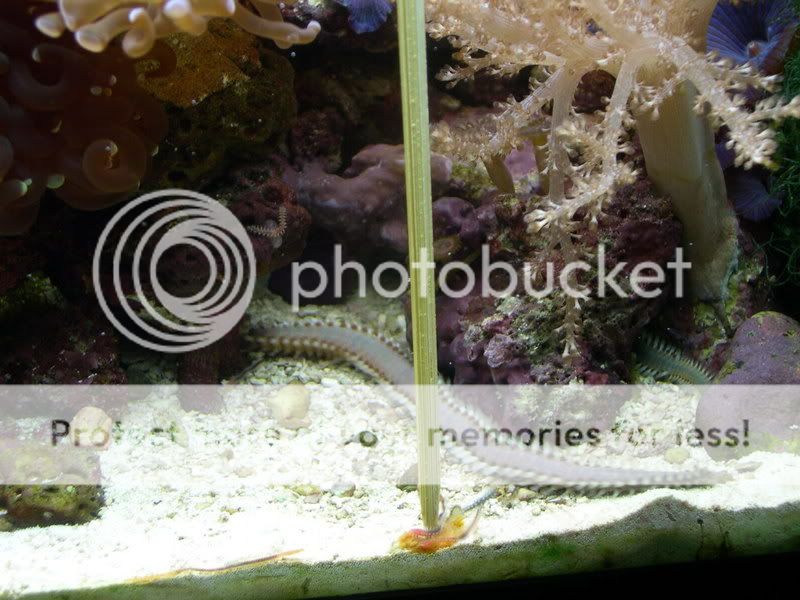
Here's feeding time with a dead mussel,
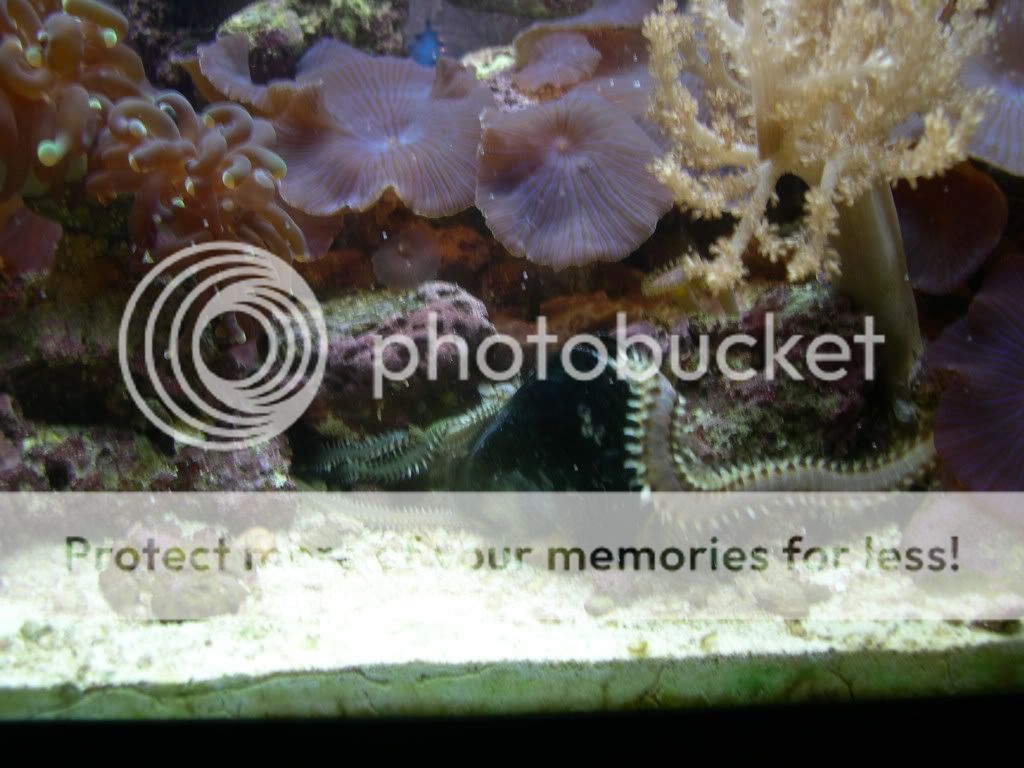
You can argue the theoretical possibilities all you want but this ten gallon tank that's been set up about 5 years has been the easiest and cleanest tank I've ever had.
Here's feeding time with a dead mussel,
You can argue the theoretical possibilities all you want but this ten gallon tank that's been set up about 5 years has been the easiest and cleanest tank I've ever had.

kingfisher62
New member
I wish I had both your camera and your steady hands! Excellent picture!
Thanks, the camera is just a fuji Finepix s700, but it takes good macros .
kingfisher62
New member
If people could find a yellow coral with black flecks they would leap for it, but show them an amazing worm with the same coloration and it's "hideous".
Actually it is green flecks! Too bad they usually mostly buried!
If I interpreted the description correctly, you're talking about spaghetti worms/terebellid polychaetes. As people have already said, these worms are hugely beneficial to your sandbed (in fact, it couldn't work without them and other worms like them). The best part is that they reproduce fine on their own if the tank is well-fed, so you're looking at a free sand-bed maintenance crew! Course, I'm also biased cause these guys are one of the bases of my PhD research...
Link if you're curious about these critters http://en.wikipedia.org/wiki/Terebellid
Cool! I always wondered what those strings/tentacles were that I see all over the reef when scuba diving... Are they light sensitive? On night dives I notice they retract when you light them up...

Opcn
Member
Actually it is green flecks! Too bad they usually mostly buried!
Do you have a whole breeding population of these? If so I hope you send m out to other aquarists and share them around. In 5 years or so when I get a nice big tank set up I'm going to want to find some of these yellow and green beauties!

elegance coral
They call me EC
(First of all I'm sincerely glad you asked these questions cause this is the central topic of my PhD research I'm defending on Monday and this is sooooo much help finishing the report writeup)
I'm glad I could be of assistance. Perhaps this will help as well.
First of all, you're largely right, but there's one thing I would argue [and which I try to defend in the proposals I'm working on] is important: the worms stir up phosphate deposits (organic, mineral-bound, what have you), which shifts around its redox states and changes their solubility to change which can help return it to the water column to be removed by filtration.
We in the hobby, attempt to keep as much phosphate out of the water column as possible. The system you're advocating, by your own admission, is steadily pumping phosphate into the water column. This puts a load on our filter systems, fuels algae problems, stunts stony coral growth, and degrades our water quality. I fail to see how this can be viewed as a good thing, or beneficial.
Again though, you're right that it's not the worms eating stuff that reduces phosphate, it's the fact that they're there stirring stuff.
Worms stirring stuff does not remove phosphate. For starters, you must first allow the phosphate contained within the system to rise before you can support these large populations of worms. In order for these large populations of worms to survive, there must be an even larger amount of phosphate laden, rotting, organic matter for them to feed on. There is always more vegetation in the forest than there are deer that feed on it, there are more wildebeest than there are lions that feed on them, there is more plankton than there are whales that feed on it.............., and there will always be more phosphate laden, rotting organic matter in the sand than there are worms that feed on it. This is simply how nature works. The only thing accomplished by worms stirring stuff, is that the rate of decomposition can increase. This simply means that the rate the phosphate escapes the sand, increases. This phosphate, once it escapes the sand, must first make its way past the algae, and stony corals, held in the display, before it has a chance to make its way to the filter for removal. I honestly don't see how we can give the sand bed and worms credit for removing the phosphate that was removed by the GFO in the sump????????
Actually, decomposition is a good thing, but we want only certain kinds of decomposition. Decomposition (ie breakdown of organic matter) takes place in a certain order: aerobic degradation takes place first until oxygen is depleted, and this produces ammonium as a result, which is oxidized to nitrate. This nitrate can have one of two fates: it can be used by our higher life like algal cells
You just admitted that decomposition leads to nitrate and algae growth. There are countless threads, on this and other forms, from people battling algae problems. It overgrows, and kills coral. Both in our tanks, and our oceans. Knowing this, I'm puzzled by how you can view decomposition as a "good thing".
HOWEVER, most of the nitrate goes through the other pathway if things are operating properly
Can you post a link that backs up this statement? Especially where you used the word, "most".
(which is good, because we don't want too much flowing to the organisms and becoming pest algae floods): denitrification, which replaces oxygen as the electron acceptor to degrade organic matter after oxygen is depleted. The catch is that if there isn't enough organic matter left over (which would require at least 150 micro moles/L...a significant amount), then there will be nothing to fuel denitrification (which requires both organic matter and nitrate).
Think about what you just said. You just said that it takes "a significant amount" of organic matter to fuel denitrification. You also admitted that nitrate takes two paths. It goes on to fuel algae blooms, and it can be converted into N2. So, even with the a portion of the nitrate being converted into N2, we still have a portion going on to fuel algae growth. The more "significant" the amount of organic matter, the more significant the amount of nitrate that goes on to fuel algae blooms will be.
If there's nothing stirring the surface and/or not enough free organic matter, then oxygen never gets used up and nitrate never gets reduced to free nitrogen.
Oxygen will indeed get used up without worms stirring the surface. Virtually every surface in our systems is covered with microbes. These microbes can, and do, deplete the oxygen content of the water as it slowly moves deeper into the sand. We don't have critters stirring the surface of LR, yet the O2 level gets depleted as the water penetrates deeper into the rock.
Why not just reduce the organic matter and cut off the nitrates that way?
:bounce2: Yayyyyy!!!!! Doesn't that sound soooooo simple? When you remove a particle of organic matter, you remove 100% of the nitrate and phosphate it contains. There is nothing left to fuel algae blooms, cause health issues in corals, and degrade our water quality.
You can do that if it suits you, but be warned that all reef tanks with corals need some form of feeding. If you prefer to control the feeding yourself, then whatever method suits you...this is off topic, though.
I would never suggest someone withhold food, as a means of maintaining good water quality. This is like not feeding your dog, so it won't poo in the house. All I'm suggesting is that we should clean up after our pets.
nitrate and phosphate are not harmful (except at VERY high concentrations.
This is relative to the organism you are referring to. In our case, we are keeping organisms that live on coral reefs. These are very nutrient poor environments. When the products of decomposition, like nitrate and phosphate, rise, coral reefs die. It does not take a "VERY" high concentration to do this. There are thread after thread from people that detect low levels of nitrate and phosphate, yet their invasion of hair algae won't subside.
They do, however, fuel growth: both the growth of our corals and reef, or algae if we don't properly manage nutrient levels with proper denitrification.
Denitrification in a sand bed does absolutely nothing to reduce phosphate, and it's only capable of converting a fraction of the nitrate.
Nitrate and phosphate levels that are low enough to negatively impact "the growth of our corals and reef", is very very very rare in this hobby. We typically don't have issues with low nitrate, or low phosphate. We have problems with elevated nitrate and phosphate. Having a compost pile on the bottom of our tank only make this issue worse.
Except that it isn't a problem, as I hope I've shown. I really do hope that's clear.
I hope you've taken the time to read what I've typed, and gave it some serious thought. If you do this, thing should become clear for you.
It's a complex topic,
It does not need to be. The typical hobbyist does not need to understand all the intricate workings of the global nutrient cycle just to maintain a healthy, and long lived reef tank. They simply need to understand that maintaining low nutrient levels is the key to a healthy, relatively algae free, and easy to care for reef system. Leaving a sand bed untouched will lead to the accumulation of rotting organic matter. At this point it is no different than a compost pile, leaf litter on the forest floor, dung and dead grass on the plains of Africa, or anywhere else that organic matter accumulates and rots. It produces fertilizer. It does not matter how many worms, insects, pods, or microbes you throw in it. It still produces fertilizer. The only way to avoid this, is to simply remove the compost pile from the system.
But do remember that it's possible to remove dissolved phosphates, as well as organic-complexed phosphates, fairly easily.
Phosphate is one of, if not the, hardest substance to remove from a reef tank. Phosphate binds with calcium carbonate. The typical reef tank is full of LR's that are made of calcium carbonate, and sand that is small particles of calcium carbonate. This produces a large reservoir of phosphate. It can take months to reduce this reservoir of phosphate to levels where it no longer feeds algae problems and stunts stony coral growth.
And to anticipate a potential question: why not let the phosphate stay locked up in the particles? It won't...those particles WILL be broken down if they are organic, and there is no way to prevent it in an aquarium.
Why not simply remove the particle?????? If it is removed, it WILL NOT be broken down in the aquarium.
I hope by now that you do, though I will also add that I am not claiming it's impossible to support a reef without these. They're beneficial, though, and they can play a central part of a successful sand bed method.
I'm sorry, but you have still failed to show how a pile of rotting organic matter, crawling with worms and other organisms is "beneficial" to a reef tank.
And yes, I'm biased because I've spent the past 104 weeks (literally, no time off...) studying these guys. Do feel free to ask questions
Cheers!
You should be proud of all your hard work and what you are trying to do with your life. I sincerely hope it pays off beyond your wildest dreams. It does not make all that you say more true though. You keep bringing up the fact that you are in school, and this is your "area of expertise", as if it make what you are saying somehow more true. It doesn't. I avoid bringing up my experience in these conversation because I feel it is irrelevant Either what I say is true, or it isn't. In this case I will make an exception. You have been studying for the past 104 weeks. I have been studying for the past 40 years. Nature is my passion. It's who I am. So by all means, do feel free to ask questions.
Cheers!
Last edited:


Vegas.
Member
Going back to the OP. I do not know of any predator that will hunt and eat the worms in your sandbed. However it is all quite simple, if you have sand and worms of any kind then they are beneficial, part of the ecology of the bed. Anyone have sand and no worms? They are there for a reason. If you do not like the worms go BB. That simple. My 2cents.
kingfisher62
New member
Do you have a whole breeding population of these? If so I hope you send m out to other aquarists and share them around. In 5 years or so when I get a nice big tank set up I'm going to want to find some of these yellow and green beauties!
Oh yeah! Started with a a couple that came on a piece of coral now I have hundreds, was actually toying with the idea of selling them.

bif24701
New member
P
I love to see other that enjoy the natural beauty of biology and diversity. I love coral tanks but in my eye a real mixed reef that contains many different life form is much more beautiful.
Beauty is in the eye of the beholder. I have a fishless junk tank (so called because it's set up with junk I had laying around.) Primary mobile life forms are bristle worms.
Here's feeding time with a dead mussel,
You can argue the theoretical possibilities all you want but this ten gallon tank that's been set up about 5 years has been the easiest and cleanest tank I've ever had.
I love to see other that enjoy the natural beauty of biology and diversity. I love coral tanks but in my eye a real mixed reef that contains many different life form is much more beautiful.

benzreef
New member
When you remove a particle of organic matter, you remove 100% of the nitrate and phosphate it contains. There is nothing left to fuel algae blooms, cause health issues in corals, and degrade our water quality.
+1. Bingo. Nothing else to argue about.
BeanAnimal
Premium Member
+1. Bingo. Nothing else to argue about.
Unless if course you read any of the well infromed opinions above...
Hoenstly, after all that has been said (by those well infomred posters); to post a one sentance summation in support of the discredited opinion that, has no context to the conversation, is kind of silly.
The simple fact that the "worms" eat food that has settled and has NOT been removed (and will therefore rot into the water column anyway) is blissfully ignored in EC's opinion and your support of that opinion.
elegance coral
They call me EC
I thought you bowed out of this conversation?
What's silly is to read this thread and think that one word of what I've said has been "discredited". If you'd like to try, simply crack a book and start studying.:reading: You bring nothing to this conversation. You say I'm wrong, but you offer nothing to back up your claims. You obviously have your opinion, but you don't even know how the things you believe in work. You simply put your blind faith in authors that are misleading you. Then get upset when someone shows you they're wrong. At least Amphiprionocellaris is attempting to substantiate his/her position. You don't have that ability, so you get argumentative.
This is the advanced forum where people come to learn about advanced topics, or discuss advanced topics. You are doing neither. You're simply here calling people "silly" because they don't believe in the same propaganda that you do. You really need to do some studying. I'm not talking about reading some article, by some guy that's trying to drum up support for his latest and greatest gimmick for the hobby. I'm talking about real studying. Crack a biology, or chemistry book. Then come back when you have something more than inflammatory statements to offer.
What you're blissfully ignoring is the fact that particles that have settled can still be removed. There's nothing stopping us from removing particles after they settle. Check out this cool invention. It came out long before reef tanks even existed. http://www.google.com/aclk?sa=l&ai=...djQWzu0|pcrid|4166642406&cmpid=PPC-_-G-_-4032
Even people that keep the very hardy guppies, and goldfish understand the importance of removing the animals waste from the tank they live in. How some authors have convinced people to keep some of the most environmentally sensitive creatures on the planet, wallering in their own filth is beyond me.
If hobbyists want to keep worms as pets, that's great. I like that yellow one. They just shouldn't be under the illusion that they are somehow cleaning their tank, or improving their water quality. They shold also understand that if they have large populations, they have a large amount of rotting organic matter that's putting an unnecessary load on their filter, and water change system. Removing the rotting organic matter will reduce the worm population.
Hoenstly, after all that has been said (by those well infomred posters); to post a one sentance summation in support of the discredited opinion that, has no context to the conversation, is kind of silly.
What's silly is to read this thread and think that one word of what I've said has been "discredited". If you'd like to try, simply crack a book and start studying.:reading: You bring nothing to this conversation. You say I'm wrong, but you offer nothing to back up your claims. You obviously have your opinion, but you don't even know how the things you believe in work. You simply put your blind faith in authors that are misleading you. Then get upset when someone shows you they're wrong. At least Amphiprionocellaris is attempting to substantiate his/her position. You don't have that ability, so you get argumentative.
This is the advanced forum where people come to learn about advanced topics, or discuss advanced topics. You are doing neither. You're simply here calling people "silly" because they don't believe in the same propaganda that you do. You really need to do some studying. I'm not talking about reading some article, by some guy that's trying to drum up support for his latest and greatest gimmick for the hobby. I'm talking about real studying. Crack a biology, or chemistry book. Then come back when you have something more than inflammatory statements to offer.
The simple fact that the "worms" eat food that has settled and has NOT been removed (and will therefore rot into the water column anyway) is blissfully ignored in EC's opinion and your support of that opinion.
What you're blissfully ignoring is the fact that particles that have settled can still be removed. There's nothing stopping us from removing particles after they settle. Check out this cool invention. It came out long before reef tanks even existed. http://www.google.com/aclk?sa=l&ai=...djQWzu0|pcrid|4166642406&cmpid=PPC-_-G-_-4032
Even people that keep the very hardy guppies, and goldfish understand the importance of removing the animals waste from the tank they live in. How some authors have convinced people to keep some of the most environmentally sensitive creatures on the planet, wallering in their own filth is beyond me.
If hobbyists want to keep worms as pets, that's great. I like that yellow one. They just shouldn't be under the illusion that they are somehow cleaning their tank, or improving their water quality. They shold also understand that if they have large populations, they have a large amount of rotting organic matter that's putting an unnecessary load on their filter, and water change system. Removing the rotting organic matter will reduce the worm population.
Amphiprionocellaris
New member
First of all let me say I've redacted a lot of the original post...reiteration of an incorrect statement for rhetorical purposes doesn't serve much good.
I must point out, though, I did not say my system pumps phosphate into the water column (which is good, because my tank wouldn't be pristine). Phosphate can only be pumped into the water column if it is added to the system, and care should always be taken with phosphate import. What I AM claiming is that bioturbation helps flush locked-up phosphates out of the sandbed. I would, however, add that the potential increased "load" is a good thing (within a limit, of course) because it increases the productivity and diversity of the system. I do not, however, advocate the inclusion of benthic worms because of their effects on phosphate, but their effects on nitrates.
Because otherwise it would remain in the sand, locked up until some event causes it to be released all at once. I never said that bioturbation removes phosphate...I said it enhances phosphate cycling which helps flush it out of a system.
This is the importance of balance: too much decomposition obviously leads to excess growth of algae with all the negative consequences it entails. However, if there is insufficient organic matter, then oxygen is never depleted and nitrate never consumed. I explained last post why this is the case.
That said, if it's possible to set up a tank that has absolutely zero decomposition, then that system might also succeed just as well (though I personally would find it rather dull). My point is that worms in the sandbed enhance denitrification so that decomposition results primarily in free nitrate, not that they're necessary for every single aquarium.
First of all, let me say this again because it doesn't seem to be emphasized enough: nitrates are necessary for life. There seems to be a mindset that any entering the water column is bad, and this is just untrue. Nitrate fuels algae blooms only when there is insufficient life (i.e. corals) to take it up and there isn't enough pressure from herbivores. The problem with excess organic material, however, is that it can lead to buildups of sulfide or precipitated iron sulfides in the sandbed. There are other problems associated with those, but I won't go into them because they're not topical.
I also wanna put some numbers to this: when I run these models, it generally takes a concentration of 200+ micromoles/L of carbon to get nitrate flux to begin with...below that, all nitrate is consumed as well. This corresponds to roughly a gram of food dissolved in the water column of a 40 gallon tank 24/7. Of course, that's a lot, and yet we see algae problems still. I personally think - and am building the proof to support - that it's related to insufficient export due to lack of denitrification or organism growth.
Live rock is stirred, though...the actions of copepods etc are vital for moving porewater deeper into the rock, just not as effectively as bioturbation in the sand bed. But the point remains that the infauna are essential for the system working right.
First, I say that the emphasis on removing all phosphate from the water column is just plain wrong and is one of the biggest mistakes a hobbyist can make when coming up with a maintenance scheme. First of all, it's not possible given the nature of phosphate (it's simply hard to get all of it out of a system). Second, phosphate is a necessity for life. Without it, our systems cannot grow...period. I would also extend that to include algae, but that's much more abstracted. There is simply no arguing this point. What you can argue is how much phosphate we need, and that's something I don't intend to argue right now.I'm glad I could be of assistance.
We in the hobby, attempt to keep as much phosphate out of the water column as possible. The system you're advocating, by your own admission, is steadily pumping phosphate into the water column. This puts a load on our filter systems, fuels algae problems, stunts stony coral growth, and degrades our water quality. I fail to see how this can be viewed as a good thing, or beneficial.
I must point out, though, I did not say my system pumps phosphate into the water column (which is good, because my tank wouldn't be pristine). Phosphate can only be pumped into the water column if it is added to the system, and care should always be taken with phosphate import. What I AM claiming is that bioturbation helps flush locked-up phosphates out of the sandbed. I would, however, add that the potential increased "load" is a good thing (within a limit, of course) because it increases the productivity and diversity of the system. I do not, however, advocate the inclusion of benthic worms because of their effects on phosphate, but their effects on nitrates.
Worms stirring stuff does not remove phosphate. For starters, you must first allow the phosphate contained within the system to rise before you can support these large populations of worms. In order for these large populations of worms to survive, there must be an even larger amount of phosphate laden, rotting, organic matter for them to feed on. There is always more vegetation in the forest than there are deer that feed on it, there are more wildebeest than there are lions that feed on them, there is more plankton than there are whales that feed on it.............., and there will always be more phosphate laden, rotting organic matter in the sand than there are worms that feed on it. This is simply how nature works. The only thing accomplished by worms stirring stuff, is that the rate of decomposition can increase. This simply means that the rate the phosphate escapes the sand, increases. This phosphate, once it escapes the sand, must first make its way past the algae, and stony corals, held in the display, before it has a chance to make its way to the filter for removal. I honestly don't see how we can give the sand bed and worms credit for removing the phosphate that was removed by the GFO in the sump????????
Because otherwise it would remain in the sand, locked up until some event causes it to be released all at once. I never said that bioturbation removes phosphate...I said it enhances phosphate cycling which helps flush it out of a system.
You just admitted that decomposition leads to nitrate and algae growth. There are countless threads, on this and other forms, from people battling algae problems. It overgrows, and kills coral. Both in our tanks, and our oceans. Knowing this, I'm puzzled by how you can view decomposition as a "good thing".
This is the importance of balance: too much decomposition obviously leads to excess growth of algae with all the negative consequences it entails. However, if there is insufficient organic matter, then oxygen is never depleted and nitrate never consumed. I explained last post why this is the case.
That said, if it's possible to set up a tank that has absolutely zero decomposition, then that system might also succeed just as well (though I personally would find it rather dull). My point is that worms in the sandbed enhance denitrification so that decomposition results primarily in free nitrate, not that they're necessary for every single aquarium.
Unfortunately, no, because there is no agreement on this yet in science (I make this claim as part of my research). Indeed, most of what is known about nitrogen on reefs is that there is huge input of nitrogen compounds through fixation (ie. bacteria turning N2 gas intro nitrate) and lots of denitrification, as seen through isotope studies. We're still trying to explain other sources of nitrogen, though, because as it stands, there isn't enough nitrogen entering the system to explain the productivity.Can you post a link that backs up this statement? Especially where you used the word, "most".
Think about what you just said. You just said that it takes "a significant amount" of organic matter to fuel denitrification. You also admitted that nitrate takes two paths. It goes on to fuel algae blooms, and it can be converted into N2. So, even with the a portion of the nitrate being converted into N2, we still have a portion going on to fuel algae growth. The more "significant" the amount of organic matter, the more significant the amount of nitrate that goes on to fuel algae blooms will be.
First of all, let me say this again because it doesn't seem to be emphasized enough: nitrates are necessary for life. There seems to be a mindset that any entering the water column is bad, and this is just untrue. Nitrate fuels algae blooms only when there is insufficient life (i.e. corals) to take it up and there isn't enough pressure from herbivores. The problem with excess organic material, however, is that it can lead to buildups of sulfide or precipitated iron sulfides in the sandbed. There are other problems associated with those, but I won't go into them because they're not topical.
I also wanna put some numbers to this: when I run these models, it generally takes a concentration of 200+ micromoles/L of carbon to get nitrate flux to begin with...below that, all nitrate is consumed as well. This corresponds to roughly a gram of food dissolved in the water column of a 40 gallon tank 24/7. Of course, that's a lot, and yet we see algae problems still. I personally think - and am building the proof to support - that it's related to insufficient export due to lack of denitrification or organism growth.
Actually, not all rocks are anaerobic, but that's besides the point. Yes, oxygen gets used up, but in the absence of stirring, the supply of organics tends to match the supply of oxygen. When that's the case, then there is no anoxia and no denitrification. Simple.Oxygen will indeed get used up without worms stirring the surface. Virtually every surface in our systems is covered with microbes. These microbes can, and do, deplete the oxygen content of the water as it slowly moves deeper into the sand. We don't have critters stirring the surface of LR, yet the O2 level gets depleted as the water penetrates deeper into the rock.
Live rock is stirred, though...the actions of copepods etc are vital for moving porewater deeper into the rock, just not as effectively as bioturbation in the sand bed. But the point remains that the infauna are essential for the system working right.
Yayyyyy!!!!! Doesn't that sound soooooo simple? When you remove a particle of organic matter, you remove 100% of the nitrate and phosphate it contains. There is nothing left to fuel algae blooms, cause health issues in corals, and degrade our water quality.[/quoute]
I have a couple of issues. 1) Yes, it does sound simple, which is why I don't like it. I have and always will be an advocate of the holistic natural method of reefkeeping, which encourages the processes I've been describing. Other methods, such as bulk removal of sediment, still function the same way in an ecological perspective, but the exports for nutrients are very different. 2) There's also no organic material to support system growth.
I'm suggesting the same thing, but suggesting a natural approach to clean-up that lets the system develop some of its innate characteristics. And part of that is the inclusion of worms that were part of the OP concern.would never suggest someone withhold food, as a means of maintaining good water quality. This is like not feeding your dog, so it won't poo in the house. All I'm suggesting is that we should clean up after our pets.
First of all, the hobby should be moving away from the idea that the coral reef is nutrient poor. It has low levels of detectable nutrients, but it has extremely high levels of throughput (meaning nitrates are produced and consumed at equal and very high rates). These systems absolutely need a rapid turnover of nutrients to survive. The problem comes when things get out of balance, as in polluted coastal areas (or tanks), but it's crucial to keep in mind the difference between "low levels" of nutrients and true oligotrophic conditions.This is relative to the organism you are referring to. In our case, we are keeping organisms that live on coral reefs. These are very nutrient poor environments. When the products of decomposition, like nitrate and phosphate, rise, coral reefs die. It does not take a "VERY" high concentration to do this. There are thread after thread from people that detect low levels of nitrate and phosphate, yet their invasion of hair algae won't subside.
In conditions where hair algae won't subside, it's really an elementary matter of reducing import and increasing export, specifically shifting export away from algae growth and towards other things (GFO, coral growth, etc)
There are actually a growing number of anorexic reefs (a relatively recent edition of "Coral" magazine had a feature article on it); this is just a guess, but I would bet it has to do with the improvement of filtration technology. My own was one of these, and I had to supplement feeding and nutrient import (I gather hair algae from others' tanks and feed it to mine, for instance), so I 100% disagree that this is an issue that never comes up. The trick is balance. And yes, having a compost pile at the bottom doesn't help, but I would say that the inclusion of fauna turns the compost pile into a marine lung.Nitrate and phosphate levels that are low enough to negatively impact "the growth of our corals and reef", is very very very rare in this hobby. We typically don't have issues with low nitrate, or low phosphate. We have problems with elevated nitrate and phosphate. Having a compost pile on the bottom of our tank only make this issue worse.
I did. What has especially become clear is that we're arguing slightly different things, which I hope I've cleared up.I hope you've taken the time to read what I've typed, and gave it some serious thought. If you do this, thing should become clear for you.
I insist that at least a cursory knowledge of the way that these systems work is necessary to being a good aquarist. This is especially true because many concepts (as I've noticed) aren't understood well, and are often mis-applied. For instance, your analogy of the sand bed as a compost pile implies that the best solution is to remove it. First of all, I would challenge anyone to grow the Amazon without the compost pile, and second, I entirely reject any claim that sand beds can't be hugely beneficial for a tank when maintained properly; I have the systems to show for it.It does not need to be. The typical hobbyist does not need to understand all the intricate workings of the global nutrient cycle just to maintain a healthy, and long lived reef tank. They simply need to understand that maintaining low nutrient levels is the key to a healthy, relatively algae free, and easy to care for reef system. Leaving a sand bed untouched will lead to the accumulation of rotting organic matter. At this point it is no different than a compost pile, leaf litter on the forest floor, dung and dead grass on the plains of Africa, or anywhere else that organic matter accumulates and rots. It produces fertilizer. It does not matter how many worms, insects, pods, or microbes you throw in it. It still produces fertilizer. The only way to avoid this, is to simply remove the compost pile from the system.
I'm sorry, but you have still failed to show how a pile of rotting organic matter, crawling with worms and other organisms is "beneficial" to a reef tank.
For starters, I never once said at the get-go that the sandbed was the benefit...I said that the worms benefit the sand bed and help it work properly. The primary benefits from the sandbed itself are having a natural nitrate reducer and increases the throughput of energy; yes, both of these benefits can be achieved with other goals, and I never once said they couldn't.
So to recap:
1) Worms stir the sandbed
2) Stirring the sandbed increases the efficiency of phosphate and nitrogen cycling
3) The supply of relatively high levels of organic matter to deeper anoxic sediment allows denitrification
4) Bioturbation, by supplying organic matter, increases rates of mineralization and denitrification
5) Denitrification removes troublesome nitrate, and the increased mineralization increases system productivity.
That should be fairly clear. And I'll add that without these worms, then a sand bed can indeed become a rotting mass, which is why I emphasize their importance.
Same here, except I should say that the past 104 weeks is only the specific area of bioturbation's effects on sediment processes. I've had an aquarium literally my entire life (so 24 years). I include that not to say that what I say "more true" (science doesn't work that way...it's either true or it's not), but to establish that I know what I'm talking about. I can provide the 100's of papers that go into what I type, so no one has to take my word simply because I am an expert on the topic (just as no one should take your word simply because you've been doing it for a while). These aquaria run by natural processes, and regardless of how long we've been studying the topic, I am confident in the science I've presented.It does not make all that you say more true though. You keep bringing up the fact that you are in school, and this is your "area of expertise", as if it make what you are saying somehow more true. It doesn't. I avoid bringing up my experience in these conversation because I feel it is irrelevant Either what I say is true, or it isn't. In this case I will make an exception. You have been studying for the past 104 weeks. I have been studying for the past 40 years. Nature is my passion. It's who I am. So by all means, do feel free to ask questions.
Last edited:

rick12
New member
I'm looking for something that will start Eating those nasty little worms that are in my sand that have these little feelers that go all overr sans bed ??? Any help please !!!
just checking in with koll12, Have we been helpful

elegance coral
They call me EC
Let me start by saying I have a great deal of respect for you. I still don't agree with you, LOL, but I respect you. You've handled yourself very well in this little debate. Very mature and professional. I'm sure you have a great future ahead of you.
I'm sure that you are. Sadly, I have a very busy few days ahead of me, and I probably won't have time to respond to all of your post. I would like to leave you with a little something to think about though.
You were right about one thing. We could have no Amazon without a huge amount of rotting organic matter, and the organisms that live in it. Why is that? Why does the Amazon need rotting matter? Because the trees and other plant life needs the fertilizer that's produced by decomposition, and the organisms that make that decomposition possible. Most plant life, outside of carnivorous plants, can not utilize nutrients that are held in solid particles of organic matter. They rely on other organisms to break down those solid particles and free the nutrients they contain. Only then can plants utilize these nutrients and grow. The Amazon forest simply would not exist without the nitrate, phosphate, and other nutrients from decomposition. This is the same in virtually every environment around the globe. Even in our oceans. Our oceans hold a DSB of its own. Scientists refer to it as the great abyssal plain. It's job in nature is the same as the rotting leaf litter on the floor of the Amazon forest. It breaks down organic matter, and fuels plant life. ( Mostly algae in marine environments. ) This DSB is to far below the waves, to receive enough light, to power photosynthesis, so algae/plants don't grow here. In areas where the currents bring, the waters from this DSB, to the surface (where it's exposed to light) it creates algae blooms. This is essential and a very good thing in nature. Not so good in our tiny little glass boxes. We don't want algae blooms. Algae is the largest problem hobbyists face. Just check GRD and this becomes clear. Everywhere we look in nature, rotting organic matter fuels plant/algae growth. It is no different in our little glass boxes. If hobbyists understood that it's okay to remove that rotting filth from their sand bed, and doing so would rob nutrients from those problem causing algae blooms, most of the algae threads in GRD would disappear. This whole DSB thing has convinced people to leave the rotting organic matter on the bottom of their tank, and it does just as it does in nature. It fuels algae blooms. We can pick this apart, and view it form many different perspectives, but we can't get past this fact. Ignoring this fact will simply lead to more, "Why do I have algae" threads in GRD.
I am confident in the science I've presented.
I'm sure that you are. Sadly, I have a very busy few days ahead of me, and I probably won't have time to respond to all of your post. I would like to leave you with a little something to think about though.
You were right about one thing. We could have no Amazon without a huge amount of rotting organic matter, and the organisms that live in it. Why is that? Why does the Amazon need rotting matter? Because the trees and other plant life needs the fertilizer that's produced by decomposition, and the organisms that make that decomposition possible. Most plant life, outside of carnivorous plants, can not utilize nutrients that are held in solid particles of organic matter. They rely on other organisms to break down those solid particles and free the nutrients they contain. Only then can plants utilize these nutrients and grow. The Amazon forest simply would not exist without the nitrate, phosphate, and other nutrients from decomposition. This is the same in virtually every environment around the globe. Even in our oceans. Our oceans hold a DSB of its own. Scientists refer to it as the great abyssal plain. It's job in nature is the same as the rotting leaf litter on the floor of the Amazon forest. It breaks down organic matter, and fuels plant life. ( Mostly algae in marine environments. ) This DSB is to far below the waves, to receive enough light, to power photosynthesis, so algae/plants don't grow here. In areas where the currents bring, the waters from this DSB, to the surface (where it's exposed to light) it creates algae blooms. This is essential and a very good thing in nature. Not so good in our tiny little glass boxes. We don't want algae blooms. Algae is the largest problem hobbyists face. Just check GRD and this becomes clear. Everywhere we look in nature, rotting organic matter fuels plant/algae growth. It is no different in our little glass boxes. If hobbyists understood that it's okay to remove that rotting filth from their sand bed, and doing so would rob nutrients from those problem causing algae blooms, most of the algae threads in GRD would disappear. This whole DSB thing has convinced people to leave the rotting organic matter on the bottom of their tank, and it does just as it does in nature. It fuels algae blooms. We can pick this apart, and view it form many different perspectives, but we can't get past this fact. Ignoring this fact will simply lead to more, "Why do I have algae" threads in GRD.
Last edited:
BeanAnimal
Premium Member
I am not sure that insults do anything to discredit the standing body of work done in this area or the general consensus in the hobby or related fields. While I may be as dumb as a box of rocks, I tend to lean on the side of published works as opposed to one guys opinion that has no supporting references.]You say I'm wrong, but you offer nothing to back up your claims. You obviously have your opinion, but you don't even know how the things you believe in work.
I am not at all upset, nor have I been insulting. On the other hand, it certainly does appear that you are becoming rather insulting because I am not blindly following your opinion. You are asking me to put BLIND FAITH in your opinion and do so without ANY evidence other than your opinion. At the same time I am to believe that every other voice on the subject is misleading me, including two who have provided well articulated evidence in this very thread? I hope you see the irony in your remarksYou simply put your blind faith in authors that are misleading you. Then get upset when someone shows you they're wrong. At least Amphiprionocellaris is attempting to substantiate his/her position. You don't have that ability, so you get argumentative.
Sir, if we are all wrong, ignorant and/or being misled, it is up to you to show the evidence and prove so. That is, you (in your own words) are not just attempting to discredit me, but the entire body or work thus far that disproves your opinion. It is up to YOU to provide evidence and proof
I suggest you consider your words more carefully, both because they constitute personal attacks and because you are doing the very thing that you are attempting to convince people I am doing. I was more than happy to carry on an "advanced" conversation with you and others, but you keep saying the same thing and/or purposefully responding out of context.This is the advanced forum where people come to learn about advanced topics, or discuss advanced topics. You are doing neither. You're simply here calling people "silly" because they don't believe in the same propaganda that you do.
I called the one sentence "+1 in full agreement" of your opinion silly, and it is. It adds nothing to the thread or conversation. I only point this due to your remarks above as it (again) is somewhat ironic with regard to your insult toward me.
I suppose pointing out that your entire post to this point has been nothing but inflammatory statements would be prudent. Instead of attacking me and what you feel my level of education or ignorance is, simply show evidence to prove your position. I offer the two contributors to this thread, and all of those published authors as my evidence.You really need to do some studying. I'm not talking about reading some article, by some guy that's trying to drum up support for his latest and greatest gimmick for the hobby. I'm talking about real studying. Crack a biology, or chemistry book. Then come back when you have something more than inflammatory statements to offer.
I have not ignored anything. Of course particles can be removed. So can sand, so can worms, so can fish. You debate with a moving target. Each time somebody responds you slightly change the parameters of the debate.What you're blissfully ignoring is the fact that particles that have settled can still be removed. There's nothing stopping us from removing particles after they settle.
Now you have rolled in a completely different eco-system, filtration methodology and set of water parameters that are simply not relevant to this discussion.Even people that keep the very hardy guppies, and goldfish understand the importance of removing the animals waste from the tank they live in. How some authors have convinced people to keep some of the most environmentally sensitive creatures on the planet, wallering in their own filth is beyond me.
They are part of a SYSTEM that helps to maintain a healthy environment, as numerous authors and several well informed posters to this thread have pointed out. You have spent considerable energy telling all of us that we are wrong, but have yet to provide any proof and I think that is what many of us are waiting for.If hobbyists want to keep worms as pets, that's great. I like that yellow one. They just shouldn't be under the illusion that they are somehow cleaning their tank, or improving their water quality.
I am going to very kindly ask you to refrain from further personal attacks or insults, they have no place here. This is a very interesting conversation and I certainly hope that you continue to kindly contribute.
Last edited:
Similar threads

- Replies
- 24
- Views
- 662


- Replies
- 14
- Views
- 1K