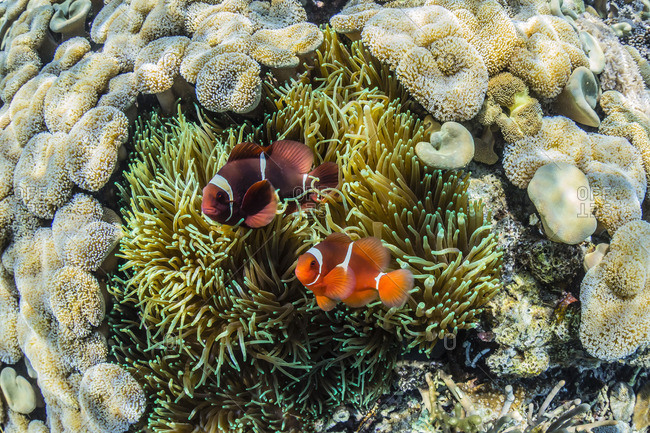
never saw this......

Wow. And there was 3 fairly good sized individuals side by side, along with Some A frenatus.

I've never even had a male grow more than 1/4 the size of a female, even after 10-12 years. All my males seemed to have reached a small size and never grow, although the females grow.
 
I think normally you find pairs in solitary BTAs. I can't remember to have seen maroons in BTA clone colonies as those are most of the time occupied by members of the Tomato complex or clarkiis.
That they are here in a clone colony side by side with members of the Tomato complex (seemingly A. melanopus) might be one of the reasons why so many large ones get along. It may just be a necessity for them to maintain their status there.

Sent from my XT1254 using Tapatalk
 
I think that its (A. melanopus).......a rare variety from Solomon Islands.......they are red....with White tail.......

very rare to find pictures of this (A. melanopus) variety........in all these years I think that I have only 2 or 3...........
 
I think that its (A. melanopus).......a rare variety from Solomon Islands.......they are red....with White tail.......

very rare to find pictures of this (A. melanopus) variety........in all these years I think that I have only 2 or 3...........
I think I had a pair of quite similar melanopus back in Germany. I got them as large adults and interestingly the male was larger than the female.

Sent from my XT1254 using Tapatalk
 
Maybe the female maroons were only that close because they were trying to chase off the diver. Their home anemones could have be 5-6 feet from each other.
Just a thought.
 
Also several of the Maroons got chunks missing of their fins. I am sure that there are a lot of aggressive interaction between these fishes.
 
...
I've never even had a male grow more than 1/4 the size of a female, even after 10-12 years. All my males seemed to have reached a small size and never grow, although the females grow.

I have seen Maroon pairs where the male was at least 3/4 of the female. I don't think it's impossible or even extremely rare in the wild.

photo.jpg

lm1.jpg


Also several of the Maroons got chunks missing of their fins. I am sure that there are a lot of aggressive interaction between these fishes.

I would see it more likely that there was aggression between the Maroons and the melanopus. That might also be the reason why so many large Maroons get along - common enemies unite.
 
Yes Phil.......the anemone colony seems to be large..........and the clowns have its own territory........

and some have lost pieces of the tail..........

this is the only Picture I know of a pair with similar size........from Andaman...

picture.php


all the other Pictures I saw males are very tiny............
 
I've seen more pairs of gold stripe maroons with large males. IMO, they are a different species than the "normal" maroons.
 
yes......(Premnas epigrammata)........
I would even question if Premnas is actually a valid genus.
I think the genetic evidence is strong that they are Amphiprion like the rest of the clownfish. This is also supported by the fact that they can easily be crossed with percula and ocellaris.
Another possibility would be that percula and ocellaris belong to Premnas as they all belong to the same clade.

Sent from my XT1254 using Tapatalk
 
They all changed names........

for exemple....

Saddlebacks are Genus (Paramphiprion)

Skunks are Genus (Phalerebus)

Spinecheeks are Genus (Premnas)

Tomato Complex are Genus (Amphiprion)

Ocellaris - Percula are Genus (Actinicola)

the rest are needing a revision..........

Chrysogaster - Fuscocaudatus

Latifasciatus - Allardi

Bicinctus - Omanensis - Chagosensis - Nigripes

Chrysopterus group

Clark´s (Yellow tail group)

Chrysagyrus (White tail group)

Latezonatus

Akindynos - Mccullochi

Leucokranos - Thiellei
 
There have always been lumpers and splitters among taxonomists. I'm thinking you might have a hard time convincing most of the taxonomists that populations that can interbreed and produce fertile offspring deserve to be in separate genus.
 
YES....almost impossible task.......


In case of (A.leucokranos) and (A. thiellei)........due the fact that all have a strong influence of a common Parental species (A. sandaracinos)........these two taxa should be placed in a new Genus........maybe taxonomists have to create this new Genus..........I think it do not exist...........

Parental species of (A. thiellei)......

picture.php


Parental species of (A. leucokranos)..........

picture.php
 
In my oppinion Taxonomists have to create 8 new Genus :

1) Chrysogaster - Fuscocaudatus

2) Latifasciatus - Allardi

3) Bicinctus - Omanensis - Chagosensis - Nigripes

4) Chrysopterus group

5) Clark´s (Yellow tail group)

6) Chrysagyrus (White tail group)

7) Latezonatus (monotypic)

8) Akindynos - Mccullochi

9) Leucokranos - Thiellei

Only the 5) and the 6)........maybe should be put at the same Genus..........
 
this is what exists today...........


Saddlebacks are Genus (Paramphiprion)

Skunks are Genus (Phalerebus)

Spinecheeks are Genus (Premnas)

Tomato Complex are Genus (Amphiprion)

Ocellaris - Percula are Genus (Actinicola)


the others have to be created.........
 
Back
Top