New gigantea from LA

ThRoewer

New member
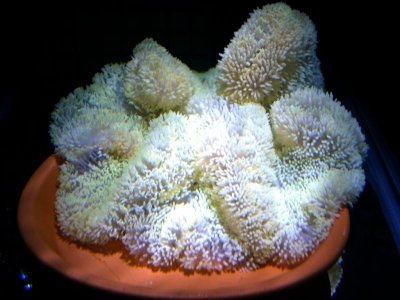
La got some giganteas in and since I still had some credit with them and wanted also order a few other things, I got one medium sized one for $70.
It arrived this morning and I put it straight into quarantine.

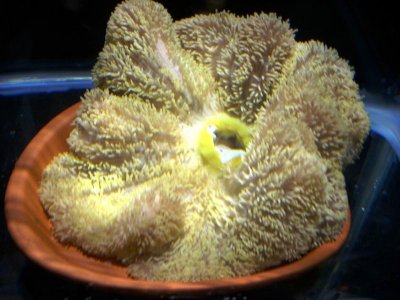
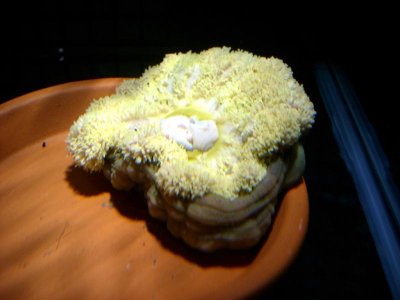
Out of the bag:
attachment.php


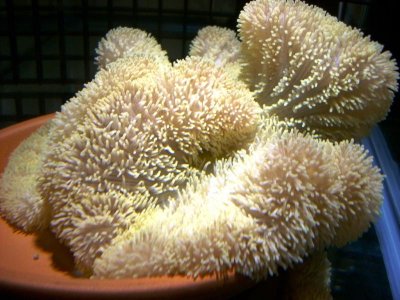
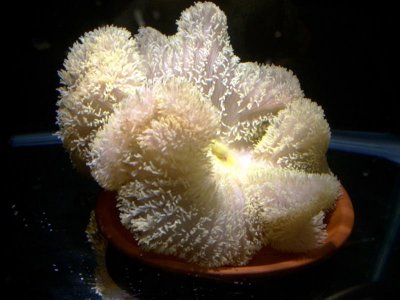
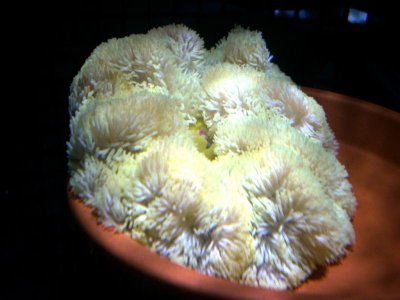
4 hours later:
attachment.php


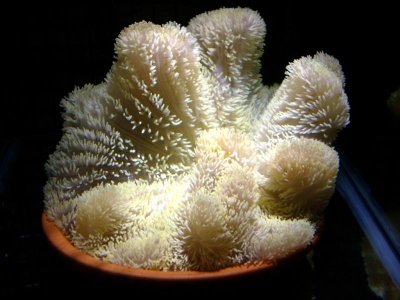
another 4 hours later:
attachment.php


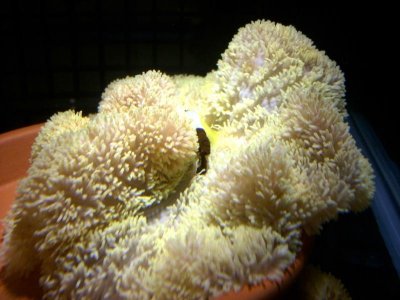
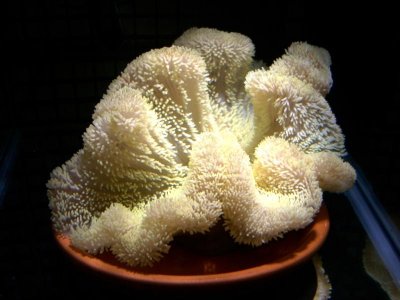
another 3 hours later:
attachment.php


attachment.php


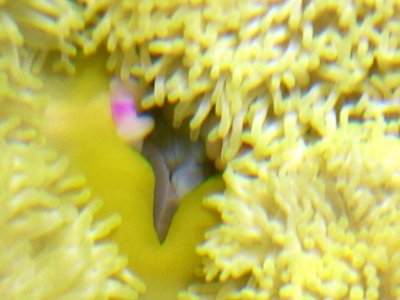
I looked at the dark matter coming out of its mouth under my microscope and it's a solid mass of Zooxanthellae :uhoh2:
So it looks like it is expelling its Zooxanthellae - is that normal?

In any case I will see if I can separate some of the zooxanthellae and try to culture them. If it works I will at least have the right species of Symbiodinium to reinfect it.

I will see how the anemone does tomorrow and see if I need to start treating it.
 

Attachments

  • 20150421-100100.jpg
    20150421-100100.jpg
    64.9 KB · Views: 1
  • 20150421-141000.jpg
    20150421-141000.jpg
    63.8 KB · Views: 0
  • 20150421-181200.jpg
    20150421-181200.jpg
    76.4 KB · Views: 1
  • 20150421-211900.jpg
    20150421-211900.jpg
    58.5 KB · Views: 1
  • 20150421-213000.jpg
    20150421-213000.jpg
    54.2 KB · Views: 1
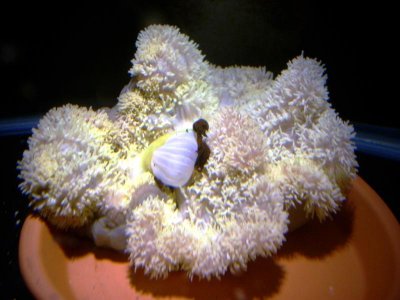
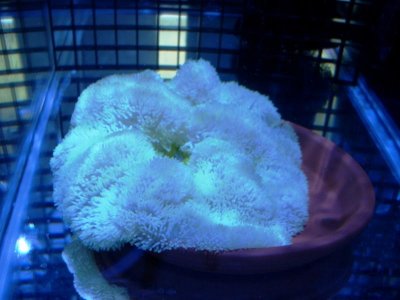
By now it completely deflated:
attachment.php


I just added the first cipro dose.
 

Attachments

  • 20150421-230700.jpg
    20150421-230700.jpg
    39.1 KB · Views: 1
Typical sick gig. The expelled zoox and deflation are dead giveaways. My hypothesis is that the zoox dies in transport (not from LA to your house, but prior to that) and is slowly expelled. I would be interested to see the result of your culture experiment -- if they multiply they're obviously not dead.

Your zoox looks a bit different than what we typically see. I describe it as "rat poop" because it usually looks like pellets, very similar to what rat poop looks like.

Over the course of the next few days with treatment, you should see an improvement in the nem's posture -- it should be able to hold itself upright -- and less deflation. If not, you can try changing to Septra, but I haven't had any luck with it.
 
I just checked a sample of the culture and the zoox look very much alive. You can see that they have some limited mobility and some of them clump together when they get within reach of each other. That may be the reason why they are not easy to culture in high density.
I also see something that might be the motile stages. Though at this point I'm not sure. It could also be contaminations.
This Symbiodinium strain is definitely smaller that the PycoPure strain which cultures actually pretty well in a bottle. The color is also different. This culture appears golden brown while the PycoPure looks now green.


As for the anemone - after almost curling up to ball it opened up again and started to inflate. Hopefully it will show improvement tomorrow morning.

BTW, are the 100% water changes mandatory or only required if the water gets cloudy?

Also what is the best light?
Right now I use a 75W equivalent Phillips Daylight LED bulb. I would have an extra Kessil A360W which is destined for the new tank but currently sitting around unused. I'm only afraid that it may be to strong at this point.
 
Best of luck! It will be a nice tan/green gig I think if it pulls through. With the drought and all I understand 100% can be a pain but I would still do 100% water changes even if you only fill up a 10 gallon tank with 70%-80% of recommended water volume because in a small uncycled hospital tank ammonia spike is inevitable without 100% water changes.
 
100% water changes are absolutely mandatory, more often if the water gets funky. You need that water to be pristine at this critical time.
 
100% water changes are absolutely mandatory, more often if the water gets funky. You need that water to be pristine at this critical time.

+1. The thought is that the pathogen is released by the nem, but if not removed by water changes, the nem could re-ingest the pathogen and the recovery process is prolonged. I usually have a turket baster handy and remove any expelled zoox as soon as I see it, but have also done multiple 100% water changes. On most occasions when new water is added, the nem perks up.
 
Would it be better to set up 2 QT and switch the nem over daily? or leave it and drain the water?
 
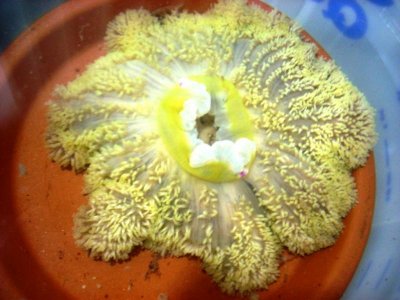
It's looking much better this morning.

This is how I found it at 10:00:
attachment.php


attachment.php


attachment.php


At around 11:40
attachment.php


It still has its mouth a bit open but overall seems to be doing better.

Right now the water is still clear and ammonia shouldn't be a problem since I have a seeded filter in front of the powerhead.
But I will do a full water change in the evening.

+1. The thought is that the pathogen is released by the nem, but if not removed by water changes, the nem could re-ingest the pathogen and the recovery process is prolonged. I usually have a turket baster handy and remove any expelled zoox as soon as I see it, but have also done multiple 100% water changes. On most occasions when new water is added, the nem perks up.

Has anybody identified the pathogen and what it actually is?
Is it just a bacterial infection or is the bacterial infection just secondary and the real culprit is something else?

On some of my dying corals I found something that looked like Heliocostoma nonatum - a ciliate that seems to be an opportunistic, internal parasite of corals. It primarily feeds on Zooxanthellae and is usually found on corals with Rapid Tissue Necrosis (RTN).

An unidentified vibrio bacterium has been observed in combination with this ciliate, but it isn't conclusive if this is a secondary infection or the primary cause of RTN.

After reading up on Heliocostoma nonatum on a German website I found that tests with antibiotics have shown to be effective in killing it.

Maybe there is something like this infecting anemones as well - or maybe it is even the same.

Would it be better to set up 2 QT and switch the nem over daily? or leave it and drain the water?

I have done the tank transfer before, but only because the tank with the anemone was totally slimed up. Though if reinfection has to be prevented this should probably be the method of choice.
 

Attachments

  • 20150422-100300.jpg
    20150422-100300.jpg
    36.1 KB · Views: 1
  • 20150422-100400.jpg
    20150422-100400.jpg
    51.7 KB · Views: 1
  • 20150422-101600.jpg
    20150422-101600.jpg
    58.7 KB · Views: 1
  • 20150422-113900.jpg
    20150422-113900.jpg
    53.6 KB · Views: 1
Good luck, I hope it does well for you.

I got one of their tan giganteas a month ago and it is still doing well, other than the bleaching during treatment.
 
It didn't deflate all day but still had a slightly open mouth (hard to see because it always covers it with a fold).

attachment.php


It also still expels small amounts of Zooxanthellae.

Did the water change and next dose of Cipro.

Let's see how it looks in the morning.
 

Attachments

  • 20150422-234600.jpg
    20150422-234600.jpg
    59.7 KB · Views: 1
I am no expert by any means but just thought I would share I really enjoy the fact that you seem to be digging deeper into the true culprit to what makes our nems sick. I hope you not only keep us updated with your nems progress but also with what you find. Just out of pure curiosity, how possible would it be to post some pictures of your findings with the microscope?
 
It's looking good. Make sure you're able to clean underneath the nem as well, as lots of gunk tends to collect there, especially when inside a dish or saucer. They also produce a slime coat that projects the foot -- if it gets dirty, pull away the slime and remove it (its stringy and is fairly easy to remove).

In terms of the pathogen, no one has been able to determine what it is. Frankly, I don't know if anyone has tried. The assumption has always been that it was a bacteria that caused the infection, but you're right in guessing that it may not be the primary cause of death (which I hypothesize is starvation since the nem doesn't eat nor have the ability to rely on zoox for nutrients, who knows).

It would be great to be able to isolate the pathogen (assuming a bactieria by running culture and sensitivity tests) and determine the best remedy. Cipro has worked well, but it's not 100% effective. I wonder if other antibiotics would produce even better results. I've experimented with nitrofurazone with limited success. In reading up on it though, it appears that it's not readily absorbed via normal bath treatments (though this applied to fish, not anemones).
 
Last night, when doing the water change, I removed the filter attachment from the powerhead, assuming it was loaded with whatever the anemone expelled.
That may have been a mistake as the water was pretty cloudy this morning.

So I washed the filter medium in saltwater and put it back and within an hour the water cleared up. I also started the skimmer and it too removed quite a bit of gunk.
I actually don't think cipro is skimmed off - during the treatment of my crispa I let it run some days and it never removed a thing. So maybe I keep it running - if nothing else it will add oxygen to the water and remove dead zoox.

I will do a full tank transfer later this afternoon.

The anemone hasn't deflated but contracted a bit when I removed the slime from the plate and around it's foot.

attachment.php


It also still has its mouth open and one of its mouth flaps is ballooning like it's eating. Also it always keeps one of its folds covering the mouth.
It still looks like it is expelling something

attachment.php


Unfortunately my current inspection/micro assembly microscope is not strong enough to see bacteria. With the 20x eye pieces I get a maximum of 90x. I can get a 2x add-on lens to get up to 180x which should get me in the right range.
Though better would be to get lab microscope that is more suited for hunting microbes.
I will also need to get a C-mount to attach a camera for documentation.
But those things have to wait until I have the money for it.

I'm a bit surprised none of the marine biology institutes of the big universities has looked into these diseases or made the connection to anemones yet. I feel we may deal with something that also affects other corals.
At the time I was treating the crispa I had a birdsnest coral frag with slow tissue necrosis at several places. So I added it to the treatment tank. The necrosis stopped and by now it looks like at least at the top parts the coral is reoccupying the exposed skeleton.

In general I feel SPS and LPS could also benefit from antibiotic treatment, especially if there is a suspicion of a Heliocostoma infection.

I would like to try this antibiotic cocktail I found for isolating and culturing Symbiodinium strains. Maybe it is more effective than just a single antibiotic and it should also be much less harsh on the zoox.
 

Attachments

  • 20150423-150000.jpg
    20150423-150000.jpg
    47.1 KB · Views: 1
  • 20150423-150100.jpg
    20150423-150100.jpg
    49.5 KB · Views: 1
An easier way to protect the nem from the powerhead is to cut a piece of light defuser (eggcreate) to fit your tank creating a wall in front of the powerhead. It works quite well and if it needs to be cleaned, it can be easily removed.
 
The anemone hasn't deflated but still has a slightly open mouth.

attachment.php


It is also still expelling Zooxanthellae in the form of black stringy goo.
I extracted it and under the microscope you can see it crawling with little organisms that obviously feed on the Zooxanthellae.

At this point I start worrying it may bleach completely.

I changed the light to a Kessil A360W in the hope it may help in the recovery.


An easier way to protect the nem from the powerhead is to cut a piece of light defuser (eggcreate) to fit your tank creating a wall in front of the powerhead. It works quite well and if it needs to be cleaned, it can be easily removed.

That's what I'm doing. The filter is to keep the water clean.
 

Attachments

  • 20150424-143000.jpg
    20150424-143000.jpg
    48.7 KB · Views: 1
Back
Top