drummereef
Team RC
Hey Pete, typically where do you like to keep your NO3 and PO4 levels - and where do you see the best balance of growth and color?


That's a great price for that crimper! I'd love to see some crimps that one makes for sure, if you get a moment to post some pics. Man o' man how I'd love to get a frag of that Pearlberry. Gorgeous coral!
thanks, in these, as in most cases I grab a piece of white paper and set the white ballance looking at it through the tank or on the top of the tank but under the lights.Dude, your white balancing has always been spot on. whats your trick? I shoot some pretty high end gear and I can never get mine just quite right...
NO3 some where around 3-5Hey Pete, typically where do you like to keep your NO3 and PO4 levels - and where do you see the best balance of growth and color?
How bout an updated fts. Oh and letting me get some pieces for my 110
Those pics are great!!
Yeah, new FTS!
Everything looks great and awesome pics.
Beautiful pics Pete, can't wait for more
The crimper does a good job, I'll see about taking a couple pictures so you can see. That Pearlberry is doing awesome, it seems to be a pretty stable coral, I'll have to send you a care package once the weather coopoerates a bit.
thanks, in these, as in most cases I grab a piece of white paper and set the white ballance looking at it through the tank or on the top of the tank but under the lights.
NO3 some where around 3-5
PO4 around 0.03 but it will creep higher, every once and a while it will hit the 0.10 level and I'll change out the GFO
as for the best balance, it's hard to say as lately with all the light changes. I still haven't finished this latest go around and I'm my corals are letting me know they don't like being without the extra blue they have gotten use to.
Right now and for about the past 2 months I have my outer LED bars with 24 royal blues that use to run 18 hours a day out being reworked.
 I still think I'm battling a nutrient imbalance but hopefully am making headway. Shhh don't tell.
Very nice pictures and great tank build!
thanks sushiThis tank still looks great! It's always time consuming to see it in person...I always hate to leave! LOL
That would be awesome!! :dance: Thanks for the nutrient info too. I'm doing some experimentation at the moment trying to get my NO3 up to where you keep yours. Having some success so far but I'll give it more time. I too see fluctuation in my PO4. Anywhere from 0.04-0.15. I've narrowed it down to not changing my socks frequently enough...
p.s. I might be bugging you for some CaRx setup tips in the coming weeks.
yeah it seems having just slight measurments of No3 seem to add come coloration to the corals but it may be nothing more then a side bar of having elevated nutrients for the corals to absorb
no problem on the reactor Brett - I don't understand all the Ca Rx haters lately. I actuall have some dosing pumps but continue to favor the CaRx
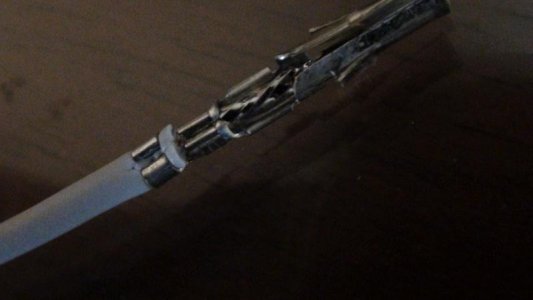
here's a pic of the what a wire looks like after crimping using the tool I referenced. In this case the wire is a tinned stranded wire (not solid).
Plumbing question for you... I will be feeding my calcium reactor from my manifold. Is there any risk to placing the reactor above the running water level in the sump? Would there possibly be any weird siphoning issues by doing this? I plan on building a small platform to set the reactor on so it's not just sitting on the cold concrete floor, but it would be above the water level in the sump.
With your manifold setup you may get a little air in the system on shutdown but flows are so slow it won’t be much, if any. If both the supply manifold feed (tee) and all reactor tubing enter your sump below the sump water level in shut off mode, the manifold and all reactors stay flooded. In your case I believe your manifold tee is above so it will likely get some air in when in shut down. The amount of air will depend on duration and tubing restriction and considering the flow through the reactor is set so slow (just above drip) the static head on the reactor wont be pushing much water out, hence drawing air in from the un-flooded manifold. Also set your CO2 to off in feed and fail mode so the CO2 pressure doesn’t continue to blow through.
That all said, even if the main pump is offline for an extended time and the reactor reaches equilibrium with the sump the worse case is you get some air/CO2 blown through the system on start up. If the reactor is 100% above the sump (like on a shelf) the water level in the reactor will only drop to the lowest level of the feed water inlet or outlet <– this may be a design consideration to keep the feed and outlet close to the top of the reactor.
I can’t think of anything wrong with a drain to equilibrium scenario and know several people with set ups like this and they’ve never mentioned any issues to me about it.
A full drain scenario could cause some problem to your recirc pump. For example if the bottom of the reactor is elevated above the sump and your return is exposed to air (not submersed in the sump), in a power off situation the reactor would drain to the level of the lowest point of entry (the feed or outlet) leaving the recirc pump dry. This could be an issue over time as the recirc pump would run dry on startup causing premature wear on the internal parts.
 I plan on using either vinyl tubing or rigid polyethylene tubing to feed the reactor. Thanks for the help Pete, always appreciated. (sorry if my questions always derail your thread btw ).
sorry to be so long winded on that last response
OK, yes I didn't think of that... The Geo Reactor's feed is near the top of the reactor so I'm assuming the water level won't drop any further than that if/when the feed is turned off. The effluent comes from the plumbing above the reactor so I'm guessing the reactor would not drain below the feed inlet when the feed is shut down as to avoid siphoning. Makes sense, at least in my head at this point. :lol:
George (Geo) recommended to me, since I would be running the reactor off the manifold to add a TEE in the feed line so it could bleed off any excess pressure that could cause pressure issues inside the reactor. Do you think this is necessary and/or would a small valve be needed to regulate the bleed flow? I'm not exactly sure how to incorporate that, other than teeing off the feed tubing with a short piece of tubing back to the sump.
Not at all!! I appreciate the detail in your explanation. Always good info!!!
Over pressuring from a manifold fed by a pressure pump can be of concern and is probably why I have a recirc pump seal failure every 6 months or so. A secondary bleed would help but in the long run doesn't act much different then your return tubing. Think of it as a backup (before the system) preventing it from being blocked in (outlet valve closed, line clogged or other restriction). Using an unrestricted small diameter tube (smaller then airline) or one of those small plastic needle valves will suffice. Clearly this advice comes from experience, although I would expect the reactor itself would hold up fine there are weak links in the system at the tubing connections, uniseals (if any) and pH port. And like I said my little MJ recirc pump seal gives out about every 6 months like clock work and is likely why George and most all others moved away from MJs to more expensive pumps for recirculation even though it adds cost to their product.
By the way I have a replacement recirc pump on order, and I'm not going with an MJ
Very interesting. So you are saying if there is a pressure issue inside the reactor the weakest point of failure is likely the recirculation pump? Not the reactor itself?
exactly, when you have flow the system pressure drops over the distance traveled. Pressure in the system increases as the flow is restricted to the point of equalized pressure on full line blockage.I'm trying to wrap my head around how valving down the through-flow from my manifold would be any different than using the recommended maxi-jet feed pump... Guessing if there was an effluent failure (blockage), the maxi-jet is more likely to just shut down versus the pressurized flow from my Reeflo Dart? Is that what the main issue is?
It probably wont stop spinning but you cut off flow causing pressure inside the pump. MJ's are pretty low tech (low cost flow) and like any paddle wheel impellor don't generate much pressure (hence not much vertical lift), now your Dart in comaprison generates a lot of pressure and if blocked in that pressure will be seen at all points in the system - not just the reactor.Like if I put my finger over the output of a maxi-jet, the impeller will stop spinning...?
In my case the recirc pump seal gives out first, then the uniseal on the side. The MJ pumps are very low pressure and in my set up they are exposed to pressure higher then they generate or the seal allows for. Other more conventional pumps have a more robust seal design so they would likely not be the weak link, my gues would be the pH port or uniseal (but I don't think GEO uses them anymore) would be the next most likely place for a leak. Uniseals are more designed for static or head pressure.
exactly, when you have flow the system pressure drops over the distance traveled. Pressure in the system increases as the flow is restricted to the point of equalized pressure on full line blockage.
It probably wont stop spinning but you cut off flow causing pressure inside the pump. MJ's are pretty low tech (low cost flow) and like any paddle wheel impellor don't generate much pressure (hence not much vertical lift), now your Dart in comaprison generates a lot of pressure and if blocked in that pressure will be seen at all points in the system - not just the reactor.
Restricting flow upstream (or near the header) helps as long as there is unrestricted flow through the system. Restrictions on the outlet (like a small needle valve for fine tuning flow) increases the pressure on everything upsteam. What George is pointing out is a means of unrestricted (other then line size) flow upstream of the reactor to avoid potential pressure generated leaks, using quality parts (like GEO does) they become less likely but can and do often happen. Again I suspect it's why he changed his recirc pump from an MJ on his smaller units and chamber connection method on his reactors.
So is there any real issue regulating the flow-through the reactor (effluent) via the valve on my manifold versus the small valve on the output of the effluent tubing? Is the flow too low on the effluent side to be able to do this you think?
That all makes perfect sense, thank you.