Plumbing Help...

msujohn

New member
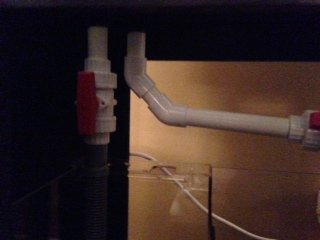
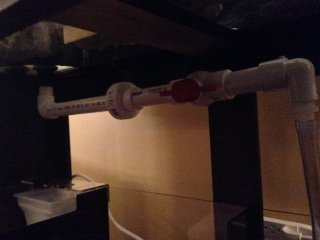
This is my first attempt at plumbing my sump. These are not cemented they are dry fitted. In photo 1, this is my return. Should I worry about the 2 90's, will that really slow down the flow? Photo 4 shows both my drain and my modified return. My drain pipe goes straight down into my sump, will this cause any issues? I put a shut off valve, here in case I need to slow it down. Also, you can see on the return that I tried to adjust the 90 degree, using a more subtle approach. Any advice would be appreaciated.

This is on a 90 gallon, 1 drain line and 1 return line. I'm using a Eshopp R200 sump, Reef Octopus 150, and Eheim 3000 return pipe.
 

Attachments

  • photo 1.JPG
    photo 1.JPG
    28.1 KB · Views: 2
  • photo 4.JPG
    photo 4.JPG
    27.7 KB · Views: 2
Remove the valve on the drain line all together. You should not have it there at all. Control the flow with the valve on the return line. The flow of water going in is what controls the amount going out.
 
The drain straight down into the sump is fine, with the exception of the valve - I would remove it if it were mine. It is an unneeded restriction begging to get clogged. I prefer the 2nd return setup, but the actual difference between using 2 x 45's vs 1 90 would be negligible I think so whichever works best for you should be fine.

jm.02
 
I just set up my first tank. My advise would be to relocate the return to the middle of the tank, behind it with a 90 over the tank. I did this so I could incorporate the Herbie method (search for it). Basically this method utilizes two drains. One acts as a syphon 3/4", the other an emergency drain 1". This method as eliminated all the noise of the water and air splashing down the 1 drain.

Have fun!
 
Thanks for all the advice. I wanted to play it safe, so I added the valve on the drain side. I have a few other questions. I have a 300 watt eheim heater, it is huge (won't fit in my sump), can I put it behind the wall where my drain/return lines are located inside the tank? Or should I just replace it with a smaller one and keep it in the sump? Also, when I fill up the tank, is there any reason why I can't just mix the salt in the tank vs. mixing it in a bucket? It will be cycling for several weeks and I figure it will mix in the tank? Any tips on putting salt in for the first time?
 
I wanted to play it safe, so I added the valve on the drain side.

Valves on the drain are actually the opposite of playing it safe. They are actually asking for overflows. That's why everyone is saying to get rid of it ;)

While the heater will be alright inside the main tank, having a heater located in the sump instead reduces the possibilities of accidents. Such as forgetting to unplug it when doing water changes, which would expose it air.

For the first fill (after leak checking your system with it running), no reason you can mix the salt right in the tank. No life in it yet to be bothered ;)
 
I have a valve on my drain... I see how it could result in an overflow issue for sure. I use it redirect some flow from my to my refugium and to reduce noise levels. I suppose getting a T valve and just restricting the fuge flow would be more ideal?
 
Not really because you are allowing a the detritus from the display to be introduced into the refugium. Over time, this stuff becomes a source of problem nutrients. You would be better running the drain directly into the skimmer section and supplying the refugium from the return pump.
 
I have a valve on my drain... I see how it could result in an overflow issue for sure. I use it redirect some flow from my to my refugium and to reduce noise levels. I suppose getting a T valve and just restricting the fuge flow would be more ideal?

Me too, I use a drain valve to control the DT water level to reduce/eliminate noise. If the sump is designed correctly it I'd impossible to overflow the DT or the sump.

I haven't had any problems or noise...
 
Not really because you are allowing a the detritus from the display to be introduced into the refugium. Over time, this stuff becomes a source of problem nutrients. You would be better running the drain directly into the skimmer section and supplying the refugium from the return pump.

Now that is something I didn't think of...great idea. Thanks
 
I haven't had any problems or noise...


Yet...

Seriously, valves or other restrictions in drain lines are accidents waiting to happen. If you want to go with a valve in drain line, you also need a redundant unrestricted emergency overflow to deal with the probability of overflow with a valved drain.
 
Agree with Bill 100%.

There are setups where a valve on the drain is fine, but for what the OP is working with, I would remove the drain valve.
 
Yet...

Seriously, valves or other restrictions in drain lines are accidents waiting to happen. If you want to go with a valve in drain line, you also need a redundant unrestricted emergency overflow to deal with the probability of overflow with a valved drain.

I agree it's not ideal...but in my case the return chamber is less volume then the remaining volume of the the DT. In other words I can close the drain valve completely and not overflow the DT.

I don't have the room for fancy drain systems so I had to engineer the sump. Water in = water out...

Let's agree that it's not ideal but it is possible. I have a 90gal that I'll be drilling to eliminate the drain valve, and drill an E-drain.
 
Back
Top