"Pushing the Window"

I would only saw 2 (( maybe a 3rd )).

A Golden (( Centropyge aurantia )) dwarf angel. Never actually saw it eat prepared foods, but was getting fatter each week. Had it for about 3 months, lost it when it battled my pink skunks and their S. Haddoni -- I sold the pink skunks shortly after that.

Venustus dwarf angel -- have had it since 6/24/10, is doing great and eats whatever I put in the tank.

Lastly (( and not sure if it counts, the fish in general isn't hard to keep, but this color morph is pretty rare )) -- My blue morph of C. Nox -- have 4 months now, really has settled in and doing really well.
 
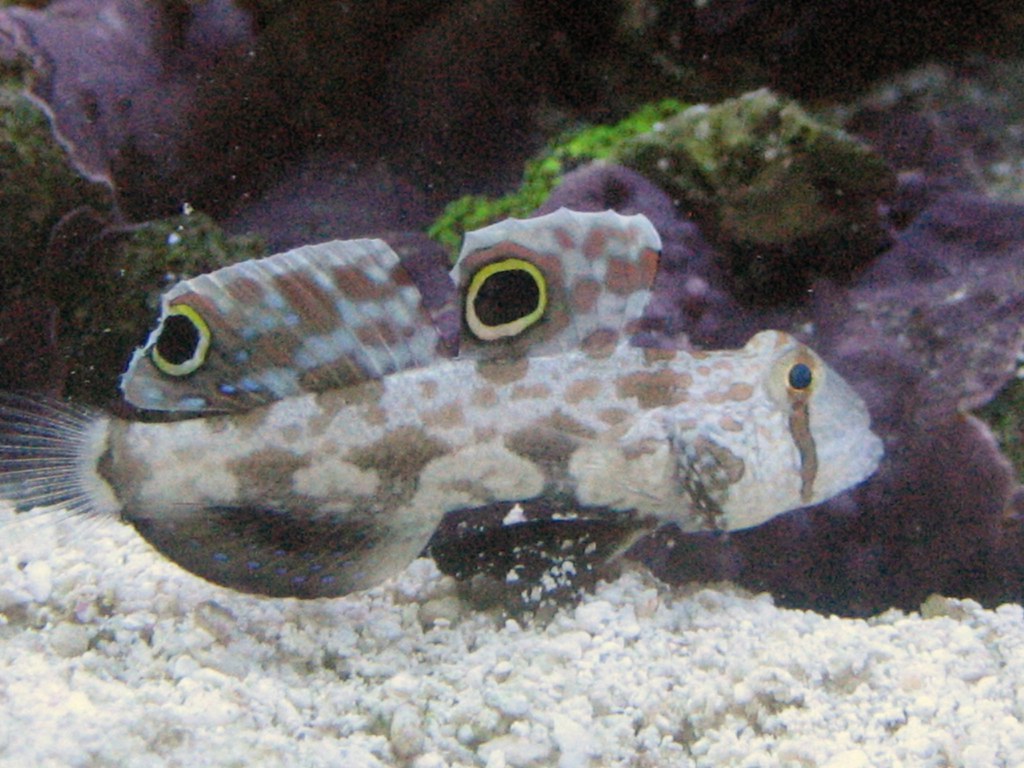
I have two twinspot/two spot/signal/crabeye gobies. They are on everyone's "do not buy" list, but so far, so good. I've had them a month, and they seem to be fat and healthy even though they are receiving 100% of their nutrition from prepared foods.

My only problem is that I have two males. So far, their territorial behavior is mild--just a bit of gill flaring and gaping. I'm afraid to trade one in for another on the the chance it might be female because these two are doing so well.
 
Here's my alpha male two spot goby. I've had him for a month. The end of his dorsal fin was ragged when I got him, but is healing nicely:

5520169894_c39f47c378_b.jpg
 
Here's my alpha male two spot goby. I've had him for a month. The end of his dorsal fin was ragged when I got him, but is healing nicely:

5520169894_c39f47c378_b.jpg

Unfortunately he looks skinny to me. They should have round little pot bellies. Maybe increase your feeding schedule if he's eating.
 
I wouldn't say he's skinny. He is well-rounded, although not fat. He was much skinnier when I got him, and has fleshed out nicely. I imagine in another 4 weeks, he will have fat to spare.

Edit:
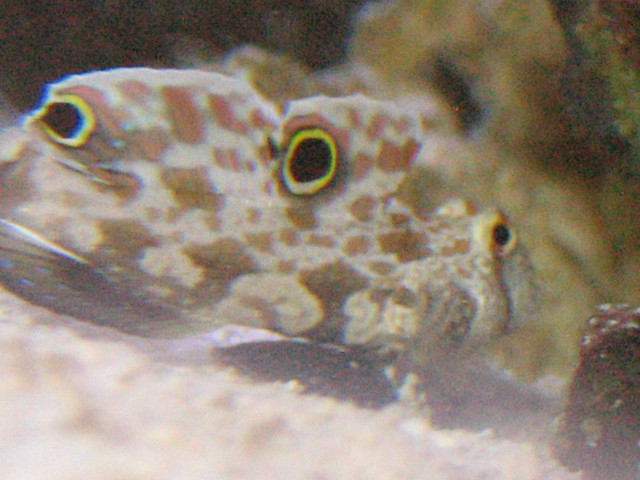
I got concerned, so I took another picture. In the picture above, you can see that his spine is slightly curved, which makes his abdomen look concave. In the picture below with a level spine (sorry that it's a bit blurry), you can see his round belly. I'd still like him to have the "pot belly" you mentioned, and we're definitely working on it...

5520255690_4694671e79_z.jpg
 
Last edited:
Fantastic picture. That fish is definitely one I'd love to try but I'm very hesitant. Also, Moorish Idols and Blue Ribbon Eel.

My first sw fish was a scooter dragonet and I've been kinda hooked on hard to feed fish ever since.

I keep or have kept:
Green and Spotted Mandarins in small tanks. Not tooo successful.

OSFF pair. Successful!

Scooter dragonets in small tanks. Successful.

All the common aquarium pipes except Janss'. Mixed success.

Meleagris leopards. Not really that hard. Successful.
 
"Pushing the envelope" is pretty much what the hobby has become for us. Pretty much all of our livestock is either hard to find or hard to keep.

For instance, we've just recently passed the 1 year mark with our bluefin/blackfoot lionfish (Parapterois heterura). From what I understand, this is a record for this fish.

We've had our OSFF pair for over two years IIRC, and we didn't buy them "pre-weaned".

We've had excellent results with Rhinopias scorps.

Our H. borbonius trio has being going strong for 15 months now. We also keep P. flavoguttaus (a year+) and have kept P. squamapinnis for 8 years.

We've kept 4 species of SH and 3 species of pipefish for a number of years. We currently keep 2 species of SH.

We've also kept green mandies, leopard wrasses, and CBB for several years.

We're still working on trying to keep ambon scorps (Pteroidicthys amboinensis) past the year mark...we've only made it to 10 months.

There's something for everyone in this hobby, which is what makes it so great...you can make it as easy or as challenging as you want.
 
I'm pushing the window. Not necessarily with a hard to keep species (other than inverts), but with the number of individuals I want to keep. As of right now, in my 120, I have...

A breeding pair of perculas
A trio of Lyretail anthias
Two female Bartletts
Three green Chromis
Three blue Chromis
A blue flasher wrasse
A long fin fairy wrasse
A female blue headed fairy wrasse (soon to be evicted)
I will soon be adding a filamented flasher

I think I'll stop there, in my 120. I'm in the process of setting up a 200 gallon DD tank. I'll be using my 120 as a sump, with a moded MSX300 skimmer. At that point, I'll be adding more anthias, basslets, and wrasses. I'll be trying a harem of Royal Grammas too. I also plan on raising a clutch of eggs from the perculas and adding several of them to the tank. This will be pushing the window, but I have other tanks I can move fish to, if thing go bad. I'll also be asking a bunch of questions from the members here. I've already received a great deal of help from members here.(Thanks Steve:thumbsup:)

Here's a video of my tank as is.
elegancecoral
[/URL][/img]
 
Centropyge bicolor: Sort of like the Singapore Angel, but even an eating one can crash and burn during aclimation. This one is my 2nd, he has been in my tank(s) for over 13 months now.

Matthew
So far, not terribly destructive in my Reef. But I don't kid myself. No Aussie Scolys or Tracy's need apply for residency!
 
I think those that are dabbling in the cold water species of fish and coral are pushing the envelope the most right now. Way different focus with no real need for light, the need of plankton and COOL temps.
 
With all due credit to Kevin Kohen, I just want to point out that Matt Pedersen is the one who first bred and reared the Orange Spot Filefish in captivity. Kevin is responsible for bringing in a lot of stuff and conditioning it that would normally not be available so healthy, such as crinoids, dwarf cardinals, delicate dwarf angels, the list goes on and on...

Stuff I want to work with but haven't gotten the chance yet that is still considered nearly impossible to keep:
Hippocampus bargibanti or denise
Solenostomus spp.
Acrochordus granulatus (yes, not a typo)

Except for the first one, I feel very strongly that the main problem we have in keeping them alive is that they need exceptional collection and handling conditions that are not currently being met. Check back in a few years from now and hopefully some problems will be solved...
 
Most dwarf angels are pretty hardy - With supposedly difficult angels like golden angels, bicolors, Herald's angels, venustus angels, Singapore etc. It's not a husbandry issue. The problem with these fish is the type of collection used where they come from or type of collection used because of their habitat.

Goldens are among the worst. In my opinion unless you have personal knowledge of the person collecting it - you should not buy one of these. Either the rock has to be torn up or chemicals would have to be used.

I'm not saying some skill isn't involved, for example, Singapores are kind of shy and need tlc in acclimation. But it's not envelope pushing husbandry. But if we want really do something useful to successfully have these fishes in our tanks, we can start by refusing to buy unless we have good reason to believe they were properly collected.

It's illegal to import fish into the US that were collected contrary to the laws of the originating country. And hard as it is to believe, chemicals are illegal in the Philippines and Indonesia. LFS's know where their fish are coming from if they care at all.
 
I had my Dragonface Pipefish for a few years in a 55 until I upgraded to my current tank that houses wrasses that might eat them.

I currently have 2 Heathy MM Leopards and one MG Leopard.
 
I've had a Spotted Drum for 15 months. Several pictures of it taken shortly after I brought it home are on my personal profile. I don't think I've ever seen one in a dealer's or wholesaler's tanks, though on-line sites occasionally list them. It's a beautiful, wonderful fish, a delight for divers who see them on the reef.

This is the second one I've had. The first lived for 7 years, I lost it when it jumped out of a partially uncovered aquarium. My fault. I find them very easy to keep, willing to eat almost anything. The problem is they don't travel well in the tiny space commercial shippers allocate to fishes. I hand caught my Spotted Drum (Equetes punctatus) off the Caribbean coast of Central America, and shipped it home in quadrupled box bags with more than a gallon of water, in a cooler chest fitted inside a nylon check-through suitcase. I know Customs inspected the cooler because they drilled holes in it , presumably looking for drugs. They did not disturb the fish, and reclosed everything properly. The required Fish and Wildlife form was attached to the cooler.

This kind of extravagant care and swimming room is not commercially feasable, but it's what is needed to successfully ship these fish.
 
My Public Profile has a few pictures of the fish in a small album of pics I took a few days after bringing the Drum home. It is now about 8 inches long, with the spectacular adult pattern, a brilliant constellation of white dots on jet black, and that amazing body shape. He dominates his 220 gal, shares it with a lovely Blotched Anthias I've had for a year, a mated pair of false Perculas, a Blue Chromis, and a Sharknosed Cleaner Goby and some inverts. I believe in light stocking and minimal bioloads.
The Short Bigeyes and the Cowfish in the album now live in a public aquarium. My trip to Central America 15 months ago was made with the intention of bringing home a Spotted Drum, so I was prepared. Parts of Panama and Colombia are fabulous, both the Caribbean coasts and the mountainous interiors.

So many places, so little time.
 
Back
Top