D-Nak
Active member
Here is my treatment log for a red haddoni. I can tell you now that this is not going to end well, but I think it's important to document all threads related to anemone treatment, both successes and failures.
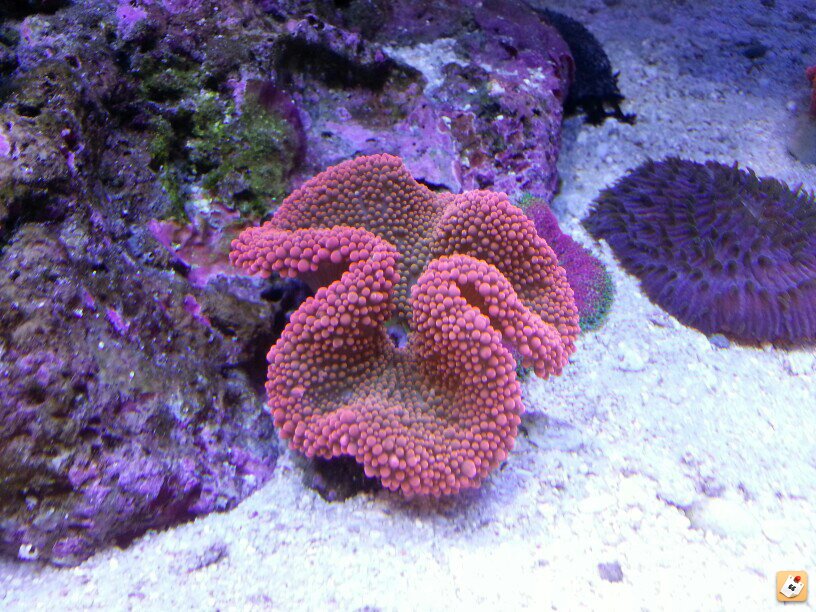
Here's what it looked like in the store:

Not bad, the mouth is not tight and the color is very off. The size was perfect (about 3") and the color, though off, was still nice. I nudged it a bit and it responded, so I decided to take it home.
That night the mouth started gaping even more, so I decided to start treatment (250mg Cipro per 10 gallons):

The next day:

Unfortunately, I don't have photos of what transpired over the course of the next few days (lost my iPhone) but the appearance and behavior were typical of a sick anemone: deflating, pooping "rat poop" which I was removing as soon as I saw it, and overall general decline in health. 50% water changes were done every night prior to the next dose of Cipro.
I treated the haddoni for a full 7 days, which ended yesterday. It never showed signs of recovery, nor did it ever fully inflate after it began gaping. I decided to do a 90% water change to see if it would perk up with minimal meds in the water (I assume that light had already broken down most of it).
Here's what it looked like this morning (under natural light):

I haven't removed it yet but I will soon. I just haven't gotten the stomach to do the smell test.
My thoughts/questions:
1. Haddoni are harder to treat than gigantea. Since gigantea are rock dwellers, IME once they attach to rocks, they tend to stay put. It's a good indicator of sickness since when they are bad shape, they lose the ability to stay on the rock. Because haddoni are sand dwellers, I placed it in a plastic container filled with rock rubble, then a layer of sand. It never attached to anything, nor did it try to bury itself. I took this as a bad sign. It's also hard to determine if the sand and rocks have an affect on how much medication the nem is getting. Obviously the nem respires water, so it must be taking in the medication. When treating a gig or mag, this isn't a factor since there's no sand or container.
2. Stickiness isn't a sign of anything. The haddoni is still sticky even though it's an terrible shape. I have a feeling that the nematocysts are stuck in the "on position".
3. Gaping could have something to do with dead zoax. I observed the haddoni throughout the week and noticed (what appeared to be) dead zoax right under the surface of the oral disc gathering in clumps. It would slowly migrate to the mouth, then is expelled. Obviously, this has to happen since the mouth is in the center, but if you look closely at the photos, you can see how the center of the nem is paler than the edges. It's almost as if the zoax dies from the center moving outward. I can't tell if the gaping happens as a result of this, or if gaping just occurs to remove the dead zoax, or if the two events are even related. I just think it's something to be on the lookout for when looking for a healthy haddoni.
4. Could the dosage been too high? My initial thoughts are "no" since we're dosage is calculated by the water volume and not the size the nem being treated. I only wonder though, since in this case, the nem was about about 3" could it have been a factor?
I definitely want to open this up for discussion. It's one for the loss column, but I'm hoping to take the sting away by learning as much as we can. Please ask any questions as I know I'm probably forgetting something.
Here's what it looked like in the store:
Not bad, the mouth is not tight and the color is very off. The size was perfect (about 3") and the color, though off, was still nice. I nudged it a bit and it responded, so I decided to take it home.
That night the mouth started gaping even more, so I decided to start treatment (250mg Cipro per 10 gallons):
The next day:
Unfortunately, I don't have photos of what transpired over the course of the next few days (lost my iPhone) but the appearance and behavior were typical of a sick anemone: deflating, pooping "rat poop" which I was removing as soon as I saw it, and overall general decline in health. 50% water changes were done every night prior to the next dose of Cipro.
I treated the haddoni for a full 7 days, which ended yesterday. It never showed signs of recovery, nor did it ever fully inflate after it began gaping. I decided to do a 90% water change to see if it would perk up with minimal meds in the water (I assume that light had already broken down most of it).
Here's what it looked like this morning (under natural light):
I haven't removed it yet but I will soon. I just haven't gotten the stomach to do the smell test.
My thoughts/questions:
1. Haddoni are harder to treat than gigantea. Since gigantea are rock dwellers, IME once they attach to rocks, they tend to stay put. It's a good indicator of sickness since when they are bad shape, they lose the ability to stay on the rock. Because haddoni are sand dwellers, I placed it in a plastic container filled with rock rubble, then a layer of sand. It never attached to anything, nor did it try to bury itself. I took this as a bad sign. It's also hard to determine if the sand and rocks have an affect on how much medication the nem is getting. Obviously the nem respires water, so it must be taking in the medication. When treating a gig or mag, this isn't a factor since there's no sand or container.
2. Stickiness isn't a sign of anything. The haddoni is still sticky even though it's an terrible shape. I have a feeling that the nematocysts are stuck in the "on position".
3. Gaping could have something to do with dead zoax. I observed the haddoni throughout the week and noticed (what appeared to be) dead zoax right under the surface of the oral disc gathering in clumps. It would slowly migrate to the mouth, then is expelled. Obviously, this has to happen since the mouth is in the center, but if you look closely at the photos, you can see how the center of the nem is paler than the edges. It's almost as if the zoax dies from the center moving outward. I can't tell if the gaping happens as a result of this, or if gaping just occurs to remove the dead zoax, or if the two events are even related. I just think it's something to be on the lookout for when looking for a healthy haddoni.
4. Could the dosage been too high? My initial thoughts are "no" since we're dosage is calculated by the water volume and not the size the nem being treated. I only wonder though, since in this case, the nem was about about 3" could it have been a factor?
I definitely want to open this up for discussion. It's one for the loss column, but I'm hoping to take the sting away by learning as much as we can. Please ask any questions as I know I'm probably forgetting something.