
Remote sump questions

kjonulak

New member
Goals:
Remote sump in equipment room.
Quiet Overflow.

What is known:
Distance from tank to equipment room: 36 feet.
Floors will be concrete slab.


What can be changed:
Number of pipes from tank to equipment.
Size of pipes.
Material of pipe. (I was thinking high flex PVC tubing used in ponds. Advantage is no elbows, smooth surface inside tubing. Uses standard Schedule 40 fittings. Fittings can be glued to tubing.)
Floor height in equipment room. Right now builder was going to drop floor around 4-6 inches. He indicated he could make part of the floor 1 foot or more lower.
I don't have the tank or stand yet. Thinking of a 5'x3'x2' or 5'x3'x30". I would think the overflow would be ~5' off the floor level.


Option 1: 1 sump in equipment room.
What type of silencer can I use? Bean/Herbie/Durso/Stockman/Other?
What size should the drain line(s) and return line(s) be?
Would like to have a 150 gallon sump. How high for sump?
Depending on the silencer, where should the drain enter sump?


Option 2: 2 sumps, one under tank the other in equipment room.
Would this setup work? Why or why not?
I would like to use a Bean style which would drain into the sump 1. This would allow me to keep tank overflow quiet.
What size should the drain line(s) and return line(s) be? (overflow to Sump 1)
What size should the drain line(s) and return line(s) be? (Sump 1 to Sump 2)
Noise from Sump 1 to Sump 2?
Would like to have a 150 gallon sump. How high for sump?
What should the height difference be the 2 sumps?
Height of the pipe leaving Sump 1?
Where should the pipe from Sump 1 enter Sump 2?
To get more height between Sump 1 and Sump 2, I can raise Sump 1 and/or lower Sump 2.
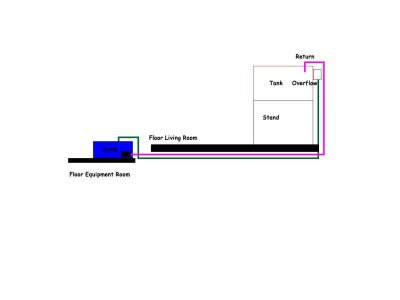
 

Attachments

  • image.jpg
    image.jpg
    17.3 KB · Views: 1
Regardless of what you're doing, you don't want the drains to run up or uphill at any point.

So should the drain hose come in low into the sump? For example drill the sump and put in a bulkhead low to keep,the drain hose at least horizontal? That is if the sump height is above the height of the hose entering in to the equipment room.
 
Same problem, unless you plan to keep the sump filled below that level.

Approach it from this way: all the drains need to run downhill and be above the water level of the sump at all times.
 
Ok. I'm thinking that with the pipes going under the floor this may not work. I may not be able to get the sump low enough. Need to think more about this. Does the input to the sump need to come in from above. What if the drain line from the aquarium came in low on the sump and filled the sump from the bottom up? Why wouldn't that work?
 
Because then water isn't really flowing in the drain line, and the potential of a clog is now exponential.
 
You need to talk to Elliott or Ryan. They both have all or part of their equipment a good distance away from the tank.
 
Hi,
I am thinking to build also a remote sump and I will choice for option 1, just one sump in the fish room. Regardless the size of the pipes I guess depend also of the size of your tank and the total volume of the system. I will build a 320 gallons tank and will put bean system with 3 x 2" drain lines and 2 x 1.5" return lines.
The size of the sump will depend on, at least, two factors: what will you put inside (internal return pump, internal skimmer, etc.) and again the size of your tank. If the return pump shut down, the sump must have enough space to get the water from the overflow.
Finally, I think that difference level will work good for water circulation. If the drain line goes up but is lower than the tank water level is not problem.
 
Hi,
I am thinking to build also a remote sump and I will choice for option 1, just one sump in the fish room. Regardless the size of the pipes I guess depend also of the size of your tank and the total volume of the system. I will build a 320 gallons tank and will put bean system with 3 x 2" drain lines and 2 x 1.5" return lines.
The size of the sump will depend on, at least, two factors: what will you put inside (internal return pump, internal skimmer, etc.) and again the size of your tank. If the return pump shut down, the sump must have enough space to get the water from the overflow.
Finally, I think that difference level will work good for water circulation. If the drain line goes up but is lower than the tank water level is not problem.

I was also thinking of using the high flex PVC so that I wouldn't need elbows. Less friction loss.
I am also going to call a couple companies that build custom sumps and get feedback from them.
 
So I called a sump manufacturer today and explained what I am trying to do. They said as long as the sump will be below the overflow drain it will work. I can either go up and over the top of the sump or I could have bulkheads feeding the water low into the first chamber and have that chamber fill from the bottom up. They also recommended using the PVC flex hose, no elbows to minimize friction loss. Also either a bean or Herbie should work just fine to silence the overflow. I am going to send them more detailed info so that they can determine the size of the sump based on the drain lines, tank,etc.
 
Agree with Hunter...

Always want the water to have a good about a flow to prevent any larger particles from sitting in the drains. Overtime can be a serious problem. Would recommend minimum 1 1/2"-2" piping.

The rule of thumb I go by for long span is 1/4"/ft slope minimum to maintain a constant flow from gravity.

What the manufacture had told you is partially true. Hope they know your going 36' and not 36". Go with hard pvc piping...Good luck with flex hose!
As Hunter mentioned, it is also imperative that the drain must never travel upwards.
 
So I called a sump manufacturer today and explained what I am trying to do. They said as long as the sump will be below the overflow drain it will work. I can either go up and over the top of the sump or I could have bulkheads feeding the water low into the first chamber and have that chamber fill from the bottom up. They also recommended using the PVC flex hose, no elbows to minimize friction loss. Also either a bean or Herbie should work just fine to silence the overflow. I am going to send them more detailed info so that they can determine the size of the sump based on the drain lines, tank,etc.

Excellent news!

Just le us know your progress :)
 
Agree with Hunter...

Always want the water to have a good about a flow to prevent any larger particles from sitting in the drains. Overtime can be a serious problem. Would recommend minimum 1 1/2"-2" piping.

The rule of thumb I go by for long span is 1/4"/ft slope minimum to maintain a constant flow from gravity.

What the manufacture had told you is partially true. Hope they know your going 36' and not 36". Go with hard pvc piping...Good luck with flex hose!
As Hunter mentioned, it is also imperative that the drain must never travel upwards.

Hi dream54ing,
I am not sure if I got your message correct regarding the "drain must never travel upwards" Just in case, check Socaltoaz thread and you can see how the drain goes under the house and back without any problem. http://www.reefcentral.com/forums/showthread.php?t=2477486 ;)
 
I don't think either of us are saying it won't work, just that it's not the best way to do things. Of course, sometimes you may not have a choice.
 
What the guy said is that going up isn't going to cause an issue as long as you don't go above the overflow height. Most likely I will have bulkheads installed on the sump to go into it straight. The only line that would go up slightly (12" max) would be the emergency drain. If that drain is used I could use my shop vac to get the water out or install a T fitting below the rise with a ball valve to get any leftover water out. I will also have part of the floor lowered in the equipment room down another 12". I should have a drop from tank overflow to sump of ~4 feet.

Flow will most likely be 1500 gph through drain lines. A 2" drain line can handle 2350gph max using gravity. Even with some losses I should be fine.
 
x.jpg
[/URL][/IMG]

I will have something similar to the questionable, but the hose will slope to the fish room under the floor. With the 12-16" lower floor section in the fish room that will help with the slope of the pipe under the floor. 36' with 1/4" drop/ft plus the floor thickness will put me close to the 12-16" lower section of the floor. That is why I think coming into the side of the sump would be my best bet.
 
I lost you...I think you need to draw out a diagram of the plumbing with height changes. I still think your not understanding what we're trying to say. In the image, I'm trying to show what we mean by "upward". Draw up your diagram and If you don't have any upward, you should be fine.
 
Back
Top