Ritteri anemone question

I have heard this and had this happen myself personally w/ BTA's and percs, but not w/ mags.
Mags are natural host to percs

It has nothing to do with being a natural host or not but with the anemone type. You simply won't see a percula in a magnifica that has much black, if any.
The percula with a lot of black were all fished out of giganteas.

Now with designer onyx things may be a little different, but I wouldn't take the risk.
 
Well I just got finished acclimating my new mag and within less then 5 mins the clowns jumped right in! I've only seen this nem in pics and today was the first time seeing it in person before buying it. He ended up having two and both arrived the same time about two months ago. One was well over 12" in diameter which was to large for my tank and the other about 8-10" which still may end up being to big but if he makes it I'll consider upgrading just to keep this beautiful animal. They where also the same colors, purple foot wit long tan tenticles with neon green tips. I have taken a crappy cell phone pic that doesn't do it justice at all but will work on getting a better pic soon. Thanks everyone for the help and keep your fingers crossed for me :)


<a href="http://s104.photobucket.com/user/lenny732/media/Mobile%20Uploads/image.jpg.html" target="_blank"><img src="http://i104.photobucket.com/albums/m178/lenny732/Mobile%20Uploads/image.jpg" border="0" alt=" photo image.jpg"/></a>
 
2 more

<a href="http://s104.photobucket.com/user/lenny732/media/Mobile%20Uploads/image_1.jpg.html" target="_blank"><img src="http://i104.photobucket.com/albums/m178/lenny732/Mobile%20Uploads/image_1.jpg" border="0" alt=" photo image_1.jpg"/></a>


<a href="http://s104.photobucket.com/user/lenny732/media/Mobile%20Uploads/image_2.jpg.html" target="_blank"><img src="http://i104.photobucket.com/albums/m178/lenny732/Mobile%20Uploads/image_2.jpg" border="0" alt=" photo image_2.jpg"/></a>
 
One more before lights out

<a href="http://s104.photobucket.com/user/lenny732/media/Mobile%20Uploads/image_3.jpg.html" target="_blank"><img src="http://i104.photobucket.com/albums/m178/lenny732/Mobile%20Uploads/image_3.jpg" border="0" alt=" photo image_3.jpg"/></a>
 
Keep us updated if your clowns loose their black.
If it happens you will see it usually within a week or two.
 
Keep us updated if your clowns loose their black.
If it happens you will see it usually within a week or two.

I defiantly will keep everyone updated as the days go on and hopefully it will be all good news. Thanks again to everyone for the help and advice!
 
Quick question for you mag keepers. The nem is still looking good since adding it to the tank yesterday, hasn't deflated and mouth is closed. My only concern is over night it moved very close to my power head, it appeared to be getting plenty of flow even though it's not turned up all the way but what would cause it to wander so close? Should I increase the flow?
 
Be prepared for them to loose their black and just turn orange and white.
Mags have that effect on clownfish, especially on ocellaris and percula.

You keep posting this in various threads and never did respond to my reply in your thread about your Soloman Island Percula.

My Rods Onyx Percs are in and have been an H.magnifica the entire time I had them. They're still black. They lost color briefly early on when I changed foods. When I changed back to whole foods like shrimp and scallop, they colored right back up and have remained that way.

You're a very knowledgable reefer, but I dont think you're correct in this case.
 
Quick question for you mag keepers. The nem is still looking good since adding it to the tank yesterday, hasn't deflated and mouth is closed. My only concern is over night it moved very close to my power head, it appeared to be getting plenty of flow even though it's not turned up all the way but what would cause it to wander so close? Should I increase the flow?

Increase or adjust it so the anemone is getting more of it. Might consider moving the power head to ensure the anemone cannot reach it.

Also, your anemone appears have some slightly shrunken tentacle tips, which is normal after being newly/recently shipped. The anemone appears to be in good health overall.

But, I would pay attention to the clowns. If an anemone is weakened, (like from shipping stress), it may have a compromised/slowed feeding response. Being slow and weaker means that the clowns can rip food away from the anemone.
Weak anemone with little reserves using energy to bring food to its mouth only to have clowns tear it away from it, is a loss of energy for the anemone.

In very weak anemones, this can drain to the point the are lost.

I dont think it's really a concern with your anemone, but it's something to keep in mind.
 
Increase or adjust it so the anemone is getting more of it. Might consider moving the power head to ensure the anemone cannot reach it.

Also, your anemone appears have some slightly shrunken tentacle tips, which is normal after being newly/recently shipped. The anemone appears to be in good health overall.

But, I would pay attention to the clowns. If an anemone is weakened, (like from shipping stress), it may have a compromised/slowed feeding response. Being slow and weaker means that the clowns can rip food away from the anemone.
Weak anemone with little reserves using energy to bring food to its mouth only to have clowns tear it away from it, is a loss of energy for the anemone.

In very weak anemones, this can drain to the point the are lost.

I dont think it's really a concern with your anemone, but it's something to keep in mind.

Thank you! I since moved the pump to the other side of the tank from the nem. How do you determine how much flow is to much or to little for that matter? I have the RW4 pump and it's only on the second speed setting less then half full power but the mag is "swaying" nicely, not sure if I should increase it at all. Also I haven't feed it since I brought it home yesterday and was wondering what you guys feed yours? I have some chopped chunks of shrimp I used to feed my haddoni left over but I wasn't sure if I'd be better of with something smaller like mysis? Thanks again for the fast reply!
 
A quick cell phone video to get a better understanding of what's going on. Sorry about Life Of PI in the background lol.


You keep posting this in various threads and never did respond to my reply in your thread about your Soloman Island Percula.

My Rods Onyx Percs are in and have been an H.magnifica the entire time I had them. They're still black. They lost color briefly early on when I changed foods. When I changed back to whole foods like shrimp and scallop, they colored right back up and have remained that way.

You're a very knowledgable reefer, but I dont think you're correct in this case.

Some of the designer onyx will maintain their black, like the wild black ocellaris from Darwin.

But wild onyx percula will loose their black pretty much for sure. And likely also most designers that don't go back to certain selectively bred onyx lines like the ones from C-Quest.
In the wild you will never find onyx percula in a magnifica. Actually all percula you find in a magnifica in the wild have nearly no black at all. Just check all the photos and videos you easily find online if you don't believe me.
That alone would be already pretty good evidence.

Now there are two things that may play into this:
1. influence of the anemone's chemical signature on the clownfish's appearance.
It is well known with several species of clownfish that they change color when moved to a different anemone species. A. clarkii is one of the best examples.

2. Imprinting of the chemical signature of the anemone species the parents live in onto the larva which then preferably selects the same type of anemone.
There is some research done on this and it seems more than plausible that this would lead to different genetic strains within a species.
It would to some point explain why certain strains of ocellaris or percula won't develop much black even when hosted by a carpet anemone, while others get almost completely black (besides the white bars of course).

In general all wild and most captive observations of this effect on percula support my point, while the only percula that are maintaining black are highly selected captive bred designer strains.
 
Last edited:
Thank you! I since moved the pump to the other side of the tank from the nem. How do you determine how much flow is to much or to little for that matter? I have the RW4 pump and it's only on the second speed setting less then half full power but the mag is "swaying" nicely, not sure if I should increase it at all. Also I haven't feed it since I brought it home yesterday and was wondering what you guys feed yours? I have some chopped chunks of shrimp I used to feed my haddoni left over but I wasn't sure if I'd be better of with something smaller like mysis? Thanks again for the fast reply!

Based on the video you posted, I would angle the flow down a bit so that more of the anemone's left side ,(as seen in the video/facing the tank), is getting some flow as well. Not a massive amount, but enough so that the tentacles on the left side are moving as much as those on the right are in the video.

I only feed my anemones sparingly as I dont want them to get too big. I've seen a 30 inch (in diameter) H.Magnifica in a 180 gallon tank and it was MONSTEROUS.
When I do deliberately feed them, it's small chunks of usually shrimp and scallop. I will ocassionally feed mysis & Mysid shrimp to them as well when I'm feeding the tank. But it's not very often,(on e every couple of month's...max), since I'm trying to limit their size.
 
Based on the video you posted, I would angle the flow down a bit so that more of the anemone's left side ,(as seen in the video/facing the tank), is getting some flow as well. Not a massive amount, but enough so that the tentacles on the left side are moving as much as those on the right are in the video.

I only feed my anemones sparingly as I dont want them to get too big. I've seen a 30 inch (in diameter) H.Magnifica in a 180 gallon tank and it was MONSTEROUS.
When I do deliberately feed them, it's small chunks of usually shrimp and scallop. I will ocassionally feed mysis & Mysid shrimp to them as well when I'm feeding the tank. But it's not very often,(on e every couple of month's...max), since I'm trying to limit their size.


Thanks. I centered the pump better so now it appears to get the same amount on each side. I'll see how it goes and update later.
 
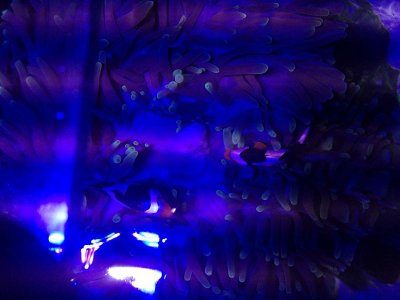
Ok guys the mag hasn't deflated or moved and is looking good with the exception of the mouth, it maybe nothing and maybe I'm just paranoid but the mouth was slightly open and one of the clowns pulled some brown stuff out. It wasn't the typical rat poop looking stuff that I associate with gigs but it was dark brown and leafy looking. Other then that nothing else to report. I'm hoping it's nothing but preparing for the worse. Sorry for the crappy cell phone pic but it's hard to get a clear shot under LEDs.
 

Attachments

  • image.jpg
    image.jpg
    43.2 KB · Views: 1
Some of the designer onyx will maintain their black, like the wild black ocellaris from Darwin.

But wild onyx percula will loose their black pretty much for sure. And likely also most designers that don't go back to certain selectively bred onyx lines like the ones from C-Quest.
In the wild you will never find onyx percula in a magnifica. Actually all percula you find in a magnifica in the wild have nearly no black at all. Just check all the photos and videos you easily find online if you don't believe me.
That alone would be already pretty good evidence.

Now there are two things that may play into this:
1. influence of the anemone's chemical signature on the clownfish's appearance.
It is well known with several species of clownfish that they change color when moved to a different anemone species. A. clarkii is one of the best examples.

2. Imprinting of the chemical signature of the anemone species the parents live in onto the larva which then preferably selects the same type of anemone.
There is some research done on this and it seems more than plausible that this would lead to different genetic strains within a species.
It would to some point explain why certain strains of ocellaris or percula won't develop much black even when hosted by a carpet anemone, while others get almost completely black (besides the white bars of course).

In general all wild and most captive observations of this effect on percula support my point, while the only percula that are maintaining black are highly selected captive bred designer strains.

With all due respect,
You mention studies backing your statement, but dont cite them, or offer a link to them. Everything else you posted was either anecdotal observation, or opinion.

I have a sample size of one...which is statistically non existent, but it does disprove your statement that A.percula loses color in H.magnifica anemones. There have others as well who have posted that they have H.magnifica anemones hosting A.percula clowns which have not lost color. Again, anecdotal reports statistically non existant, but still disproving your statement.

I dont pretend to know or understand exactly what causes clowns to change colors or what was the actual cause of my clowns going from black to brown to black again, all while being hosted by a healthy H.magnifica anemone. I assume it was food related, but might very well be due to something else entirely.

This particular anemone has been in my care since Mar 2006. It is brown based, with yellow tipped tentacles, and the tentacles are rounded/clubbed vs long and finger like with the tentacle tips being more tapered/pointed. This anemone also has a very potent sting and will burn me if i brush up against it. I dont have particularly sensitive skin and my other two H.magnifica anemones dont burn me at all. They are also purple based with purple tipped tentacles that are long and tapered.

I mention all of this because Minh,(Orion), mentioned he suspected at least two different sub species of H.magnifica due go the differences in tentacle tips.

So, with my anemones... Is it the fact that the tencles are purple tipped, tapered, or the anemones themselves are purple based that causes their nematocysts to be weaker/less painful to me? The yellow tipped anemone and one of my purple tipped anemones have both killed and eaten previously healthy fish in my tank, yet the purple tipped one doesnt burn me. Why not? Is it because of the tentacle tip coloration, (does the color of the tentacles affect the shape/potency of the nematocysts?), the tentacle tip shape,(does the shape of the tentacles affect the shape/potency of the nematocysts?), or does the color of the base affect the potency of the nematocysts?

If any of the above are true,(and I dont think they are, I'm using all of that as an example), then how do we explain how my Onyx Percs are still maintaining their black in one of the purple based, purple tipped, tapered tentacled H.magnifica anemones? Before you state that my Rod's Onyx Percs are probably sourced from C-Quest's lines of Onyx Percs, (I've heard rumors of this, but Rod himself has never confirmed this to my knowledge), how do you explain the fact that mine HAVE changed color in the past and browned out for several months and have since gone dark black again?

In your Solomon Island Perc thread, you told me to look up Fautin and Allen's book on clownfish. I did so and went through it and pointed out that even they had no conclusive answers and were careful to point out that they observed certain anemone species appeared to cause certain species of clownfish to darken in color. The anemones listed by Fautin & Allen where darker clowns were observed in the wild were S.mertensii, S. gigantea, and H. crispa.

I've been reefkeeping since 1986 and a member here since 2003 yet have never once read of an incident where an H.crispa has killed a fish from its nematocysts. In fact I've never heard of any reports where an H.crispa anemone has ever been mentioned as having a powerful or painful sting. I've read about divers being painfully burned/stung after bushing up against an S. mertensii in the wild,(burns occurred where skin was not protected by a wetsuit), and of aquarists being burned/stung by S. gigantea, S. haddonii, and H.magnifica, but never by H. crispa. Yet this one of the anemones reported to contain melanistic clowns in the wild?

I've also read about the P. imperator killed by the crocea clam ,( http://www.reefkeeping.com/issues/2007-08/totm/ ),and the damsel killed and eaten by the Trachyphyllia coral: http://www.reefcentral.com/forums/showthread.php?t=2156961, but I have not ever found anything other than anecdotal observations and opinions such as yours that H.magnifica anemones cause clownfish that were previously dark to lighten up in color.

My point in all of this is not to bash you or start an internet squabble, (which is why I dropped in your other thread as I didnt want to derail your thread any further as you were posting valuable and useful information with regard to clowns and the treatments you were using), but rather to point out that you are claiming something as a fact when it's not. There is not currently any factual cause as to what makes some clowns darken in some anemones. To state otherwise is to promote a misunderstanding and false information.

If it can be proven that H.magnifica does in fact cause clownfish to lighten in color, then I will happily start a thread publicly apologizing to you.

Again, you are a very knowledgable reef keeper have alot of useful information to share, and I look forward to more of your posts and picking up more from you, but I disagree with you in this matter.

 
The mouth is tightly closed now but it looks like the clowns are nipping at it??

I've seen my clowns do this as well. I've seen them get very forceful and actually pull food out that the anemone had fully engulfed in the oral cavatity, but not ingested,(meaning the mouth hadnt closed up tightly before the clowns "burrowed" in and ripped food out of it.

Overall, your anemone sounds and appears fine. Give a few weeks to get adjusted/acclimated to your tank and I think you'll find it pretty much bulletproof.
 
I would not sweat anything at this time, takes a while for a new nem to acclimate.
The clowns are probably removing waste from it's mouth, pretty common.

As to color on clowns, I have actually documented my picasso's losing their black color while hosted by BTA, and upon removal of that BTA they regained that color.
I had them in a malu after that, and then later a mag, never saw loss of color or change in either of those.
I had my picasso's 5 and a half years so I had plenty of observation time w/ them.
I can't say everyone will have the same exp or outcome but this was mine.
 
Back
Top