Silent and Failsafe Overflow System

Hello, I think I have come up with my plan for my new build but was hoping to run it by you guys for reassurance.

My tank will be 80x36x24 (~300 gallons) peninsula style with a full length 36" coast to coast external toothless overflow. I am planning (4) 1.5" holes be drilled into the bottom of the external overflow 2 3/8" apart (edge to edge). 3 of the holes will be for the bean system and the 4th will be for my return.

I will be using my Fluval SP4 as the return pump. I have a couple options here. I am planning on having the drain side of my sump directly under the overflow so that the 3 overflow pipes go straight down, which means the return side of the sump will be a 60" horizontal run. The total head height will be about 6'. I could either keep the return pump in the sump that way or run it external and have the return pump directly under the overflow also, so I can eliminate the additional 60" horizontal run and a couple 90s.

The reason I feel that is an important decision to make is because according to fluval at 5'9" head height the pump gives 1281gph, 7'2" 1235, 9'5" 805. Should I stick with 1.5" bulkheads or would make it as designed with 1" bulkheads?

The pump has 1" input/output connectors but I plan on running the output at 1.5" to keep all the plumbing from/to the overflow box the same and also for less friction loss. If I run the pump external would I need to up the input side to 1.5" also or could that stay at 1"?

Do you see any huge mistakes or have any suggestions for me? Thanks!
 
@805reef:

I have about the same setup, but in a smaller footprint. A few comments:

I think you will want to make it so that the overflow (siphon) drains directly into the sump without bends. This means that you will have more of a challenge attempting to set up a return pump going directly back up through the overflow. Additionally, you are not going to want to pull the return from the same side as the drain discharge.

In my case, I just set up a single internal pump to return through a 1.5". The single pump is a Jebao DC 12000, but it is not putting out quite the GPH that i would like. If I had a chance to re-do it and had the extra overflow space, I would have preferred 2 separate return lines (at least 2 bulkheads for returns) so that I could add a second pump and increase flow if desired. Also good as a backup in case of a single pump failure.

But, I would stick with the 1.5" across the board...

Shawn
 
I apologize in advance for asking the same tired question. I just want to make sure these holes are in the proper place. I am planning on one inch bulkheads.

The spacing is fine in terms of minimum clearances. Can't say whether it is appropriate for the overflow or not without seeing the box and the rest of the design.
 
Hello, I think I have come up with my plan for my new build but was hoping to run it by you guys for reassurance.

My tank will be 80x36x24 (~300 gallons) peninsula style with a full length 36" coast to coast external toothless overflow. I am planning (4) 1.5" holes be drilled into the bottom of the external overflow 2 3/8" apart (edge to edge). 3 of the holes will be for the bean system and the 4th will be for my return.

I will be using my Fluval SP4 as the return pump. I have a couple options here. I am planning on having the drain side of my sump directly under the overflow so that the 3 overflow pipes go straight down, which means the return side of the sump will be a 60" horizontal run. The total head height will be about 6'. I could either keep the return pump in the sump that way or run it external and have the return pump directly under the overflow also, so I can eliminate the additional 60" horizontal run and a couple 90s.

The reason I feel that is an important decision to make is because according to fluval at 5'9" head height the pump gives 1281gph, 7'2" 1235, 9'5" 805. Should I stick with 1.5" bulkheads or would make it as designed with 1" bulkheads?

The pump has 1" input/output connectors but I plan on running the output at 1.5" to keep all the plumbing from/to the overflow box the same and also for less friction loss. If I run the pump external would I need to up the input side to 1.5" also or could that stay at 1"?

Do you see any huge mistakes or have any suggestions for me? Thanks!

1' Bulkheads. As it looks to me, you won't break 1200gph regardless. No point in using bulkheads that can flow 3000gph. 1" bulkheads will get you to 2000gph anyway, with a little over a 3' drop.

That said, with a 300 gallon tank, you are going after a elephant with a pea shooter for a pump, and you should be targeting 3000gph, rather than playing around at 1200gph. In that case you would want to use 1.5" bulkheads.

IF you insist on using the pea shooter, you will HAVE to increase the inlet pipe size to 1.5" if you are running external, and running a 1.5" return line. 2" inlet would be better.
 
I apologize in advance for asking the same tired question. I just want to make sure these holes are in the proper place. I am planning on one inch bulkheads.
001_zpsnp7yzcle.jpg~original

I have a dimensioned drawing showing these dimensions, posted within the last ten pages. Apology accepted, and you are welcome to ask, :blown: but really folks, if you don't read this thread, you are not going to have the information you need to implement this drain system! The question I have, is you know this is a tried same old question asked every other day, why did you not find the answer? This question gets asked an average of three times a week. :headwallblue::)

The dimension down from your reference point is 2 3/4" (minimally.) Where did you find the 1.75"? Or did you just use the minimum dims from glass edges?
 
Last edited by a moderator:
cool vid. Do you have a build thread and did you cut the back of the tank for the slots? I was under the impression that the air tubing should be above the emergency line.

It absolutely needs to be higher than the inlet to the dry emergency, because the head height required to really start the system is around the top of the dry emergency. If the air inlet is lower, you get the start issues that are so often discussed: bubbles from standpipes, OC taking too much flow, etc, to varying degrees. When this system was designed, the position of this inlet was just below the trim lip inside the tank. Now, with an external box on a rimmed tank, that is ~1" above the top of the overflow box. That isn't going to work is it. Folks want to cram this stuff in a little external box, and then have a hard time figuring out why it does not work right.
 
I have a dimensioned drawing showing these dimensions, posted within the last ten pages. Apology accepted, and you are welcome to ask, :blown: but really folks, if you don't read this thread, you are not going to have the information you need to implement this drain system! The question I have, is you know this is a tried same old question asked every other day, why did you not find the answer? This question gets asked an average of three times a week. :headwallblue::)

The dimension down from your reference point is 2 3/4" (minimally.) Where did you find the 1.75"? Or did you just use the minimum dims from glass edges?
I was being lazy...
I saved a rendering and a couple quotes, I believe they are yours, to my desktop a while back. I just wanted to be sure.
 
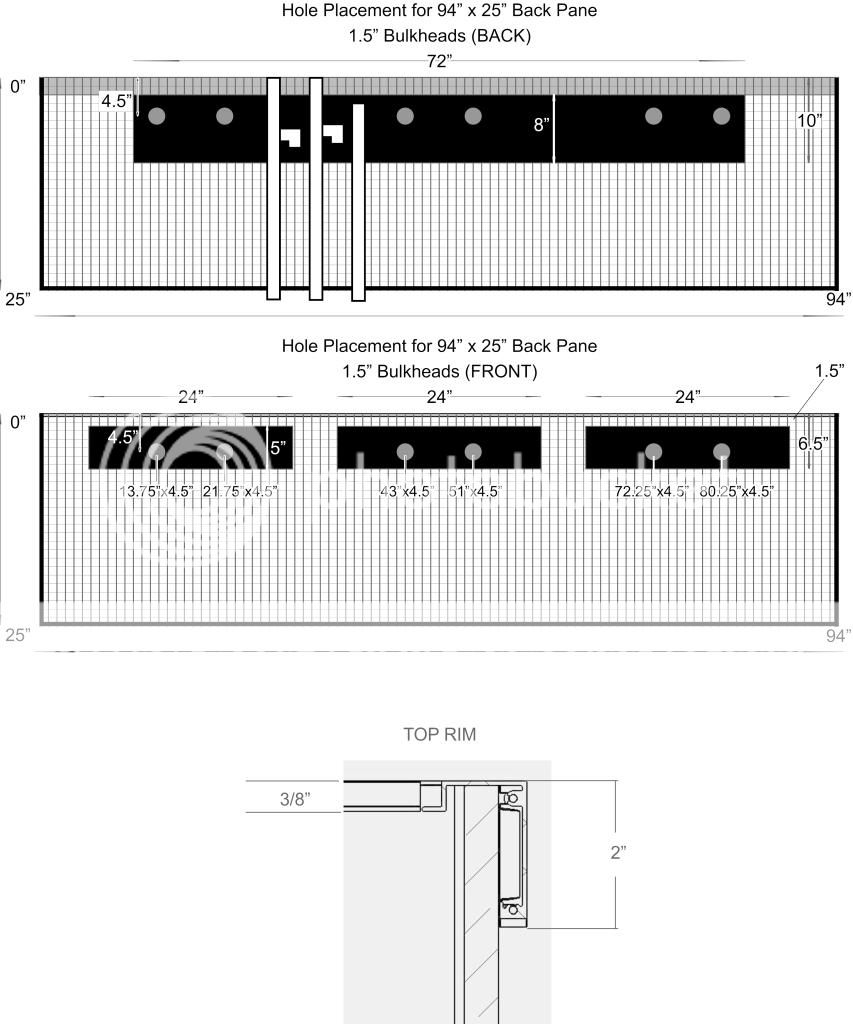
This is a massive thread and I promise I tried searching (but given the keywords just about every post comes up) as I'm sure this has been asked before, but I need some confirmation/reassurance that my hole location will be perfect for this internal/external overflow.

My concern is the depth of the 6 1.5" bulkhead holes at 4.5" from the top of the tank. Should I bring them up higher? If the minimum safe distance is 2x hole size would it be more effective to have them higher at say 3"? Have I overlooked something? Does it matter given the stand pipe will dictate how much water makes it to the sump when the pump is off?

Please excuse my illustration as I know there are some errors.

AQUARIUM%20OVERFLOW_zpsgggqqc9a.jpg
 
Last edited:
Ok everyone. I have a bit of a pickle here. My friend has a tank that he basically copied off my existing tank. He runs an external overflow that's 5" deep and 5" tall. He's running all 1.5" plumbing. The siphon is 1/2" above the bottom of the overflow and the secondary is 1" above the bottom. The secondary is tapped with a 1/4" JG fitting and uses 1/4" rigid tubing. We can not get the secondary to siphon and purge the overflow. There is water flowing thru it, but once the overflow fills, the emrgency kicks in the the secondary won't flush the OF. The tubing is air tight. I can blow thru the tubing and bubbles comes out of the inlet of the drain. And when I suck on the tubing (let's be adults about this!), the Secondary will siphon and purge. All the plumbing is 1.5". The siphon terminates about 1/4" under the water level in the sump. The secondary terminates about 3"-4" under the water level. He's not running any 45s. Only using 90s. He though the looks was cleaner. I've used 90s before for all bends and haven't had any issues likes this before. I'm thinking that maybe there's not enough head pressure over the secondary to start the siphon. But that's all I can come up with. He's running about 800GPH thru the sump. Using two 90s glued together in the overflow to get water to sump. The water height in OF normally runs about 2.5"-3" high. So... Any thoughts?
 
Not totally clear what the issue is - is the siphon channel starting up ok, but you're concerned that the open channel won't siphon? What happens when you occlude the ¼" tubing off the open channel with your finger? It should convert to an unrestricted siphon and rapidly drain the overflow box.

The normal configuration is to have the opening of the ¼" tubing above the level of the dry emergency pipe, so as long as the dry emergency is working, the water level never gets high enough to occlude the tubing and the open channel remains an open channel.
 
Thats how it's setup. I've done several beans, and this is the first time I've ever ran into this. Mine on my tank works fine, but his does not. We have all the same equipment too. Same return and same piping.

When plugging the air tube, nothing happens. It's weird. There IS water flowing down the drain. You can see the air bubbles exiting the pipe in the sump. But when plugging the tubing... Nothing. But when it's sucked on, it purges. That's why I was thinking maybe the flow isn't enough for it to work properly. Or maybe there's not enough head height over the elbows?
 
Hey All,

I just got done setting up a new external skimmer and seem to have a little problem.

I am running one of my 1" drains to the skimmer to feed dirty water to the skimmer. The other 1" is a complete siphon(awesome) no bubbles it is quiet and great!

The other seems to be a bigger problem then before. From the external skimmer it is drained to the sump and it bubbles like crazy. If I put a siphon on it the skimmer drains. Then I have to close the gate valve which the skimmer works put not like the other when it is not being siphoned..

Any ideas on how to quiet this?
 
Back
Top