Silent and Failsafe Overflow System

Just wanted to thank all of those that helped me out with my BA project. I did extensive research because I only wanted to do this once, and it came out perfect! From Floyd helping me through my acrylic fabrication overflows to Uncle giving me all the answers I needed step by step. Thanks again. Made a fun little video if you want to check it out. I should warn you ahead of time that it is a FW tank, not SW, but the idea is the same, minus the background :)

<iframe width="640" height="360" src="https://www.youtube.com/embed/NkVgAT0tLfI" frameborder="0" allowfullscreen></iframe>
 
Hey guys

So I have been reading this thread for a few months now. I made up my mind then that I wanted this design on my DP.

So now it is time to put it to practice, I have a few ideas in mind for my DP, but I am not 100% sure which one I will go for in the end (for instance, I dont know if I want to use a full size external weird/overflow or a full size internal weird with a half size external overflow). I will make up my mind this week but I have a few questions and I was wondering if you could shade some light.

I tell you what I do have for the moment

My tank will be a 160 gallon 64 x 26 x 26 inches DP. Coast to Coast overflow (teethed - can't not go teethless due to one of the inhabitants of the tank being quite sneaker and a known jumper).

Anyway, I am aiming for 1600-1700 ghp. I already bought the skimmer and the return pump (rated for 12000 lph or 3200 ghp, which is almost double of what I need). The pump can be adjusted in intervals (1-100) which will allow me to fine tune it.

For these I will be using 1.5 inches full size bulkhead and 2" bulkheads for the secondary siphon and the emergency siphon (correct me if I am wrong please). The sump will be located right beneath the tank (approx 46-50 inches).

And here is where I have a doubt, I have designed my own sump, a 2 stage sump (skimmer - return) with a external refugium. The reason why I went with an external refugium is to allow me to remove the sump and refugium in case I want to upgrade in the future.

The sump is 33 W x 18 D x 16 Tall and the refugium is 18 x 16 x 20 Tall (I had to convert from cm so I had to round up a bit sorry).

So, my question, I heard that splitting the return pump flow (going back into the tank) on full siphon designs is a bit risky as it will require a lot of fine tuning (although bean's design allows more margin for error as it has the second drain). So, I am left with 3 options

- Use the return pump anyway (tee back into the fudge) considering that the return pump can handle enough flow and can be calibrated at 1% intervals which would make tuning much easier.

- Use the return drain (from the tank) to feed the fudge (not sure if this is possible) by inserting a Tee after the gate valve as it comes into the sump

- Use a third pump just to feed the refugium

What do you recon guys? what options do I have?

I rather not built the fudge in the sump altogether as this will make it very hard for me if I need to remove it. Another option is to design the cabinet to allow me to remove the sump from the side.

I just want to know my options!

Thanks for your help lads
 
Silent and Failsafe Overflow System

My tank will be a 160 gallon 64 x 26 x 26 inches DP. Coast to Coast overflow (teethed - can't not go teethless due to one of the inhabitants of the tank being quite sneaker and a known jumper).
That doesn't automatically require teeth, but that's a different discussion.
So, my question, I heard that splitting the return pump flow (going back into the tank) on full siphon designs is a bit risky as it will require a lot of fine tuning (although bean's design allows more margin for error as it has the second drain).

- Use the return pump anyway (tee back into the fudge) considering that the return pump can handle enough flow and can be calibrated at 1% intervals which would make tuning much easier.

- Use the return drain (from the tank) to feed the fudge (not sure if this is possible) by inserting a Tee after the gate valve as it comes into the sump

- Use a third pump just to feed the refugium


There should be no problem with teeing off of the return pump to feed the fuge. This is the 'standard' setup (if there is such a thing.) Your pump has more than adequate flow, so that would make the most sense anyway. I'm not sure. Where you read that it would cause a problem unless you or someone else was mixing the return line with the siphon drain (see below.)

Many people ask about teeing off of the siphon drain. This doesn't work. You could potentially use the open channel drain, but the flow typically won't be enough, and also tends to be a bit variable. You also need to make sure that the fuge can handle the entire flow in case the siphon channel gets clogged.

An additional pump to feed the fuge is an option, but would be a waste, IMO.

You mention 2 pumps - where is the 2nd? If you're planning on having a separate pump for return flow from the fuge to the sump, that's a recipe for a flood, but that's off topic for this thread. If you want/need to bounce sump/fuge setup ideas off of people, start a new thread for that.
 
That doesn't automatically require teeth, but that's a different discussion.


There should be no problem with teeing off of the return pump to feed the fuge. This is the 'standard' setup (if there is such a thing.) Your pump has more than adequate flow, so that would make the most sense anyway. I'm not sure. Where you read that it would cause a problem unless you or someone else was mixing the return line with the siphon drain (see below.)

Many people ask about teeing off of the siphon drain. This doesn't work. You could potentially use the open channel drain, but the flow typically won't be enough, and also tends to be a bit variable. You also need to make sure that the fuge can handle the entire flow in case the siphon channel gets clogged.

An additional pump to feed the fuge is an option, but would be a waste, IMO.

You mention 2 pumps - where is the 2nd? If you're planning on having a separate pump for return flow from the fuge to the sump, that's a recipe for a flood, but that's off topic for this thread. If you want/need to bounce sump/fuge setup ideas off of people, start a new thread for that.

Hi doc

Thanks for your answer. What you mention is what I was hoping to hear.

The reason why I brought it up was because I heard that on herbie overflows teeing the return to feed the fuge (damn autocrrect keeps changing it to fudge) could be tricky but that with bean animal overflows is better because of the second drain pipe. I heard this on some website I can't remember where exactly.

I agree with using one single pump and teeing it to feed the fuge. So all good then, happy days

No I am not putting a pump on the fuge, that would be risky!

Thanks I will do that then, you also cleared my doubts on the other two options I was considering as I didnt know if they would work (using the full siphon drain to feed the fuge or using the 2nd drain).

The only second pump I might use is for the UV (between the skimmer section and the return) although I could hook up the uv to the return pipe going to the fudge but I think it might be a problem space wise

Thanks again
 
Last edited:
Sounds good. you might want to check out this thread - several people have suggestions there for teeing off the return to feed a UV sanitizer. Like I said, if you have a pump with the capacity, you might as well use it rather than buying another pump.

Can't think why this setup wouldn't work with a Herbie; Herbies are generally a bit more finicky, but I've seen plenty of pics of people teeing off the return for them too. Once the valves are set, there shouldn't be too much variation in flow.

Fudge needs feeding too, so don't worry about your autocorrect! :p
 
Sounds good. you might want to check out this thread - several people have suggestions there for teeing off the return to feed a UV sanitizer. Like I said, if you have a pump with the capacity, you might as well use it rather than buying another pump.

Can't think why this setup wouldn't work with a Herbie; Herbies are generally a bit more finicky, but I've seen plenty of pics of people teeing off the return for them too. Once the valves are set, there shouldn't be too much variation in flow.

Fudge needs feeding too, so don't worry about your autocorrect! :p

Thanks again

I had a look and I think I have a way of doing it

Thanks!
 
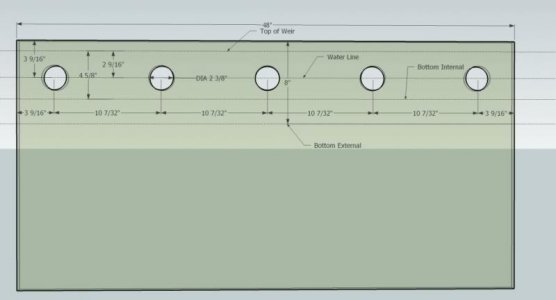
do we still go by these dimensions for hole placement and the internal and external measurements for weir and overflow box?
im assuming ill just need to test fit the drain lines INSIDE the overflow box to get the heights right for less noise?
this will be my new 150 gallon build with an external box. ill probably us 3 holes instead all of them across like the picture.
 

Attachments

  • tapatalk_1439140458566.jpg
    tapatalk_1439140458566.jpg
    24 KB · Views: 5
I remember now the height of the water in the overflox is determined by the siphon. Now I'm just wondering if I will get any noise coming from the holes through the tank.
 
The height is actually determined by the open channel. For an external box, the siphon could potentially be 12" below the water level (assuming the box was deep enough,) but it's the open channel that handles the what the siphon doesn't.

The water level in the tank will be ⅛~¼" over the weir, depending on the flow and weir width, so set it at your desired tank water level (generally even with the bottom of the trim for rimmed tanks.

The top of the external box should be even with the top of the tank, if possible, or even with the bottom of the trim if it's a rimmed tank. depth & width of the external box depends on the plumbing you use, but allow enough space so it's not too cramped.

As far as the number of holes, remember, all your flow will be going through them, and you're generally only using the bottom half to ⅔ of the holes, so better one extra than one too few.
 
Hi guys,

My bean animal does not auto priming when I shut off the pumps and on again
It is because I have horizontals pipe discharging into the sump?

Thanks
 
Hi guys,

My bean animal does not auto priming when I shut off the pumps and on again
It is because I have horizontals pipe discharging into the sump?

Thanks

It could be. Is the problem that the siphon never starts up? Some people have reported that they have had problems with horizontal runs preventing the siphon from starting but others have done it without a problem.

Is this a new problem or an old problem? How did you get it started originally? What size plumbing and how much flow? How long of a horizontal run?
 
Guys, would someone answer a quick question for me. I have looked at the drawings again and I seem to remember something being mentioned about the main full siphon line. I know the open drain has a safety air line that is just above water line to help with start up but has anyone tried something like this for the full siphon drain to help purge the bubbles from the top of the clean out plug /cap?
 
Guys, would someone answer a quick question for me. I have looked at the drawings again and I seem to remember something being mentioned about the main full siphon line. I know the open drain has a safety air line that is just above water line to help with start up but has anyone tried something like this for the full siphon drain to help purge the bubbles from the top of the clean out plug /cap?

No - that will not work. A siphon works because water is non-compressable and non-expandable (under reasonable vacuum pressures.) When gravity pulls the descending fluid column down, it creates a suction at the top, pulling more water in. As a gas, air will readily expand under a vacuum, so any air that's introduced tends to reduce the vacuum pulling water in and will break the siphon if enough air is present.

If you put an air line in the siphon channel like the open channel has, the vacuum at the top of the water channel will suck air in, break the siphon and convert the siphon channel to an open channel.

The air that is 'stuck' in the top of the tee may create some bubbles initially, but those will be purged and any remaining air will stay trapped in the top and not cause issues.
 
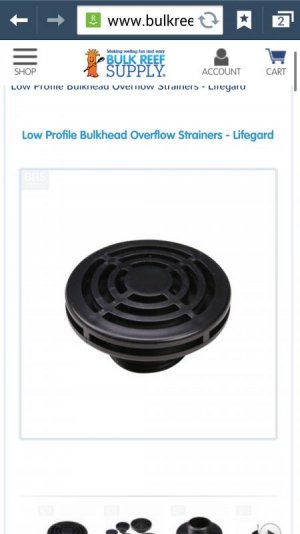
Would these be a bad idea using them on the through holes on the tank? I've lost a few fish to my drains and wondered if this would make noise or cause a problem?
 

Attachments

  • uploadfromtaptalk1439249515983.jpg
    uploadfromtaptalk1439249515983.jpg
    31.7 KB · Views: 6
Just sent you a PM

I'd probably put them on the pipe inputs rather than the through holes. They may not fit on the holes anyway - I bet they're sized to go on pipes. No personal experience with this. Maybe someone else can chime in...
 
It could be. Is the problem that the siphon never starts up? Some people have reported that they have had problems with horizontal runs preventing the siphon from starting but others have done it without a problem.

Is this a new problem or an old problem? How did you get it started originally? What size plumbing and how much flow? How long of a horizontal run?

New problem for my new setup. Tanks is 6feet. Pipe runs to the other end of sump to
Discharge . Horizontal portion is 7 feet. Pipe size is 1 inch. To start have To
Manually purge the air.
I read that if I drill a small hole at siphon pipe it will help purge the air
Thanks
 
Hi guys,

My bean animal does not auto priming when I shut off the pumps and on again
It is because I have horizontals pipe discharging into the sump?

Thanks

To add a bit to Sleepy's comment...

It's also important to have the siphon exit just below the normal operating water level of the sump. If it's too deep it can inhibit the purge!

Including pics is always good, BTW.
 
New problem for my new setup. Tanks is 6feet. Pipe runs to the other end of sump to
Discharge . Horizontal portion is 7 feet. Pipe size is 1 inch. To start have To
Manually purge the air.
I read that if I drill a small hole at siphon pipe it will help purge the air
Thanks
7 feet is a long stretch. I would suggest trying to have it slope downwards if you can.

Where did you read that drilling a hole will help purge the air? Depending where you drill it, you could easily make the problem worse.
 
Back
Top