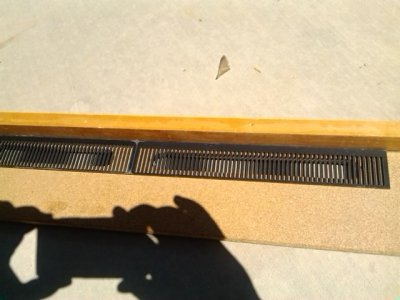
If C2C is best, then how about a C2C that wraps around the entire tank instead of just the longest side, that's technically "even better" right?
Because it won't work...

If C2C is best, then how about a C2C that wraps around the entire tank instead of just the longest side, that's technically "even better" right?
Because it won't work...
Sounds like a "zero edge" tank.why wouldn't it work?
assuming the tank is level and you build it level, it should work just fine.
btw, to answer your original question, my friend just made his external overflow box 7" tall, i think 8-10" like you said should be fine especially given your tank is larger, the extra height gives you some more room to play with.
if for some reason the teeth were reducing the flow too much, you could always bust out a few teeth, hah. Are the teeth gonna be removable? You arguably don't even need em, but if you're trying to prevent stuff from getting in there, then it's fine. I have teeth on mine and it's fine.
60% of a 40"x1" slot is 24" and well, i'm pretty sure it should handle the flow fine, it's just a matter of how far up the teeth the water level will rise.
if you think about a 1" pipe and how much flow it can handle, say, 300-400gph through a durso or maybe 1200-1600gph+ as a siphon, and then adjust that for 24" x 1", even a worst case scenario is like 7200gph? I'm thinking you'll be OK flow rate wise, however if it's rising too far up the teeth then it will reduce the effectiveness of the skimming, in which case spacing the teeth out more (or just busting out a few) would help reduce that.
I had not thought of removing teeth. I am going to try to make the teeth attached by magnets so I could easily remove them or remove teeth. So far the only magnet I've found that looks like it will work is the Avast Marine "Magnet Pair; DIY Holder". It is sealed in ABS and each one is 2"x1.25"x.5".
I am planning on using 1.5" bulkheads and plumbing. The sump will be close to directly below the overflow about 44" from sump water level to tank water level.
I don't plan on maxing out the flow on the two DCT12000 (the power supplies seem to die faster that way) so based on what I have read in this tread it sounds like I should have plenty of capacity?
Thanks again for the help!
-Paul
Thanks for the info.
I was thinking of using the "economy" gate valve from BRS. It costs half as much as the spears. It looks like the main difference is that you cannot take it apart for cleaning.
Has anyone tried that one?


Good information.Thanks.You get what you pay for in a valve. Sure, you will pay a couple bucks for the name, but there is a rather significant quality difference between a Spears valve, and a "budget" valve. I don't know the branding of the "budget" gate valves sell, however, They do appear to be KBI. (Matching patent numbers.) KBI is U.S. made, so the quality will be higher than imported budget valves.
The most obvious difference, other than "quality" (very subject) is in the ease of disassembly. They both disassemble; it is just a lot easier to get a Spears apart in place, than the KBI is. The KBI is more prone to stem leaks than the Spears. However, both the stem seal, and the "gate" are replaceable items. ETSS used the KBI sch40 gates with their high end equipment, and KBI is probably the most common gate in the hobby (at some point WalMart was selling them.) If wanting to service it in place I would strongly recommend you spend the bucks the first time around.
I am currently running the two DCT12000 pumps on my 240g both at a low setting. I had a DC12000 fail when I was on vacation and luckily I got my friend to come over and fix it when the tank sitter noticed it. After that I separated the plumbing and installed the second pump. The system will operate with either pump failed and I feel much safer with the redundancy. Eventually I would like to get them on separate circuits as well. Also I prefer submersible pumps. I can see your point about the efficiency of one pump though.Another thing I noticed is you are planning on running two DC pumps full open, for a 375 gallon tank. The whole point of running a DC pump, is the energy savings, but still have good flow at a reasonable head loss. However, running two pumps is always (I am sure an exception can be found, but that is not the point) less efficient than running a single larger pump that will do the job on its own.
In your case you are planning on running 2 DC12000 pumps, to service a 375 gallon tank. These are good pumps, when used where it is "appropriate," however the two together will eat up 278 watts, (I believe it is closer to 150watts per pump due to AC/DC conversion, but 278 makes the point.) Depending on how much you do or do not engineer your plumbing, you will probably get ~ 3200gph plus or minus total with both pumps running. (from flow curves, using around 6' - 7' total head, the mid-point on the flow curve: the point where the losses have eaten up half your theoretical max.)
A Barracuda will pump 3843gph @ 4' (236watts) and 3333 @ 8' (248watts,) and will also be more "reliable," because there are no electronics involved. Clear winner for everything that counts: Barracuda.
I will consider adding a small grate covered removable weir to the inside of the tank and keep the plumbing in the overflow box. I imagine I could make something not much bigger than the grate I pictured in the earlier post and perhaps as thin as 1/2 inch or so.When even the RLC calculator says you need a minimum of 45" of overflow for 3000gph, 24" (60% of 40") comes up way short... Because you don't have a good amount of overflow, and are channeling the flow (both with 4 separate slots, and each slot further channeled with "grates" you are most likely not going to enjoy the noise, which is part of the reason one would use a silent drain system, I would think.
I built a 300gallon + tank around 6 years ago, with an internal external setup, full length internal full length external. Never had the external box dump the entire volume into the sump (the plumbing does not allow it.) If I stop and think about it, it was pretty much a waste of time as the standard BA setup would have been just fine, and there was no real benefit.
Acrylic tanks present more of a problem due to the euro-brace, however I do think that you will be better off installing an internal weir and using through holes as a pass through to the plumbing.
I've always used a cheap ball valve. I'd suggest a spears gate valve for ease of tuning. On a ball valve the tiniest nudge does a lot. Though once dialed in I never did touch it again.
Post #9135 shows my current ball valve conglomeration.
http://www.reefcentral.com/forums/showthread.php?p=24699103

Redundancy: a part in a machine, system, etc., that has the same function as another part and that exists so that the entire machine, system, etc., will not fail if the main part fails. E.G. the probability of the "redundant" part failing is at or near zero under normal conditions, and the probability only increases if the "main" part fails. In other words the "redundant part" is not in use.
In a system with both identical pumps running, the failure probability of the pumps is equal. That is not redundancy, as both pumps together are the "main part."
A second backup, or second failsafe is a redundant failsafe, used only if the primary backup/failsafe fails.
These pumps have a "rep" for failing, though it is not so widespread as claims state. Just the same, with both running it is just as likely that both will fail at the same time, as it is that only one will fail. You would need a third pump not running, to actually get to where you feel you are. The third pump would be the actual primary failsafe, not a redundant failsafe.